
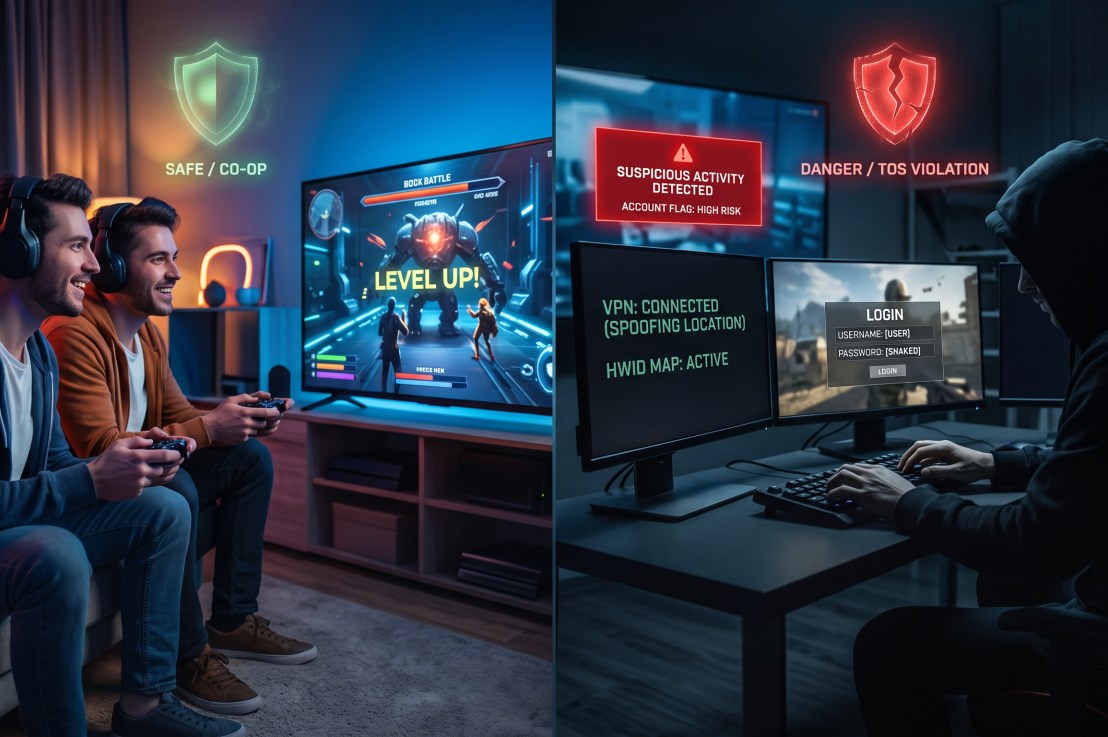
Logging into a game like Valorant, Call of Duty, or World of Warcraft after a long workday only to get crushed by a five-stack of coordinated players is a frustrating reality for modern gamers. Between daily battle pass deadlines, seasonal rank resets, and aggressive matchmaking algorithms, multiplayer games demand hundreds of hours to stay competitive.
That time sink has fueled a massive underground economy around game boosting—the practice of hiring a high-skilled player to level up your character, carry you through endgame raids, or push your account into top-tier rank brackets.
While boosting marketplace sites present these services as harmless convenience purchases, the technical reality on the backend tells a different story. Modern anti-cheat engines are no longer just looking for third-party hacks; they actively track hardware telemetry, behavioral metrics, and network fingerprints to catch and ban account sharing.
How Boosting Services Actually Work: Self-Play vs. Piloted
When you browse a marketplace for power leveling or rank services, every order falls into one of two delivery models. Understanding the technical mechanics behind each is the difference between keeping your account safe and facing a permanent HWID (Hardware ID) ban.
+-------------------------------------------------------------------------------+| BOOSTING RISK SPECTRUM || || [Self-Play / Carry] <-----> [Piloted + VPN Spoof] <-----> [Piloted + Botting] || (Low Risk) (Medium/High Risk) (Near 100% Ban) |+-------------------------------------------------------------------------------+
1. Self-Play (Co-Op / Party Carries)
- The Process: You log into your own account and queue up directly alongside a high-skilled booster (or team of boosters) in a party lobby.
- Security Risk:Low. Anti-cheat clients like Easy Anti-Cheat or BattlEye treat this as standard matchmaking. Unless the booster you are partying with gets caught using active, memory-injecting cheats during your match, your account remains clean.
- Trade-off: Self-play requires your active time and is typically 20% to 50% more expensive because it demands coordinated live scheduling from the booster.
2. Piloted (Account Sharing)
- The Process: You hand over your account credentials (username, temporary password, and 2FA auth codes). A booster logs into your account on their personal PC or virtual machine to complete the order while you are offline.
- Security Risk:Extremely High. Publishers actively monitor account authentication anomalies. Sharing credentials violates the Terms of Service (ToS) of virtually every major studio, including Riot Games, Blizzard Entertainment, Activision, and Valve.
How Anti-Cheat Systems (Vanguard & Ricochet) Flag Boosted Accounts
Many boosting providers claim that using a VPN matching your local city makes piloted boosting “100% safe.” That claim relies on outdated security assumptions. Modern kernel-level anti-cheat engines evaluate multiple telemetry layers that bypass standard VPN location spoofing:
1. Hardware ID (HWID) Fingerprinting
Anti-cheat engines like Riot Vanguard (operating at Windows kernel Ring 0) and Activision’s RICOCHET do not just check your IP address. They map your machine’s hardware composite by querying:
- SMBIOS Type 2 motherboard serial numbers (
Win32_BaseBoard). - Disk drive serial numbers (
Win32_DiskDrive). - Windows Registry cryptographic GUIDs (
MachineGuid). - CPU microcode hashes and MAC addresses.
When an account logs in from New York using a local VPN IP address, but its underlying hardware fingerprint instantly swaps from an Asus motherboard to an ASUSTeK server blade or a completely different GPU hardware composite, automated security flags fire instantly.
2. Behavioral Metrics & Input Telemetry
Server-side analytics monitor how an account is played. Anti-cheat engines build historical baselines for your profile based on:
- Input Dynamics: Mouse DPI settings, polling rates, and crosshair movement trajectories.
- Hotkey Mapping: Immediate changes to keybindings (e.g., swapping Flash from
FtoDor changing crouch inputs). - Statistical Spikes: An account jumping from a 0.9 K/D ratio in Gold 2 to a 3.5 K/D with an 85% headshot accuracy in Immortal lobby lobbies within 48 hours creates an immediate anomaly flag.
       [Normal Player Profile]              [Flagged Boosted Profile]
   +------------------------------+     +------------------------------+
   | - Win Rate: 48-52%           |     | - Win Rate: 92%              |
   | - Headshot %: 18-22%         | --> | - Headshot %: 64%            |
   | - Keybinds: Fixed / Standard |     | - Keybinds: Sudden Rebinds   |
   | - HWID: Constant Desktop PC  |     | - HWID: Unrecognized Laptop  |
   +------------------------------+     +------------------------------+
3. The Hidden Danger of Cheap “Bot-Boosted” Accounts
To maximize profit margins, low-cost boosting providers rely on automated scripts, memory hooks, or pixel-botting to farm experience points or clear repetitive quests. If a third-party booster uses an undetected cheat script on your account, an anti-cheat update 2 weeks later will catch that digital signature—resulting in a permanent, non-appealable ban on your main account.
Breakdown Across Specific Gaming Genres
The operational structure and risk profiles for boosting vary significantly depending on the genre you play:
| Game Genre | Common Boost Types | Typical Delivery Method | Risk Assessment |
| Tactical Shooters (Valorant, CS2, R6 Siege) | Rank division pushes, Placement matches, K/D fixes. | Duo-Queue (Self-Play) or Piloted | Piloted is High Risk due to kernel anti-cheat hardware checks. Self-play is strongly recommended. |
| MMORPGs (WoW, FFXIV, OSRS) | Mythic+ dungeon carries, Raid gear drops, Skill grinds (Mining/Agility). | Self-Play Raid Teams or Piloted Skill Grinding | Medium Risk. Raids are almost entirely self-play carries. Solo skill grinds in games like OSRS carry high account-sharing flags. |
| Battle Royales / FPS (Apex Legends, CoD) | Predator/Master badges, Weapon camo mastery (Interstellar/Borealis). | Piloted or Squad Carry | High Risk for Piloted Camos. RICOCHET frequently shadow-bans accounts that exhibit sudden statistical skill spikes. |
| ARPGs & Gacha Games (Diablo IV, Genshin) | Level 100 power leveling, Boss carries, Daily stamina farming. | Piloted | Low to Medium Risk. Publishers focus heavily on gold dupe/RMT bans, but account sharing carries lower automated priority than FPS titles. |
Realistic Pricing Models
If you are evaluating boosting services, pricing reflects the skill required and the time commitment involved. Be cautious of services priced drastically below industry averages:
- Entry-Level Rank Pushes (e.g., Bronze to Gold): Typically ranges from $15 to $40. These ranks require minimal time for high-rank players and are often completed in a single session.
- High-Tier Rank Pushes (e.g., Diamond to Master/Immortal): Ranges from $150 to $500+. Pushing top 1% matchmaking brackets requires elite boosters, high win-rate guarantees, and significantly more hours.
- Endgame Raid Carries (e.g., WoW Mythic Runs): Cost anywhere from $30 to $120 per run, often bundled with “loot funnels” (where boosters of your armor class trade all drop items directly to you).
Account Security Checklist: How to Protect Yourself
If you choose to use a self-play or carry service to save time, follow these strict security protocols:
- Never Share Account Passwords: Always insist on Self-Play (Duo/Party) options. If a site claims a piloted boost is the “only way,” find a different provider.
- Never Disable Two-Factor Authentication (2FA): Keep 2FA linked to your personal mobile device so credentials cannot be changed without your physical authorization.
- Beware of Discord-Only Vendors: Independent sellers operating strictly out of unregulated Discord servers offer no buyer protection or refund recourse if your account is compromised or banned.
- Change Passwords Immediately After Use: If you ever share credentials for a service, update your password and log out of all active remote sessions immediately after completion.
ARTICLE WORTH READING

