
Apex Legends has a reputation for being difficult to learn, and that reputation isn’t entirely undeserved.
The gunfights are fast. Movement is surprisingly deep. Every Legend brings a different kit, and a bad rotation can put your squad in a fight you never wanted. Then there is the small matter of getting third-partied immediately after surviving the first one.
But Apex becomes much easier once you understand what the game is actually asking you to do.
This Apex Legends beginner guide focuses on the fundamentals that matter most: choosing a Legend, surviving the drop, finding a practical loadout, using movement and cover properly, working with your squad, managing the Ring, and knowing when a fight is worth taking.
You do not need perfect aim to start improving. You need better decisions.
What Is Apex Legends?
Apex Legends is a free-to-play Battle Royale shooter from Respawn Entertainment and Electronic Arts. You choose a Legend with unique abilities, drop into a match, collect weapons and equipment, fight enemy squads, and try to survive until the end. EA currently separates the game into Core modes, including Unranked and Ranked, and Freestyle modes, including Wildcard, Bot Royale Evolved, and Mixtape.
The traditional Battle Royale experience revolves around a simple loop:
Drop → loot → rotate → fight → survive.
The difficulty comes from everything happening inside that loop.
You are managing ammunition, shields, healing, abilities, positioning, movement, teammates, enemy squads, and the shrinking Ring at the same time. That is why Apex can feel overwhelming during your first few matches.
The trick is to learn those pieces one at a time.
Start With Unranked and Practice Modes
Ranked can wait.
EA recommends Unranked for players who aren’t ready for competitive play, and Apex also offers practice and more relaxed game modes that are useful for learning.
Before you worry about winning matches, get comfortable with the basic controls and weapons.
Spend a Little Time in the Firing Range
You don’t need to turn practice into a second job.
Spend a few minutes learning how your preferred weapons feel, especially their recoil and effective range. Practice changing weapons, reloading, aiming, sliding, and moving between pieces of cover.
The goal isn’t to become a mechanical monster.
It is simply to make basic actions feel automatic so that you have more attention available for the actual fight.
Try Bot Royale
Bot Royale can be useful when the normal player population feels overwhelming. It gives new players a less punishing environment in which to practice looting, rotating, fighting, and using abilities. EA includes Bot Royale among the game’s more relaxed Freestyle options.
Use it to learn the rhythm of a match, not as a substitute for eventually playing against real opponents.
Pick a Legend You Can Understand
Apex has a large roster of Legends, and learning all of them at once is unnecessary.
EA’s current beginner documentation says new players start with Bangalore, Lifeline, and Wraith, while additional Legends can be unlocked through the Welcome Pass.
For your first matches, choose one Legend and stick with them long enough to understand the kit.
You want to know:
- What your Tactical ability does
- What your Ultimate is useful for
- When your abilities are better saved
- How your abilities help your squad
- How your Legend escapes a bad fight
Bangalore
Bangalore is a strong learning choice because her abilities can help you break enemy sightlines and create opportunities to reposition.
She teaches an important Apex lesson early: sometimes the best play is to make the enemy’s information worse rather than trying to outshoot them.
Lifeline
Lifeline is a natural option for players who enjoy supporting their squad.
She also reinforces one of the game’s most important habits: staying alive and keeping teammates in the fight can matter more than chasing another elimination.
Wraith
Wraith can appeal to players who like a more aggressive or mobile playstyle.
Her kit can help you learn when to disengage, reposition, and create safer routes for your squad.
The important thing is less about finding the mythical “best” beginner Legend and more about learning one kit properly.
Survive the Drop First
The match begins before you ever fire a weapon.
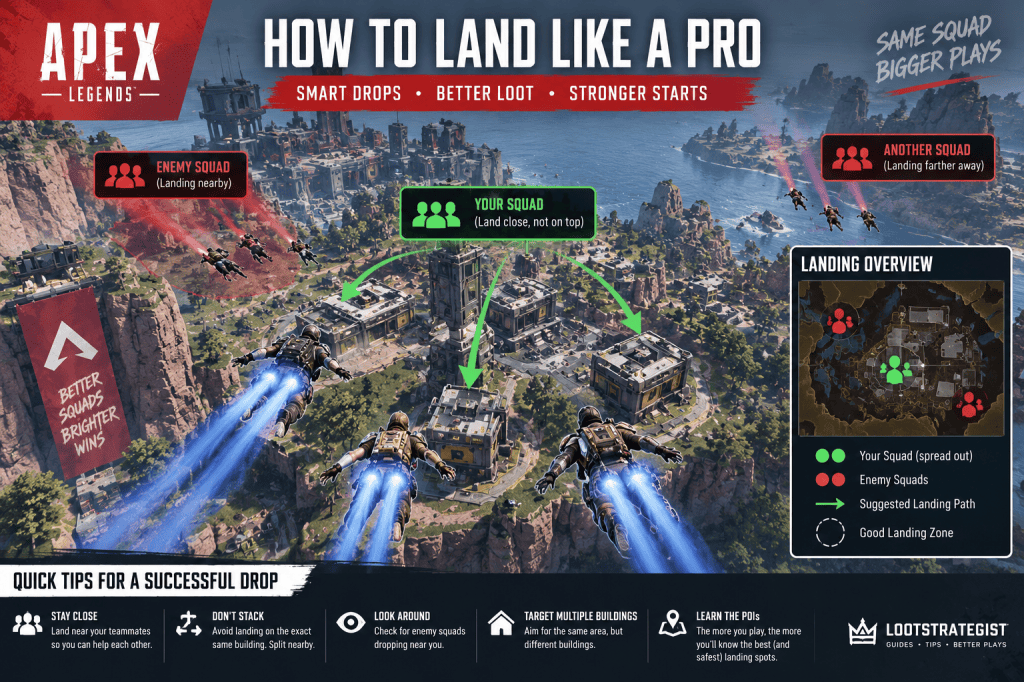
EA’s current beginner guidance recommends landing close to your teammates without dropping directly into the exact same loot spots, watching nearby enemy squads, and learning the maps over time.
For a new player, that translates into a simple rule:
Stay close enough to help your teammates, but give everyone room to loot.
If three squad members land on the same building and find one weapon between them, your squad has created its own problem.
Instead, spread across nearby rooms or buildings.
As you are dropping, look around.
Are enemy players landing nearby?
Do you have enough time to reach a quieter building?
Can your squad share the same general area without fighting over the same loot?
These decisions matter because the first 30 seconds often determine how prepared your squad will be for the first real fight.
Loot Quickly, Then Move
Your first objective is not a perfect loadout.
It is a functional loadout.
Try to secure:
- Two usable weapons
- Matching ammunition
- Shield-healing items
- Health-healing items
- A knockdown shield
- Useful attachments
- A grenade or two when space allows
EA’s current beginner guidance similarly recommends weapons and matching ammo, healing items, and useful equipment while encouraging players to keep updating their inventory as they find better loot.
Once you’re equipped well enough to fight, stop searching every corner for an upgrade.
Apex rewards movement.
If you spend too long looting the first area, another squad may already have taken the strong position you needed.
Choose Weapons by Role
Don’t worry about memorizing the entire weapon pool.
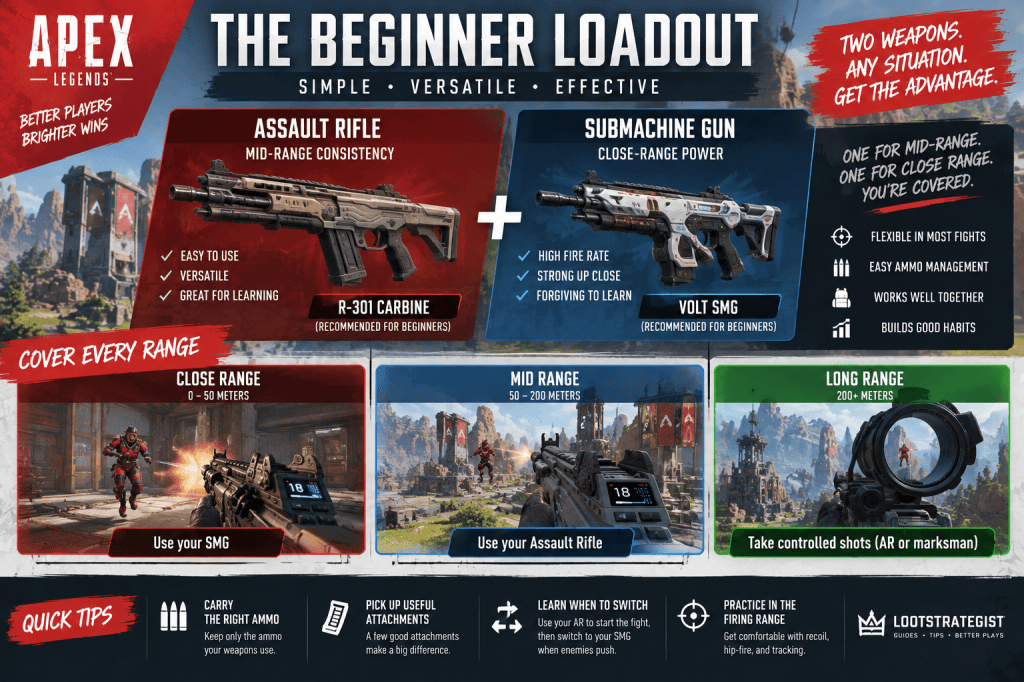
For a beginner, a simple combination is easier to manage:
One weapon for medium range + one weapon for close range.
That could mean an assault rifle paired with an SMG, for example.
EA’s current weapons guidance recommends that newer players become comfortable with assault rifles and SMGs, highlighting weapons such as the R-301 and Volt as approachable options.
Assault Rifles
Assault rifles are flexible and useful in a wide range of engagements.
That versatility makes them excellent learning weapons.
SMGs
SMGs shine at closer ranges, especially when a fight becomes aggressive.
They pair naturally with a more versatile primary weapon.
Shotguns
Shotguns can end close-range fights very quickly, but they are less forgiving when your positioning or aim is off.
Learn them once you’re comfortable taking close fights.
Snipers and Long-Range Weapons
Long-range weapons have their place, but they shouldn’t become an excuse to avoid learning close and medium-range combat.
A beginner who spends an entire match sitting on a hill and firing occasionally is not necessarily learning the skills that make Apex players dangerous.
You eventually want to become comfortable fighting at different distances.
Learn Ammo Management
Your inventory has limited space.
That means every stack of ammunition should have a reason to be there.
Carry ammo that supports the weapons you’re actually using. If you switch weapons, update your inventory too.
EA’s current beginner guidance also recommends picking up ammunition that matches your weapons and changing your inventory as your loadout changes.
A surprisingly common beginner mistake is spending half the match carrying ammunition for a weapon they abandoned ten minutes ago.
Your backpack has better things to do.
Understand Shields, Health, and EVO
This is one of the first Apex systems worth learning properly.
Your shield absorbs damage before your health, so a player with low shields is not truly ready for another engagement simply because their health bar is full.
After a fight, check both.
Shield Cells and Shield Batteries restore shields, while Syringes and Med Kits restore health.
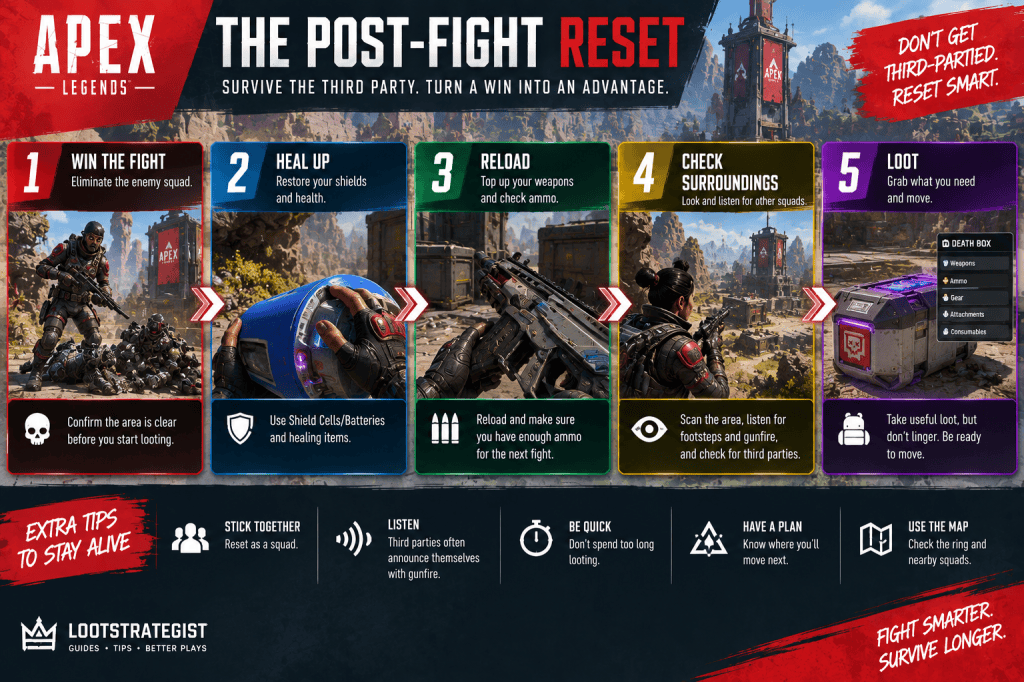
A good beginner habit is to reset after every engagement:
Heal → reload → check ammunition → check surroundings → move.
Apex also uses EVO progression, so your equipment and combat progression can develop as a match continues.
You don’t need to understand every detail immediately.
For your first few matches, simply recognize that surviving fights and managing your resources are part of getting stronger during the match.
Movement Matters, but Don’t Chase Fancy Tricks
Apex is famous for movement.
You will eventually see players using advanced techniques that make them look as though they have forgotten gravity exists.
Ignore that for now.
Learn the basics.
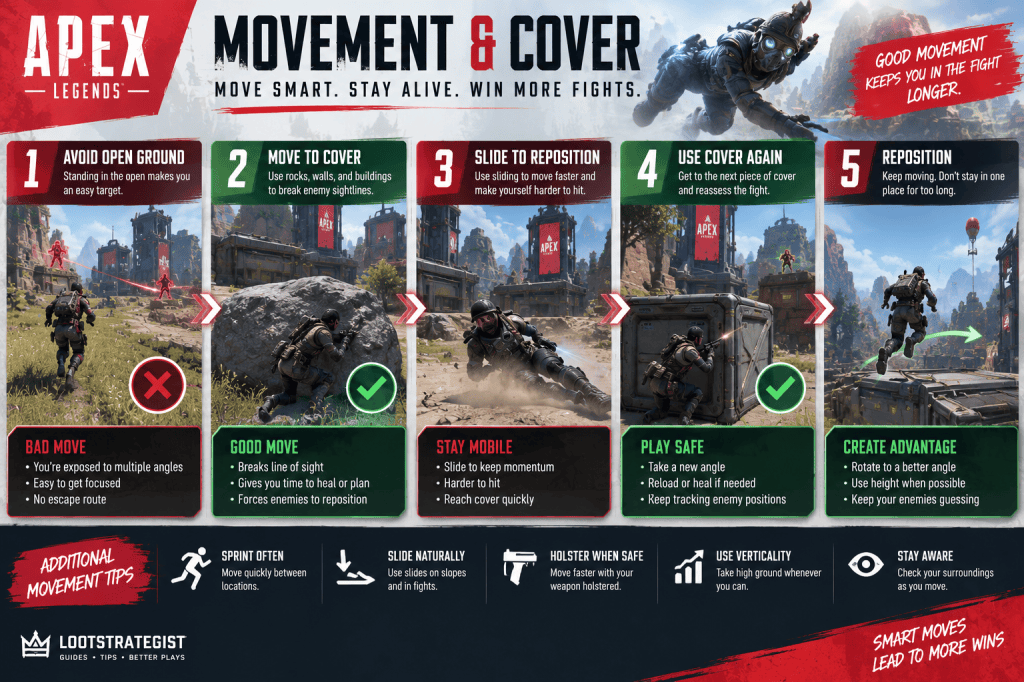
Sprint
Move decisively when you’re rotating through areas that aren’t currently under attack.
Slide
Sliding helps maintain momentum and makes your movement less predictable.
Practice sliding naturally rather than forcing it into every situation.
Holster When It Helps
Putting your weapon away can improve movement speed, but you should not remain unarmed when you are approaching an area where enemies could appear.
Speed is useful.
Being ready to shoot is also useful.
Use Cover
This is the movement habit that matters most.
Move from cover to cover.
Avoid unnecessary open ground.
Don’t confuse constant motion with good movement.
A player who smoothly moves between cover is often much harder to kill than someone who simply jumps and slides everywhere.
Positioning Wins Fights Before the Shooting Starts
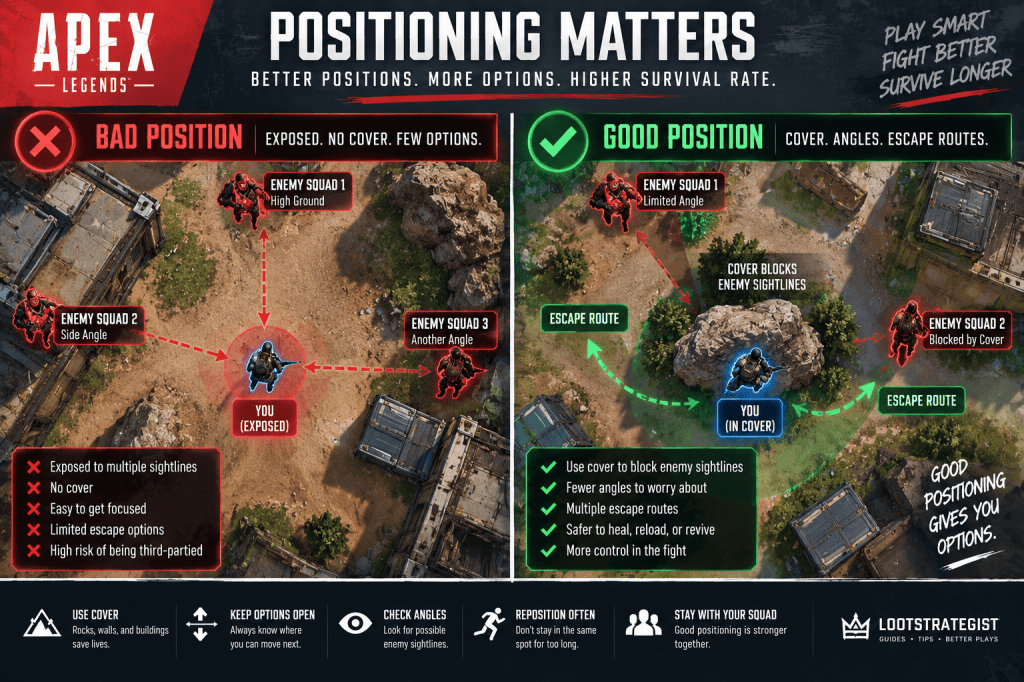
Apex is not purely an aim game.
Imagine two players with identical weapons.
One is standing in an open field.
The other is behind a rock with a clear line of retreat.
The second player already has an advantage.
Good positioning provides:
Cover.
Useful sightlines.
Escape routes.
Better angles.
More time to react.
Before starting a fight, ask yourself:
Where do I go if this goes badly?
If there is no answer, rethink the position.
That single habit will save you from a remarkable number of unnecessary deaths.
Don’t Fight in the Open
This sounds obvious until a fight starts.
Then people forget.
Heal behind cover.
Reload behind cover.
Revive behind cover.
Peek from cover.
Use buildings, rocks, walls, terrain, and other obstacles to reduce the number of angles an enemy can use against you.
You don’t have to stand still and trade damage until somebody loses.
Take a shot, reposition, and make the enemy work for theirs.
Stay Close to Your Squad
Apex is built around squad play.
You don’t need to walk shoulder-to-shoulder with your teammates, but you should usually remain close enough that they can help you when a fight begins.
EA specifically advises beginners to stay close to their squad because isolated players are easier to overwhelm.
Good squad spacing means:
- You can reinforce a teammate quickly
- You can trade damage
- You can combine abilities
- You can retreat together
- You can recover a knocked teammate more safely
The worst place for a new player is often 100 meters away from everyone else when the shooting starts.
Learn the Ping System
Apex’s ping system is one of its best tools for communication.
You don’t need a microphone to give your teammates useful information.
EA specifically recommends pinging enemy positions, loot, and locations.
Use pings to:
Mark enemies.
Highlight useful loot.
Suggest where to move.
Warn teammates about nearby danger.
Show where you intend to go.
A good ping can communicate something immediately that would otherwise take several seconds to explain.
Just remember that communication is information, not noise. One useful ping is better than twelve frantic ones.
Know When to Fight
This is probably the hardest beginner lesson.
Seeing an enemy does not mean you have to shoot them.
Before committing to a fight, look at the situation.
Do you have decent equipment?
Are your teammates nearby?
Do you have cover?
Is the enemy in a better position?
Can you disengage?
Is the Ring about to force everyone into a different area?
There is no shame in refusing a bad fight.
Apex rewards players who can recognize a favorable engagement before they commit to it.
That doesn’t mean you should spend the entire match hiding, either.
Fight when you have a reason.
Leave when you don’t.
Beware the Third Party
You win a fight.
Great.
Now you start looting.
Footsteps.
Another squad.
Death.
This is the classic Apex third-party problem.
After an engagement, your squad may be low on shields, healing, ammunition, and positional advantage. Another team arriving at that exact moment can clean up before you’ve recovered.
So make “reset” a habit.
Heal.
Reload.
Check your surroundings.
Listen for nearby footsteps and gunfire.
Then loot.
The extra few seconds can be the difference between collecting useful gear and becoming somebody else’s useful gear.
Use Grenades With a Purpose
Grenades are most useful when they solve a problem.
Use them to:
- Force enemies out of cover
- Punish a team holding a building
- Deny a route
- Create space during a retreat
- Pressure an enemy while your squad pushes
Don’t carry a backpack full of grenades simply because they were available.
Your inventory should support the way you actually play.
Watch the Ring
The Ring is one of the systems that gives Apex its pace.
As the match continues, playable space becomes more restricted, forcing squads closer together.
The beginner mistake is waiting until the last possible moment to rotate.
That often creates a terrible choice:
Run through an open area while the Ring closes behind you, or enter an unfamiliar area where another squad is already waiting.
A better approach is to think ahead.
Ask:
Where does my squad want to be next?
Then move before you absolutely have to.
Being early gives you options.
Being late gives you problems.
Don’t Throw Yourself Into a Revive
Your teammate is down.
Your instinct may be to sprint straight at them.
Sometimes that’s correct.
Sometimes it is the fastest possible way to get two teammates knocked instead of one.
Before reviving, look at:
- Enemy positions
- Available cover
- Your own health and shields
- Your other teammate’s location
- Whether the enemy squad is still watching the area
A revive is valuable.
A revive attempt with no cover and three enemies staring directly at you is usually not.
Knocked teammates can also use their knockdown shields, and surviving teammates may have opportunities to recover them or respawn them later, depending on the situation.
Don’t turn one bad position into a complete squad wipe because you felt obligated to revive immediately.
What to Do After You Get Knocked
Getting knocked is not automatically the end of the match.
Stay calm.
Use your knockdown shield when appropriate.
Move toward cover if you can.
Keep giving useful information to your teammates.
Tell them where enemies are rather than simply announcing that everything has gone terribly.
Sometimes your team can recover you.
Sometimes they can’t.
Either way, useful information can still help win the fight.
Don’t Rush Into Ranked
Ranked is designed for competitive play, so there’s no reason to force yourself into it before you’re comfortable with the basics.
EA currently requires new players below Level 20 to complete the Road to Ranked challenges before they can enter Ranked.
Treat those requirements as part of your learning period.
By the time Ranked becomes available, ideally you should already be comfortable with:
- Your preferred Legend
- Several weapons
- Basic movement
- Healing
- Ping communication
- Rotating with the Ring
- Fighting around cover
- Staying with your squad
Ranked points are not going to teach those fundamentals for you.
Practice will.
The Biggest Apex Legends Beginner Mistakes
Landing Too Far From Your Squad
You want enough space to loot without separating so far that your teammates can’t help.
Looting for Too Long
Once you can fight, move.
Carrying the Wrong Ammo
Your inventory should support your current weapons, not the guns you used ten minutes ago.
Ignoring Shields
Full health doesn’t mean you’re ready if your shields are empty.
Fighting Alone
Being aggressive is not the same as being isolated.
Chasing Every Knock
An enemy running around a corner may be leading you directly into another squad.
Ignoring the Ring
Late rotations create unnecessary problems.
Using Abilities Without a Plan
An ability being available doesn’t mean it has to be used immediately.
Reviving in the Open
Check the situation first.
Blaming Teammates for Every Death
Sometimes your teammate made a bad play.
Sometimes you did.
The useful question is what you can do differently next time.
A Simple Game Plan for Your First Matches
You don’t need to remember fifty rules while learning.
Use this instead.
Early Game
Land near your squad.
Find two workable weapons.
Collect matching ammunition.
Pick up shields and healing.
Pay attention to nearby enemies.
Then move.
Mid Game
Watch the Ring.
Stay with your squad.
Look for strong positions.
Take sensible fights.
Reset after engagements.
Be ready for third parties.
Late Game
Value positioning more than unnecessary kills.
Hold useful ground.
Stay together.
Keep healing resources available.
Think about where the next fight will happen before it starts.
That is the difference between reacting to the game and actually playing it.
How to Improve at Apex Legends Faster
Playing more matches helps, but simply repeating the same mistake doesn’t make you better at it.
Instead, review your deaths.
Not every death needs a complicated explanation.
Sometimes you simply lost a fair gunfight.
Other times there was a clear mistake:
You were standing in the open.
You pushed before your teammates arrived.
You ignored the Ring.
You had no shields.
You chased a player into a bad position.
You had no escape route.
Pick the biggest mistake and work on that one.
The next time the same situation appears, try a different decision.
That’s meaningful improvement.
Practice One Skill at a Time
Don’t try to master everything simultaneously.
Spend one session paying attention to positioning.
Another can focus on movement.
Another can focus on one or two weapons.
You will improve faster when you actually know what you’re practicing.
Loot Strategist’s Beginner Rule
For your first several matches, forget about chasing huge kill totals.
Build the habits that keep you alive:
Land with your squad.
Get a practical loadout quickly.
Keep your shields and health topped up.
Use cover.
Watch the Ring.
Don’t take fights you cannot explain.
Learn from your deaths.
Kills will come later.
First, become difficult to kill.
Apex Legends Beginner Checklist
Before and during every match, remember:
Choose a Legend you understand.
Stay close to your squad.
Loot quickly.
Carry weapons that cover different ranges.
Keep appropriate ammunition.
Carry shields and health heals.
Use cover whenever possible.
Ping useful information.
Watch the Ring.
Reset after fights.
Expect third parties.
Know when to disengage.
That is enough to get started.
You can worry about advanced movement techniques and hyper-optimized loadouts later.
Final Thoughts
Apex Legends has a steep learning curve because there is a lot happening at once.
The game asks you to shoot accurately, move intelligently, manage resources, understand your Legend, communicate with teammates, read the map, and make quick decisions under pressure.
You don’t have to master all of that immediately.
Start small.
Learn one Legend. Get comfortable with a few weapons. Practice basic movement. Stay near your squad. Use cover. Watch the Ring. Heal before taking another fight.
Most importantly, stop treating every enemy as an invitation to fight.
Good Apex players aren’t simply the ones who can win a gunfight.
They’re the ones who recognize which fights are worth taking in the first place.
And yes, you’ll still occasionally get deleted by somebody who appears to have a personal grudge against your existence.
That’s Apex.
Related Apex Legends Guides
Apex Legends Octane Guide — Learn how Octane’s mobility tools work and how to use his speed without throwing away your team’s position.
Apex Legends Squad Composition Guide — Explore how different Legends can complement each other when building a squad.
More Apex Legends Guides — Find additional Legend guides, tips, and strategies from Loot Strategist.
Sources & Updates
Last reviewed: September 6, 2026
Apex Legends changes regularly, so this guide focuses on fundamentals that remain useful across seasons rather than short-lived weapon or Legend rankings.
Current game information was checked against EA/Respawn’s official Apex Legends documentation, including beginner guidance, game modes, the current Ranked system, and the Marked Season 30 update. Marked launched on August 4, 2026.
Our gameplay recommendations are editorial guidance from Loot Strategist rather than claims that there is one objectively correct way to play Apex Legends.
How we verify: Changing factual details—such as game modes, Ranked access, seasonal systems, and beginner onboarding—are checked against official EA sources. Practical advice is presented as strategy and editorial recommendation rather than as an official game rule.

