
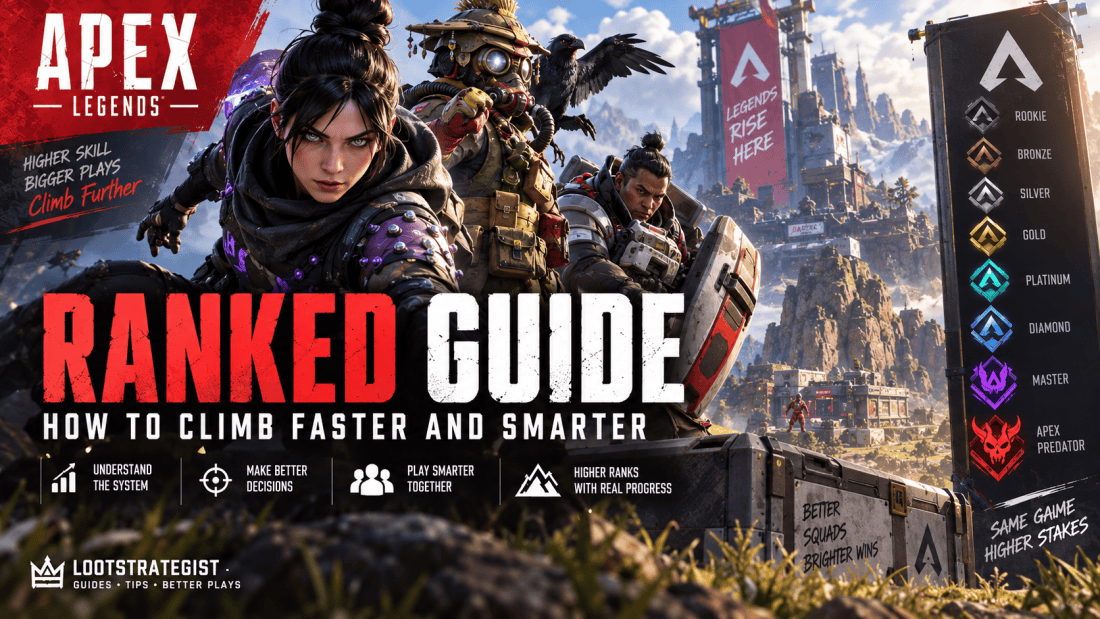
Apex Legends Ranked changes the way you think about a match.
In Unranked, a reckless push can be a funny story five minutes later. In Ranked, that same push can erase a chunk of progress you spent the last few games earning.
That’s why climbing is not simply a matter of getting more kills.
Ranked rewards a combination of placement, eliminations, and skill-based bonuses, while the cost of entering a match rises as you move up the ladder. The higher you climb, the more valuable consistency becomes.
This Apex Legends Ranked Guide explains how the current system works, how RP is earned and spent, what the ranks require, how Ranked splits and Ladders work, and—most importantly—how to make better decisions when you actually want to climb.
The aim isn’t to promise a secret trick that will carry you to Master.
It is to help you build a Ranked game plan that works.
What Is Apex Legends Ranked?
Ranked is Apex Legends’ competitive mode, where players progress through a ladder by earning Ranked Points (RP) through their match performance. Matchmaking is based on current RP, and matches become more challenging as your RP rises.
The current ranked progression is:
Rookie → Bronze → Silver → Gold → Platinum → Diamond → Master → Apex Predator
Rookie through Diamond use four divisions, such as Bronze IV through Bronze I. Once you reach Master, you can compete for the Apex Predator title; Apex Predators are the top 750 players per platform within Master.
That means Ranked has two very different experiences.
At the lower tiers, you’re learning how the system works.
At the top end, you’re competing for position against players who are already highly skilled.
How to Unlock Ranked
New players below Level 20 must complete Road to Ranked, which consists of three sets of challenges. Completing all three unlocks Ranked access. Players who already had Ranked access before the system was introduced keep that access.
That requirement is actually useful.
Use your early matches to become comfortable with movement, looting, positioning, healing, weapons, and your preferred Legends.
Ranked should be where you refine those skills—not where you first discover what your Tactical ability does.
How Ranked RP Works
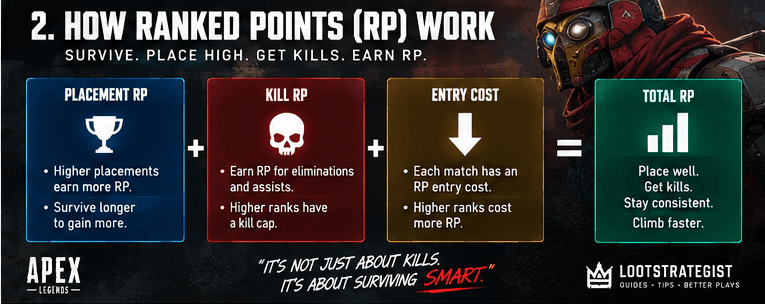
Ranked Points are the currency of progression.
You gain RP from:
- Placement
- Eliminations
- Skill-based bonuses
Higher placement increases the value of your eliminations, so kills and survival are tied together rather than functioning as completely separate goals.
This is why a five-kill game that ends early isn’t automatically better than a three-kill game that reaches the late game.
The useful question is not:
“How many kills did I get?”
It’s:
“How much RP did my decisions create?”
Ranked Entry Costs
Every Ranked match has an entry cost, and that cost increases as you climb.
| Rank | RP Entry Cost |
|---|---|
| Rookie | 0 RP |
| Bronze | 10 RP |
| Silver | 20 RP |
| Gold | 38 RP |
| Platinum | 48 RP |
| Diamond | 65 RP |
| Master / Predator | 90 RP |
EA’s current Ranked documentation confirms these costs and notes that you can finish a match with less RP than you started with.
That distinction matters.
At higher ranks, a bad game doesn’t merely mean “I didn’t gain anything.”
It can mean you lost progress.
This is why climbing becomes increasingly dependent on avoiding low-value deaths.
How Much RP Do You Need to Rank Up?
Each division requires a set amount of RP to move forward.
EA currently lists the following progression requirements:
| Promotion | RP Required |
|---|---|
| Rookie | 250 RP |
| Bronze divisions | 500 RP |
| Silver IV → III | 500 RP |
| Silver III → II | 500 RP |
| Silver II → I | 500 RP |
| Silver I → Gold IV | 750 RP |
| Gold divisions | 750 RP |
| Platinum IV → III | 750 RP |
| Platinum III → II | 750 RP |
| Platinum II → I | 1,000 RP |
| Platinum I → Diamond IV | 1,000 RP |
| Diamond divisions | 1,000 RP |
The amount needed within a division increases as you reach higher ranks.
For example, moving from Bronze II to Bronze I requires 500 RP, while moving from Platinum II to Platinum I requires 1,000 RP.
That is one reason a strategy that works comfortably in Bronze can feel much less effective in Platinum.
Every mistake becomes more expensive.
How Ranked Scoring Works
EA currently divides Ranked scoring into three main components:
Placement
Eliminations
Bonuses
Placement determines a base part of your score, while kills and assists contribute additional RP. The value of eliminations rises as your team places higher.
Kills and Assists
Your personal kills and assists count toward your score.
A kill or assist counts as one kill for scoring purposes.
If your squad eliminates an enemy without you dealing damage to that player, you can receive half a kill through the participation system.
There is also an important limit:
Once you have more than eight kills, the value of subsequent kills, assists, and participations is halved.
That doesn’t mean getting nine kills is suddenly bad.
It means that once you’ve built a strong elimination total, throwing away a good position purely to chase another kill makes less sense.
Higher-Ranked Enemies Give Bonus RP
EA currently gives a bonus when you eliminate an opponent ranked above you.
The bonus scales according to the rank difference:
| Rank difference | Bonus |
|---|---|
| 1 tier higher | +15% |
| 2 tiers higher | +25% |
| 3 tiers higher | +35% |
| 4+ tiers higher | +50% |
Your placement still determines the underlying value of the elimination.
Think of this as a reward for beating stronger opponents, not a reason to hunt them down recklessly.
An enemy being higher ranked does not make your fight automatically favorable.
Top-Five Streaks Can Earn Bonus RP
Ranked also rewards consecutive top-five finishes.
EA’s current system gives:
Second consecutive top-five: +10 RP
Third: +20 RP
Fourth: +30 RP
Fifth and subsequent: +40 RP
The streak resets whenever you finish outside the top five.
This is another reason not to treat every match as an all-or-nothing kill race.
Consistent top-five finishes can build momentum over several games.
Understanding the Apex Legends Ranked Ladder
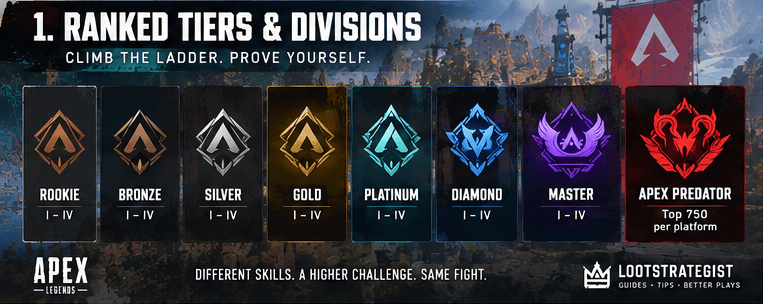
The current rank structure is:
| Rank | Divisions |
|---|---|
| Rookie | Rookie |
| Bronze | IV–I |
| Silver | IV–I |
| Gold | IV–I |
| Platinum | IV–I |
| Diamond | IV–I |
| Master | Master |
| Apex Predator | Top 750 per platform |
Rookie is designed as an introductory tier, while Apex Predator is reserved for the top 750 players per platform within Master.
Rookie
Rookie is where newer Ranked players begin learning the competitive system.
Once you’ve progressed out of Rookie, you cannot be placed back into it.
Bronze and Silver
These ranks are where you should concentrate on clean fundamentals.
Learn rotations.
Improve your aim.
Stop taking fights from terrible positions.
Gold
Gold is where inconsistent decision-making becomes much more noticeable.
A few unnecessary deaths can erase the gains from a strong match.
Platinum
Platinum is a meaningful step up.
Players are generally more disciplined about positioning, rotations, and taking favorable fights, so careless decisions tend to get punished quickly.
Diamond
Diamond demands consistency.
You need to be much more deliberate about when you fight, where you rotate, and how you spend your resources.
Master
Master is a different level of competition.
Mechanical skill matters, but decision-making and consistency are increasingly important.
Apex Predator
Predator is the top end of the ladder: the top 750 players per platform within Master.
Reaching the threshold isn’t the same as securing the title.
You are competing against other players for those positions.
How Ranked Matchmaking Works
Ranked matchmaking is based on your current RP.
For your first Ranked experience, your hidden skill value from Unranked Trios helps determine your starting rank and RP.
For players who have played Ranked before, the system uses their hidden Ranked skill value. Matches become more difficult as RP increases.
EA also recommends checking the distribution of player ranks in the lobby before the match begins so you can adapt your strategy to the competition.
Don’t overthink it.
You don’t need to memorize the lobby.
Just recognize that a stronger-looking lobby may reward a more conservative opening, while a lower-pressure lobby can give you more room to take fights.
How Drop Zones Work in Ranked
This is one of the current Ranked mechanics worth knowing.
EA says Ranked matches can currently begin in two different ways:
Dropship
or
Drop Zone.
With the normal Dropship format, a Jumpmaster chooses where the squad lands.
In a Drop Zone match, which is used when the lobby meets a certain threshold of Diamond, Master, or Predator players, your squad is assigned a POI before Legend selection. Your team then independently jumps toward that area, although you can adjust your landing to contest nearby zones.
This can change how you approach the opening.
Pay attention to the loading screen.
Know where your assigned area is.
Watch whether nearby squads are likely to contest.
Then make a decision before you are already falling out of the sky.
Ranked Legend Selection Is Different
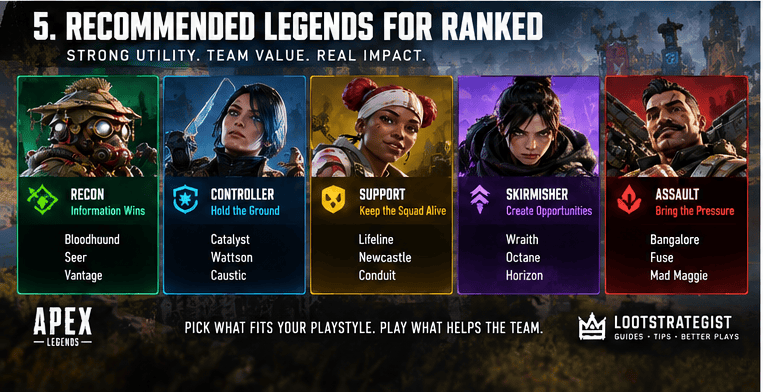
Legend selection in Ranked is staggered, meaning players choose one at a time.
You also cannot stack the same Legend on one team.
Ranked includes Legend class perks, and you can collect Legend Amps that provide additional passive abilities during the match.
That makes team composition more relevant than simply picking three characters you individually enjoy.
You don’t need a professional-level composition.
You do need a squad whose abilities make sense together.
Ranked EVO and Shield Cores
Ranked currently uses an upgrade system in which EVO progresses your armor and Legend level during the match.
EA lists three Legend levels for the armor progression:
Level 1 — White
Level 2 — Blue
Level 3 — Purple
EVO can be earned through dealing damage, finding EVO Harvesters, and collecting EVO Caches.
Ranked armor is fueled by a Shield Core rather than the older system of simply swapping armor.
Enemy death boxes contain Shield Cores tied to the defeated player’s Legend Level, while the displayed color of a dropped Core represents the charge remaining in that Core.
For beginners, you don’t need to memorize every Shield Core edge case.
The important lesson is to understand that your armor progression and remaining shield charge are separate considerations.
The Best Ranked Strategy Is Consistency
There is no single strategy that works perfectly every match.
Sometimes you’ll land uncontested and have excellent loot.
Sometimes another squad will be in your building before you’ve even found a weapon.
Sometimes your rotation will give you strong ground.
Other times the Ring will make your preferred route impossible.
Good Ranked players adapt to those situations.
Your job is not to force the match to behave the way you wanted.
It’s to make the best decision from the position you’re actually in.
How to Choose Fights in Ranked
Before committing to a fight, consider four things:
Position
Do you have cover?
Do you have a useful angle?
Do you have an escape route?
Numbers
Are your teammates nearby?
Is everyone healthy enough to fight?
Resources
Do you have ammunition, shields, and healing?
Exit
What happens if the enemy pushes back?
If those four factors look favorable, the fight may be worthwhile.
When several of them are missing, you’re taking a much larger gamble.
A fight doesn’t have to be guaranteed to be worth taking.
It simply needs to make sense.
Don’t Hot Drop Every Ranked Match
Hot dropping can be useful for practicing mechanics.
That doesn’t make it the best strategy for climbing.
A chaotic opening can end before your squad has a chance to stabilize, particularly when another team lands on the same loot.
Unless your squad has a reason to contest a POI, a controlled opening usually gives you more time to acquire weapons, shields, and information.
You can find a fight after you’re prepared.
You cannot always recover from one you started unprepared.
Rotate Early
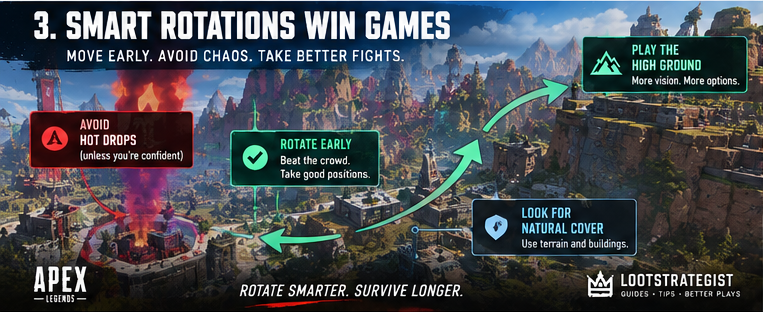
Late rotations create problems that did not need to exist.
You wait.
You loot.
The Ring moves.
You finally rotate.
The only available route now goes directly through a team holding high ground.
The better approach is to think one rotation ahead.
Ask:
Where does the squad want to be next?
Then move while you still have options.
Early rotation isn’t about running away from combat.
It’s about giving yourself the ability to decide which combat you actually want.
Play for Position Before the Endgame
You shouldn’t start thinking about your final position only when there are three squads left.
Your mid-game choices determine where you can play later.
Prioritize:
- Cover
- High ground
- Defensible terrain
- Escape routes
- Useful sightlines
- Rotations that don’t funnel you through predictable choke points
A strong position can make the enemy move first.
That is often more valuable than one additional elimination.
Learn to Recognize a Bad Fight
A bad fight often has warning signs before the first shot.
Your squad is split.
You’re low on shields.
You are fighting uphill.
The enemy has cover.
You have no escape route.
The Ring is closing.
Another team is shooting nearby.
Any one of these may be manageable.
Several at once should make you reconsider.
The best Ranked decision sometimes happens before the fight starts.
Don’t Chase a Losing Fight
One of the most expensive habits in Ranked is refusing to disengage.
You crack an enemy.
They retreat.
You follow.
They reach cover.
Another squad arrives.
Now you’re fighting two teams.
The original damage doesn’t matter anymore.
Once the conditions change, change with them.
Backing out of a bad engagement isn’t wasted time.
It preserves your squad and your next opportunity to earn RP.
Reset After Every Fight
Make this routine automatic:
Heal.
Reload.
Check ammunition.
Check your surroundings.
Recover teammates when safe.
Check the Ring.
Then loot.
The order can change slightly depending on the situation, but the principle stays the same.
A squad that immediately opens death boxes after every fight is vulnerable to the squad that heard the gunfire from two buildings away.
The loot will still be there.
Your shields may not be.
Solo Queue Ranked Tips
Solo queue requires a different mindset because your teammates won’t always want the same things you do.
You don’t control their decisions.
You do control your own.
Adapt to Your Team
Watch how your teammates play during the first few minutes.
Are they aggressive?
Do they rotate early?
Do they split during loot?
Do they prefer holding positions?
Use that information.
A flexible player can get much more value from an imperfect squad than someone who insists every teammate follow the same plan.
Don’t Follow Every Bad Push
Supporting your squad doesn’t mean copying a terrible decision.
If a teammate runs into a hopeless 1v3, don’t automatically turn it into a 2v3.
Look for an angle.
Provide cover.
Be ready for a retreat.
Preserve your position if the push is clearly lost.
Communicate
Use pings for enemies, loot, rotations, and danger.
A concise ping at the right moment is worth more than frantic communication after the fight has already started.
Ranked With a Premade Squad
A full squad has something a solo player doesn’t:
predictability.
You can create routines.
One player can make rotation calls.
Another can focus on scouting.
Another can manage support and recovery.
The exact division doesn’t matter as much as having a shared plan.
Decide before the match how your squad generally wants to play.
That prevents three players from making three different decisions when the first enemy appears.
Learn When to Play for Placement
There are moments when the correct play is to fight.
There are also moments when another team doing the fighting is exactly what you want.
Suppose your squad has:
- Good Ring position
- Strong cover
- Healthy resources
- Multiple escape routes
- Two enemy squads already fighting
You don’t necessarily gain anything by rushing into the middle of that fight.
Let them weaken each other.
Then decide whether the resulting position is favorable.
Patience isn’t passivity.
It’s choosing when the fight is cheapest to take.
Ranked Splits and Resets
Ranked splits happen twice each Season: once at the start and once at the announced second split.
Your RP is reset when the split occurs.
For Split Two, EA’s current reset structure is:
| Previous Rank | Split-Two Reset |
|---|---|
| Bronze IV–I | Bronze IV — 1,000 RP |
| Silver IV–I | Silver IV — 3,250 RP (+250 demotion protection) |
| Gold IV–I | Gold IV — 5,750 RP (+250 demotion protection) |
| Platinum IV–I | Platinum IV — 8,750 RP (+250 demotion protection) |
| Diamond IV–III | Platinum III — 9,250 RP |
| Diamond II–I | Platinum II — 10,000 RP |
| Master and above | Platinum I — 11,000 RP |
These are the current values in EA’s Ranked documentation.
Because Ranked systems can be changed between seasons, this is one section worth rechecking whenever Respawn publishes new Ranked patch notes.
Ranked Rewards
At the start of the next Season, you receive rewards based on the highest rank you achieved during the previous Season.
That highest rank can come from either split. EA also distinguishes the badge presentation depending on whether you match or surpass your first-split rank in the second split.
Ranked also has Auras, cosmetic effects that display your current rank in matches.
They range from gray for Rookie to red for Predator.
The rewards are nice.
The more useful reward, though, is knowing that your level of play has actually improved.
Can You Play Ranked With Friends?
Ranked parties have matchmaking restrictions.
EA’s current rules require players in a premade Ranked squad to be within two ranks of each other.
For example, a Bronze player can party with Rookie, Bronze, Silver, and Gold players, but not Platinum or higher. Premade squads are matched using the highest RP value in the squad.
Temporary matchmaking tests can alter those rules, so check the latest patch notes when Respawn announces an experiment or change.
Ranked Ladders Explained
Ranked Ladders are a separate leaderboard system.
EA currently describes each Ladder as a skill-based leaderboard with a maximum of 100 players.
You need at least five Ranked matches to establish a Ladder result, and your Ladder score is based on your five best Ranked RP scores during that period. Cross-play must be enabled, and you can compete with or without a squad.
The current Ladder tiers are:
| Tier | Leaderboard Position |
|---|---|
| Tier 1 | Top 10% |
| Tier 2 | Top 10–30% |
| Tier 3 | Top 30–50% |
| Tier 4 | Bottom 50% |
EA’s current Ranked page says Ladders run weekly from Tuesday through Sunday, while the Season 30 Marked update specifically extended Ranked Ladders to five days.
Because the exact Ladder schedule can be seasonal, use the in-game Compete tab as the final reference for active dates.
How to Improve Your Ranked Climb
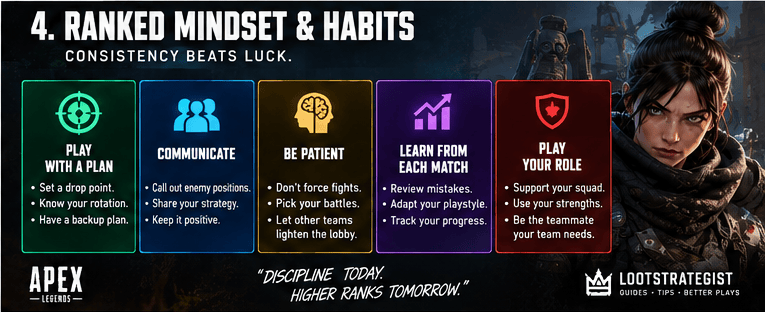
You don’t need to review every game like a professional player.
Start with your deaths.
After a bad match, ask:
Was my position good?
Was my squad together?
Did I have enough resources?
Did we choose the fight?
Did I rotate too late?
Could I have escaped?
If you keep giving the same answer, you’ve found the skill you need to work on.
That is much more useful than simply saying, “I need better aim.”
Stop Trying to Fix Everything at Once
Improvement becomes easier when you give yourself one target.
For a few matches, focus on positioning.
Then work on close-range gunfights.
Then practice movement.
Then work on rotations.
Then communication.
Once each habit becomes more automatic, combine them.
Trying to overhaul your entire gameplay at once usually creates another problem:
You start thinking about everything except the fight in front of you.
Don’t Tilt Queue
A bad Ranked session can turn into a disaster surprisingly quickly.
You lose RP.
You get frustrated.
You take a reckless fight to win it back.
You lose more RP.
Then you queue again because now you really need the points.
That cycle is rarely productive.
Take a break when you’re no longer making calm decisions.
There is no bonus RP for emotional damage.
The Biggest Ranked Mistakes to Avoid
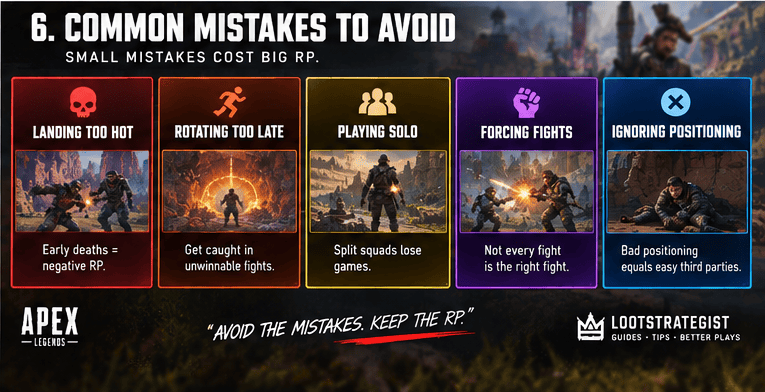
Chasing Every Fight
Not every enemy is worth fighting.
Rotating Too Late
Late rotations leave you with fewer options.
Splitting From Your Squad
An isolated player is easier to eliminate and harder to support.
Refusing to Disengage
A good fight can become a terrible one in seconds.
Looting Without Checking for Third Parties
Gunfire attracts attention.
Chasing Kills Instead of Position
Kills contribute to RP, but dying in a terrible position contributes to someone else’s match.
Ignoring the Ring
A late rotation can force a fight you could have avoided.
Changing Legends Constantly
You learn much more from a Legend when you actually understand the kit.
Playing Tilted
Bad decisions compound.
Ignoring Your Deaths
Your mistakes are information.
Use them.
A Simple Ranked Game Plan
Early Game
Land with your squad.
Get a practical weapon combination.
Secure ammunition, shields, and healing.
Identify nearby squads.
Take a fight only when the opening makes sense.
Mid Game
Rotate before you’re forced to.
Prioritize strong positions.
Take favorable engagements.
Reset after fights.
Watch for third parties.
Late Game
Value position over unnecessary kills.
Keep the squad together.
Preserve resources.
Hold useful terrain.
Make the next rotation before you desperately need it.
That’s the basic loop.
The details change from match to match.
The principles don’t.
Loot Strategist’s Ranked Rule
Don’t ask how many kills you can get this match.
Ask:
“What decision gives my squad the best chance of finishing higher?”
Sometimes the answer is a fight.
Sometimes it’s a rotation.
Sometimes it’s holding your position.
Sometimes it’s letting another squad leave.
And sometimes it’s walking away from a fight that looks tempting but offers almost no upside.
Ranked is built from hundreds of small decisions.
The flashy moments are simply the easiest ones to remember.
Final Thoughts
Apex Legends Ranked gets easier to understand once you stop thinking of RP as something you have to chase every minute.
Think about creating good outcomes consistently.
Take favorable fights.
Rotate early.
Use cover.
Stay close to your squad.
Reset after engagements.
Pay attention to the Ring.
Don’t chase an enemy simply because they are running away.
And when you lose, figure out why.
You won’t win every match.
You won’t gain RP every session.
Some games will end because the squad made one terrible call.
Others will end because another team simply played the situation better.
That’s part of competitive Apex.
What matters is whether you are making better decisions than you were ten matches ago.
That is what makes the climb sustainable.
Related Apex Legends Guides
Apex Legends Beginner Guide — Start here if you’re still learning Apex fundamentals such as weapons, movement, positioning, looting, healing, and squad play.
Apex Legends Octane Guide — Learn how to use Octane’s mobility without sacrificing your squad’s positioning.
Apex Legends Movement Guide — Learn the movement fundamentals that become increasingly important as your skill level rises.
Apex Legends Best Weapons Guide — Build a reliable loadout around weapons you can use consistently.
Apex Legends Solo Queue Guide — Learn how to adapt when you’re climbing without a premade squad.
Sources & Updates
Last reviewed: September 6, 2026
Apex Legends Ranked systems can change during a Season, so this guide separates current game mechanics from Loot Strategist’s editorial recommendations.
Current Ranked mechanics—including RP progression, entry costs, scoring, rank divisions, matchmaking, Drop Zones, Ranked splits, rewards, party restrictions, Shield Cores, and Ranked Ladders—were checked against EA’s official How Apex Legends Ranked Works documentation.
Season-specific Ranked information was also checked against the official Apex Legends: Marked Patch Notes released for Season 30. Those notes state that Ranked Ladders were extended to five days.
Editorial note: Gameplay recommendations in this guide—including fight selection, rotations, positioning, solo queue habits, and climbing strategy—are Loot Strategist’s editorial advice. They are not presented as official EA rules.


10 thoughts on “Apex Legends Ranked Guide: How to Climb Faster and Smarter”