

Apex Legends has 28 Legends, and the strongest pick can change surprisingly quickly.
One balance patch can push a forgotten character into the spotlight. A popular Legend can get nerfed and suddenly become less attractive. A supposedly “weak” specialist can still post excellent results when a skilled player builds an entire strategy around the kit.
That’s why a useful Apex Legends Tier List needs more than an S-to-C chart.
This Season 30: Marked ranking looks at current competitive strength, practical squad value, flexibility, combat impact, reliability, and specialist potential. We also use current high-level pick-rate and RP-performance data as evidence—but not as an automatic ranking machine.
The result is a tier list designed to answer the question players actually care about:
Who is worth learning right now?
Season 30 note: This ranking is a current snapshot, not a permanent verdict. Respawn launched Season 30 on August 4, 2026 and introduced a Bloodhound rework, Loba and Rampart buffs, and balance changes to Axle, Seer, and Valkyrie.
Apex Legends Tier List at a Glance
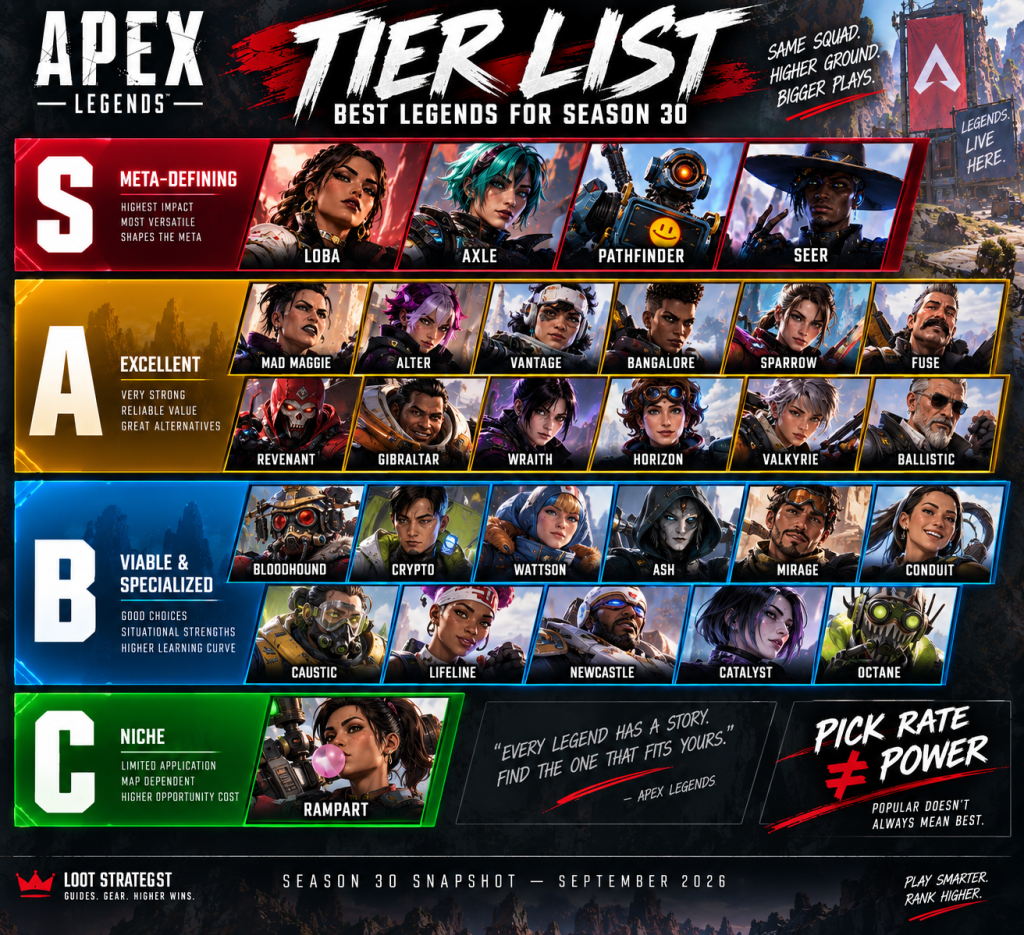
| Tier | Legends |
|---|---|
| S-Tier | Loba, Axle, Pathfinder, Seer |
| A-Tier | Mad Maggie, Alter, Vantage, Bangalore, Sparrow, Fuse, Revenant, Gibraltar, Wraith, Horizon, Valkyrie, Ballistic |
| B-Tier | Bloodhound, Crypto, Wattson, Ash, Mirage, Conduit, Caustic, Lifeline, Newcastle, Catalyst, Octane |
| C-Tier | Rampart |
That gives every current Legend a place.
And that last point matters: 28 Legends in the roster means 28 names in the tier list.
For competitive context, ApexRanked’s September 6, 2026 snapshot tracks 823 current Apex Predators across 170,269 Season 30 Split 1 appearances. Loba leads tracked pick rate at 20.2%, followed by Axle at 19.3%, Pathfinder at 11.7%, Seer at 9.4%, and Mad Maggie at 6.7%.
What S, A, B, and C Mean
A tier list is only useful when the tiers actually mean something.
S-Tier — Meta-Defining
These Legends combine exceptional current strength with broad practical value and strong competitive relevance.
They don’t need a perfect team composition to be useful.
A-Tier — Excellent
These Legends are highly effective and can absolutely carry a strong game plan, but they usually have a clearer weakness, narrower specialization, or higher opportunity cost than S-tier choices.
B-Tier — Viable and Specialized
These Legends can perform very well but generally have more specific applications, higher learning requirements, or fewer ways to influence a match than the leaders.
B-tier does not mean bad.
C-Tier — Niche
These Legends can still work and can be terrifying in the right hands.
They simply have a larger competitive opportunity cost, stronger map dependence, or fewer consistently useful situations.
How We Ranked the Legends
Our ranking uses six criteria.
Current Meta Strength
How effective is the Legend in the current Season 30 environment?
Combat Impact
How much can the kit change an engagement?
Team Utility
Does the Legend make the rest of the squad better?
Flexibility
Can the Legend contribute across different phases of a match?
Reliability
Can the kit create value consistently rather than only in specific scenarios?
Specialist Potential
Can the Legend become exceptionally strong when mastered, even if relatively few players use them?
We then compare those factors with current data.
That distinction is important because pick rate is not the same thing as power.
Why Pick Rate Isn’t the Same as Strength
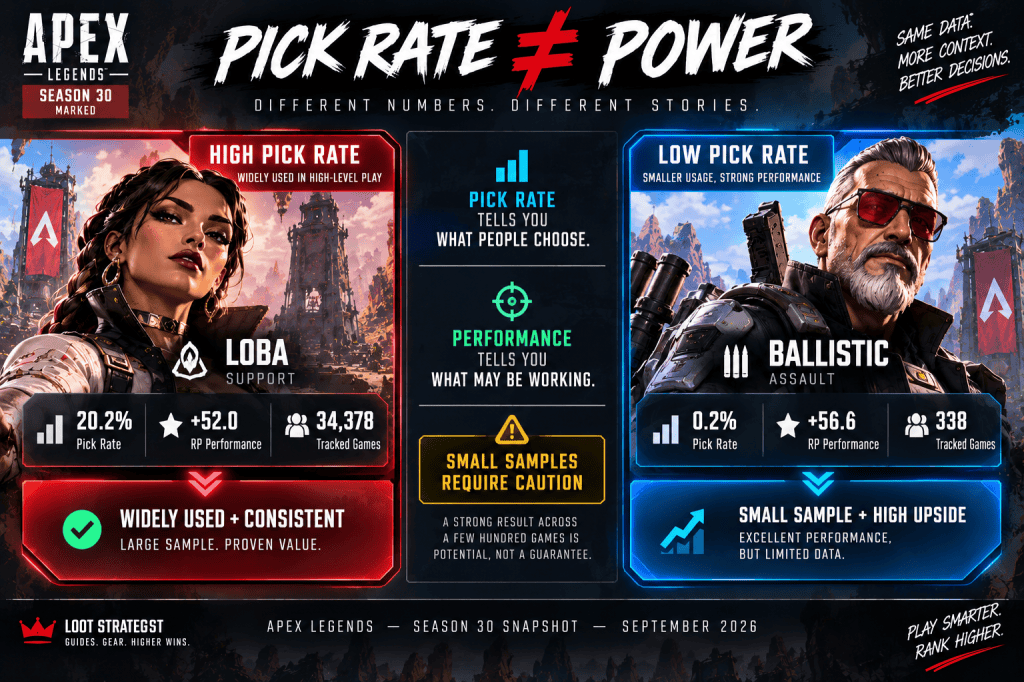
The current Season 30 data makes this especially obvious.
ApexRanked has Loba at:
20.2% pick rate
and Ballistic at:
0.2% pick rate
Yet Ballistic currently shows the highest RP-performance figure in the tracked Predator sample:
+56.6 RP
Loba sits at:
+52.0 RP.
That doesn’t mean Ballistic should automatically replace Loba at the top of the list.
Ballistic has only 338 tracked games in this dataset, compared with Loba’s 34,378.
The useful conclusion is:
Ballistic may have excellent specialist potential, but the evidence is much thinner.
That’s why we use data as evidence and editorial judgment as the final layer.
S-Tier Legends
These are the four Legends currently offering the strongest overall combination of competitive relevance, flexibility, and practical value.
Loba
Loba is our current #1 overall pick.
Her Jump Drive provides mobility, her Passive helps identify high-rarity loot, and her Black Market can improve team access to nearby resources.
Then Season 30 made her even more attractive.
EA reduced her Tactical equip time from 0.6 seconds to 0.4 seconds, increased its range, reduced travel time, and shortened Black Market Boutique’s cooldown from 150 seconds to 120 seconds. Respawn said the changes were intended to improve her survivability and team support.
The competitive numbers line up with that.
Loba currently leads ApexRanked’s Predator pick-rate table at 20.2%, with more than 34,000 tracked appearances.
Why She Is S-Tier
Excellent general utility
Strong solo-queue value
Useful mobility
Resource control
Works in many squad compositions
Best For
Ranked
Solo queue
Flexible squads
Players who value resources and positioning
Axle
Axle remains the other major meta-defining mobility pick.
Her kit lets her change engagement distance quickly, create movement opportunities, and put pressure on teams from awkward angles.
Respawn has been actively tuning her because her mobility and Kickstart drone created too much pressure in too many situations. Season 30 reduced her maximum slide-boost time from five seconds to three seconds, while also changing her Ultimate so it can affect Axle herself and her allies.
Even after those changes, she remains extremely popular at the highest level.
ApexRanked’s September 6 snapshot puts Axle at 19.3% pick rate and 32,794 tracked appearances.
Why She Is S-Tier
Exceptional mobility
Strong fight creation
Excellent repositioning
High ceiling
Best For
Aggressive players
Mechanical players
Mobility-focused squads
Pathfinder
Pathfinder is the most straightforward S-tier mobility recommendation.
His value isn’t limited to flashy movement.
He can give a squad:
Better angles
Faster rotations
High-ground access
Escape options
More freedom to choose where fights happen
That versatility is why Pathfinder continues to appear frequently in high-ranked play.
ApexRanked currently has him at 11.7% pick rate, with 19,872 tracked appearances. His RP-performance figure sits at +52.5.
Why He Is S-Tier
Broad utility
Reliable movement
Strong rotations
Works with many squad styles
Best For
Movement players
Shot-callers
Aggressive repositioning
Ranked
Seer
Seer is the most information-oriented member of the S-tier group.
That makes his strength somewhat different from Loba or the movement Legends.
Seer can help a squad understand what is happening before committing to the fight.
Respawn has also demonstrated how much power information can provide: Season 30 reduced the turn slow on his Tactical because the ability had become frustrating and oppressive when used repeatedly.
ApexRanked currently has Seer at 9.4% pick rate across 16,022 tracked appearances.
Why He Is S-Tier
Strong information
Fight control
Excellent with coordinated teammates
High value before the first shot
Best For
Information-focused players
Coordinated squads
Shot-callers
A-Tier Legends
A-tier Legends are excellent.
The difference is that their strengths are usually a little more specific than those of the S-tier group.
Mad Maggie
Maggie is one of the best answers to an enemy team that refuses to leave cover.
Her kit is built to apply pressure and force movement, making her especially useful against defensive setups.
She currently sits at 6.7% pick rate in the Predator dataset.
Best For
Breaching
Aggressive squads
Close-range pressure
Alter
Alter offers mobility and unusual ways of interacting with space.
She becomes especially valuable in squads that know how to think beyond the obvious route.
Her current Predator pick rate is 5.7%, putting her firmly among the more frequently selected Legends at the top of the ladder.
Best For
Creative rotations
Unpredictable movement
Advanced players
Vantage
Vantage offers information and ranged pressure, but her value depends heavily on whether the squad knows how to convert that information into an advantage.
Her current Predator pick rate is 3.5%.
Best For
Scouting
Long-range pressure
Information-heavy squads
Bangalore
Bangalore remains one of the safest all-purpose choices in Apex.
Smoke creates cover.
Double Time can help reposition under fire.
Rolling Thunder controls space.
The kit is straightforward enough for newer players but still useful at high levels.
Best For
Beginners
Solo queue
Balanced squads
Repositioning
Sparrow
Sparrow has established meaningful competitive presence, with a 3.3% Predator pick rate in the current dataset.
His value rises when teammates actually use the information and movement his kit provides.
Best For
Active scouting
Coordinated fights
Mobile squads
Fuse
Fuse excels at creating problems for players who think cover makes them untouchable.
His offensive utility can force enemies to move, weaken fortified positions, and make defensive setups uncomfortable.
Best For
Area denial
Aggression
Breaking defensive teams
Revenant
Revenant rewards players who understand timing.
His aggressive mobility can make him extremely dangerous, but poor timing can leave him isolated.
He currently has around 1.9% Predator pick rate.
Best For
Aggressive players
Close-range pressure
Confident entry players
Gibraltar
Gibraltar’s value comes from protection and fight control.
A well-timed Dome can completely change an engagement.
The downside is tempo.
Fast-moving squads can sometimes get more value from mobility-oriented picks.
Best For
Coordinated squads
Defensive fighting
Emergency protection
Wraith
Wraith remains useful because she gives aggressive players another way to escape a bad commitment.
Her Portal also provides a way to create safer movement options for the squad.
She currently sits around 1.5% pick rate in the Predator dataset.
Best For
Solo queue
Aggressive repositioning
Flexible squads
Horizon
Horizon becomes especially useful when vertical positioning matters.
She can create high-ground opportunities that other squads may not be able to answer as easily.
The trade-off is greater map and situation dependence.
Best For
Vertical fights
High-ground play
Coordinated pushes
Valkyrie
Valkyrie remains valuable for teams that prioritize macro movement and rotation options.
She received another balance adjustment in Season 30 as Respawn continued tuning mobility-heavy Legends.
She’s still useful.
She’s simply less automatic than she once was.
Best For
Rotations
Map mobility
Repositioning
Ballistic
Ballistic is the most interesting A-tier placement.
His current pick rate is only 0.2%, with just 338 tracked appearances in the Predator sample. Yet he posts the highest RP-performance figure at +56.6.
That’s too interesting to ignore.
It’s also too small a sample to blindly call him S-tier.
So we place him in A as a high-upside specialist.
Best For
Weapon-focused aggression
Experienced players
Players who understand fight timing
B-Tier Legends
B-tier means viable, not bad.
These are often strong choices for specific players, teams, maps, or situations.
Bloodhound
Season 30 completely refreshed Bloodhound.
The Passive now displays enemy footsteps and introduces White Ravens for tracking. The Tactical has a three-second full-body scan followed by four snapshot scans, while the new Allfather’s Cloak Ultimate provides a temporary cloaking effect within its area.
Yet Bloodhound currently has only a 0.7% Predator pick rate.
At the same time, the tracked RP-performance number is +54.7, second only to Ballistic.
That’s exactly why we don’t use pick rate as the tier itself.
Best For
Tracking
Aggressive recon
Players learning information play
Crypto
Crypto is another specialist whose numbers need context.
He currently has only 0.6% Predator pick rate, but posts +55.4 RP performance across 1,036 tracked games.
That suggests impressive potential when mastered.
The problem is execution.
Time spent controlling the drone is time not spent directly fighting.
Best For
Coordinated squads
Scouting
Advanced information play
Wattson
Wattson remains excellent when the squad can decide where it wants to fight.
Her value rises in controlled positions and late-game setups.
It falls when the squad is constantly forced to rotate.
Best For
Endgame positioning
Building control
Defensive squads
Ash
Ash remains a functional aggressive mobility option, but she faces significant competition from the stronger current movement picks.
Best For
Aggression
Mobility
Target isolation
Mirage
Mirage rewards players who understand misdirection and timing.
His deception can still create clutch situations, particularly in lower- and mid-level lobbies.
The higher the skill level of the opposition, the more important good timing becomes.
Best For
Mind games
Solo queue
Clutch situations
Conduit
Conduit is one of the better Support picks for players who want to stay active during fights.
Her value becomes much clearer when the squad plays aggressively and her abilities can keep teammates fighting.
Her current Predator pick rate is 0.4%, but her tracked RP performance is a respectable +51.9.
Best For
Aggressive support
Team sustain
Coordinated fights
Caustic
Caustic remains dangerous when the enemy has to enter controlled space.
The problem is the same one that affects many defensive specialists:
Apex eventually makes you move.
Best For
Area denial
Building defense
Close-range control
Lifeline
Lifeline is still one of the simplest ways to bring recovery utility into a squad.
Her current Predator pick rate is only 0.3%, but that says much more about high-level meta preferences than it does about her usefulness to an ordinary player.
Best For
Beginners
Support players
Recovery-focused squads
Newcastle
Newcastle can be extremely strong when a squad understands how to fight around his defensive abilities.
His current pick rate is only 0.3%, so the dataset doesn’t show widespread competitive adoption, but he remains an attractive specialist for coordinated defensive recovery.
Best For
Revives
Defensive recovery
Coordinated squads
Catalyst
Catalyst can reshape how enemies enter and exit an area.
That control is valuable, but it requires a squad that knows how to capitalize on it.
Best For
Area control
Defensive squads
Endgame positions
Octane
Octane belongs in B-tier for a simple reason:
He’s still fun, mobile, and perfectly capable of taking over a lobby in the right hands.
But the current game offers stronger overall movement options.
ApexRanked has Octane at 2.6% Predator pick rate and +43.6 RP performance in its September 6 snapshot.
That makes him a viable movement choice without giving him the same overall value as Axle or Pathfinder.
Best For
Aggressive players
Movement practice
Fast-paced casual play
C-Tier Legend
C-tier is the narrowest category in this list.
It’s not a “never play this character” warning.
It’s a statement about competitive opportunity cost.
Rampart
Rampart is the clearest example.
Respawn actually buffed her in Season 30 because the team felt she still struggled to compete despite previous improvements. The developer notes describe her as extremely strong when she can bunker into a favorable position, but difficult to make work otherwise.
That perfectly describes her current tier.
Give Rampart:
Time
Strong ground
A favorable Ring
A defensible position
and she can become terrifying.
Give her:
A bad rotation
Open terrain
Constant movement
and the value falls quickly.
Her current Predator pick rate is only 0.2% across 321 tracked appearances.
Best For
Defensive specialists
Prepared positions
Players who enjoy controlling space
What the Current Meta Actually Looks Like
The headline is straightforward:
Loba + Axle + Pathfinder
is currently the most common trio tracked by ApexRanked.
The combination has appeared 2,967 times with an average +56.2 RP in the current Season 30 Split 1 dataset.
That combination makes sense.
Axle provides aggressive movement.
Loba supplies resources and flexible utility.
Pathfinder handles mobility and rotation.
It’s a good example of what the current meta rewards:
mobility + resources + flexible positioning
But it doesn’t mean every player should copy that squad.
A different combination may suit your team better.
The Most Interesting Low-Pick Legends
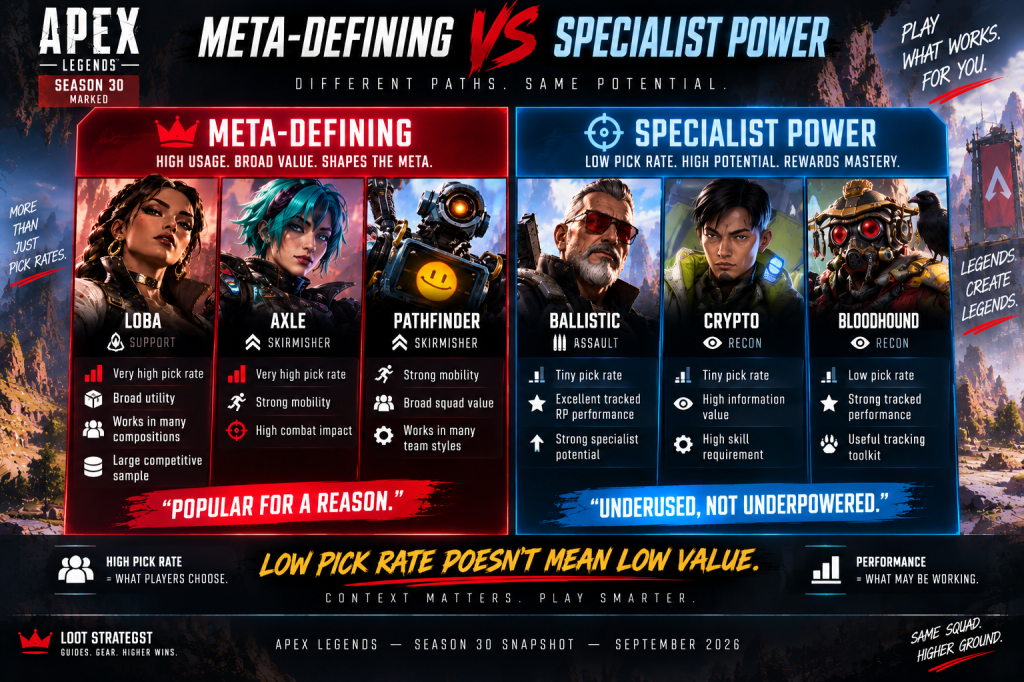
Current data gives us another story that deserves attention.
Ballistic
0.2% pick rate
+56.6 RP
Crypto
0.6% pick rate
+55.4 RP
Bloodhound
0.7% pick rate
+54.7 RP
Those are excellent performance numbers compared with their relatively tiny pick rates.
But the sample sizes matter.
Ballistic has only 338 tracked games.
Loba has more than 34,000.
You shouldn’t read those numbers as:
“Ballistic is secretly the strongest Legend.”
Read them as:
“Some low-pick specialists can perform extremely well when the right player uses them.”
That’s a much more defensible conclusion.
Why Tier Lists Shouldn’t Be Static
Season 30 already demonstrates how quickly things move.
Bloodhound received a rework.
Loba was buffed.
Rampart was buffed.
Axle was nerfed.
Seer was nerfed.
Valkyrie was adjusted.
Respawn also changed the weapon and loot systems, which can indirectly alter the value of Legend kits.
A Legend doesn’t need a direct buff to become stronger.
Sometimes the environment changes around them.
That’s why this article should be reviewed when there is a meaningful balance patch, not only when a new Season starts.
When Should You Ignore the Tier List?
You should ignore it when:
You’re still learning the game.
You don’t understand the S-tier kit.
Your squad already has too much overlapping utility.
The map doesn’t suit the Legend.
You simply play another Legend dramatically better.
A tier list describes relative strength.
It does not play the match for you.
Best Legends by Role
For readers who don’t care about tier letters, here’s the more practical version.
| Role | Strong Choices |
|---|---|
| Overall | Loba, Axle, Pathfinder |
| Aggression | Axle, Mad Maggie, Revenant |
| Mobility | Axle, Pathfinder, Wraith |
| Information | Seer, Vantage, Bloodhound |
| Support | Loba, Lifeline, Conduit |
| Defense | Rampart, Wattson, Catalyst |
| Solo Queue | Loba, Bangalore, Pathfinder, Wraith |
| Beginners | Bangalore, Lifeline, Pathfinder |
| Ranked | Loba, Axle, Pathfinder, Seer, Mad Maggie |
| Breaching | Mad Maggie, Fuse |
| Specialist | Ballistic, Crypto |
For playstyle-specific recommendations, see our Apex Legends Best Legends Guide.
Tier List vs. Best Legends Guide
These pages should answer different questions.
Apex Legends Tier List
“Who is strongest right now?”
Useful for:
Meta watchers
Ranked players
Competitive players
Players deciding which Legends deserve practice time
Apex Legends Best Legends Guide
“Who is best for my playstyle?”
Useful for:
Beginners
Solo queue players
Mobility players
Support players
Defensive players
That distinction keeps both pages useful instead of making them duplicate one another.
How to Use This Tier List
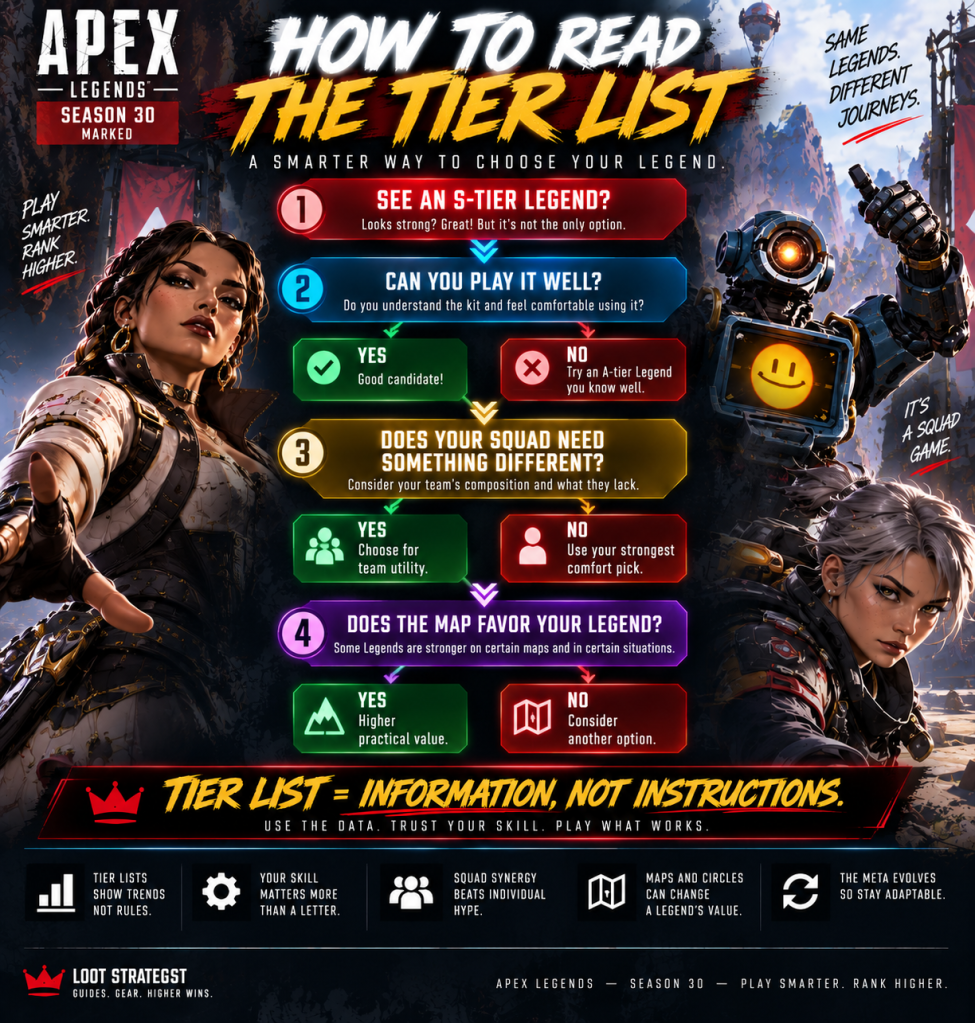
Don’t read:
S-tier = must play
Read:
S-tier = currently deserves serious attention
Then ask:
Can I play the Legend well?
Does my squad benefit from the kit?
Does the map support the Legend?
Do I understand the weaknesses?
If the answers line up, that’s probably a strong choice.
Tier List Rule
Don’t chase the letter. Chase the advantage.
The strongest Legend on paper can be a poor pick in your hands.
A specialist can be excellent when you’ve mastered the exact situation they are designed to solve.
And a balanced Legend that gives you several useful options can be worth more than a character with one spectacular trick.
That’s why this list treats:
meta strength
usage
performance
flexibility
and specialist value
as separate pieces of the puzzle.
Final Verdict
For Season 30, our current S-tier group is:
Loba
Axle
Pathfinder
Seer
They combine the strongest overall mix of current usage, competitive relevance, and broad practical value. Loba, Axle, Pathfinder, and Seer are also the four most-picked Legends in ApexRanked’s current Predator dataset.
Below them, A-tier is full of excellent alternatives, including Mad Maggie, Alter, Vantage, Bangalore, Sparrow, Fuse, Revenant, Gibraltar, Wraith, Horizon, Valkyrie, and Ballistic.
And some of the most interesting names aren’t near the top of the pick-rate chart.
Ballistic, Crypto, and Bloodhound all post exceptional RP-performance figures despite very small shares of Predator play.
That’s exactly why a good tier list needs context.
The current meta tells you who is popular.
Performance data tells you what may be working.
Game knowledge tells you why.
And your own skill determines how much of that strength you can actually use.
Final Thoughts
Apex Legends tier lists are useful.
They become dangerous when players treat them as commandments.
The current Season 30 meta clearly favors a few standout picks, especially Loba, Axle, Pathfinder, and Seer. But the same data also shows that lower-pick specialists can perform extremely well in the right hands.
So use this list as a roadmap, not a rulebook.
Learn the S-tier Legends.
Understand the A-tier options.
Don’t dismiss B-tier specialists.
And never feel bad about playing a lower-ranked Legend that you genuinely understand.
Apex is too fast, too complicated, and too dependent on team decisions for one letter to tell the entire story.
The better question isn’t:
“Who’s S-tier?”
It’s:
“Who gives me the best advantage for the way I play Apex?”
That’s where the real tier list starts.
Related Apex Legends Guides
Apex Legends Best Legends Guide — Find the best Legend for your playstyle, whether you prefer Ranked, solo queue, mobility, support, or aggressive fights.
Apex Legends Squad Composition Guide — Learn how to build stronger squads around complementary Legend roles rather than simply stacking high-tier characters.
Apex Legends Ranked Guide — Learn how RP, placement, rotations, fights, splits, and competitive decision-making work.
Apex Legends Solo Queue Guide — Learn how to adapt to random teammates and make stronger decisions without a premade squad.
Apex Legends Settings Guide — Optimize FOV, sensitivity, graphics, audio, controller, and FPS settings.
Sources & Updates
Last reviewed: September 7, 2026
This article is a Season 30: Marked snapshot. Tier placements should be revisited after major Legend balance changes, meaningful meta shifts, or significant changes to the game’s maps, weapons, or systems.
EA’s official Legend guide confirms that Apex Legends currently has 28 Legends divided into five classes: Assault, Controller, Recon, Skirmisher, and Support.
EA’s official Season 30: Marked patch notes, published August 3, 2026, were used to verify the season’s Bloodhound rework, Loba and Rampart buffs, and balance changes affecting Axle, Seer, and Valkyrie.
EA’s current Season 30 information also confirms the Bloodhound rework, including enemy-footprint tracking, White Ravens, updated Tactical scanning, and the Allfather’s Cloak Ultimate.
Competitive usage data comes from ApexRanked’s September 6, 2026 Season 30 Split 1 Predator dataset, which tracks 823 current Apex Predators across 170,269 match appearances. The dataset records Legend pick rates, RP performance, and common trio compositions.
Current tracked pick rates place Loba at 20.2%, Axle at 19.3%, Pathfinder at 11.7%, Seer at 9.4%, Mad Maggie at 6.7%, Alter at 5.7%, and Octane at 2.6%.
The same dataset shows why pick rate is not used as an automatic tier calculation: Ballistic currently has +56.6 RP performance across 338 tracked games, Crypto +55.4 across 1,036, and Bloodhound +54.7 across 1,107, while Loba has +52.0 across 34,378.
ApexRanked currently lists Axle / Loba / Pathfinder as the most common tracked trio in Season 30 Split 1, appearing 2,967 times with +56.2 RP in its current dataset.
Editorial methodology: Loot Strategist’s tier placements combine current competitive usage, RP-performance context, combat impact, team utility, flexibility, reliability, specialist potential, and editorial judgment. Small samples are treated cautiously and are not allowed to overrule large-sample competitive evidence by themselves.
Editorial note: This is Loot Strategist‘s analysis, not an official EA ranking. The phrase “S-tier,” “A-tier,” “B-tier,” and “C-tier” represents our editorial assessment of relative usefulness within the Season 30 environment.


2 thoughts on “Apex Legends Tier List: Best Legends for Season 30”