
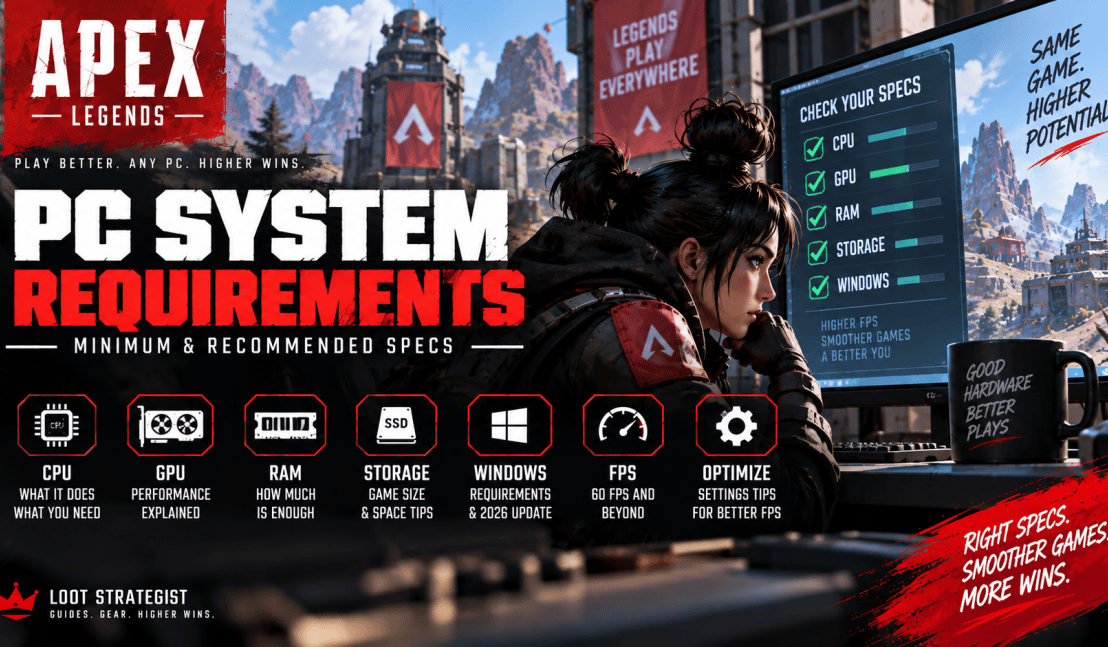
Wondering whether your PC can run Apex Legends? EA’s current system requirements are relatively modest by 2026 standards, but there is a big difference between being able to launch the game and getting the stable performance you actually want from a competitive shooter.
EA currently lists 6GB of RAM, a GTX 950 or Radeon HD 7790-class graphics card, and an Intel Core i3-6300 or AMD FX-4350-class processor as the minimum specification. Its recommended configuration moves to 8GB of RAM, a GTX 970 or Radeon R9 290, and an Intel Core i5-3570K or Ryzen 5-class CPU. Both configurations call for a DirectX 12-compatible graphics card and at least 75GB of free storage. EA associates its recommended specification with smooth 60 FPS gameplay. (EA)
Those numbers tell you where the official hardware requirements stand. They don’t, however, answer the question most players actually care about:
Will Apex Legends run well on my PC?
This guide answers that question.
Apex Legends PC System Requirements at a Glance
Here are EA’s currently published minimum and recommended specifications. (EA)
| Component | Minimum | Recommended |
|---|---|---|
| Operating System | 64-bit Windows 10 | 64-bit Windows 10 |
| CPU | Intel Core i3-6300 / AMD FX-4350 | Intel Core i5-3570K / Ryzen 5 equivalent |
| RAM | 6GB DDR3 | 8GB DDR3 |
| GPU | NVIDIA GTX 950 / AMD Radeon HD 7790 2GB | NVIDIA GTX 970 / AMD Radeon R9 290 |
| DirectX | DirectX 12-compatible video card | DirectX 12-compatible video card |
| Storage | 75GB free space | 75GB free space |
| Internet | 512 Kbps or faster | Broadband connection |
Important: these are EA’s published requirements, not a recommendation to buy these exact older components today.
A GTX 970 appearing on an official requirements page doesn’t mean a GTX 970 is the graphics card you should shop for in 2026. Modern hardware should be judged by its actual performance rather than by matching an old model number.
Can Your PC Run Apex Legends? Minimum vs. Recommended
The simplest way to interpret the requirements is to think of them as two different thresholds.
Minimum requirements
The minimum specification is the official floor for running Apex Legends:
- 64-bit Windows 10
- Intel Core i3-6300 or AMD FX-4350
- 6GB RAM
- GTX 950 or Radeon HD 7790 2GB
- DirectX 12-compatible graphics card
- 75GB of free storage
- 512 Kbps or faster internet connection (EA)
Recommended requirements
The recommended specification raises those targets to:
- 64-bit Windows 10
- Intel Core i5-3570K or Ryzen 5 equivalent
- 8GB RAM
- GTX 970 or Radeon R9 290
- DirectX 12-compatible graphics card
- 75GB of free storage
- Broadband connection (EA)
The key distinction is straightforward:
Minimum tells you whether your PC clears the published floor. Recommended gives you a more useful reference point for a smoother experience.
And neither one tells you exactly what FPS you will see on your particular system.
“Can Run” vs. “Runs Well”
This is the distinction that matters most.
A PC can technically meet a game’s minimum requirements while still producing an experience that feels poor.
A system hovering around the minimum may need aggressive graphics reductions and can have less performance headroom when several things are happening at once. A machine comfortably above the recommended specification has more room to maintain the performance target you actually care about.
Think of the requirements as a starting point, not a performance guarantee.
For Apex Legends, your real target might be:
Stable 60 FPS
120 FPS
144 FPS
Or simply the highest consistent frame rate your monitor can use.
Those are different goals, and they can require very different levels of hardware.
What Do the Recommended Specs Mean for 60 FPS?
EA describes its recommended configuration as suitable for smooth 60 FPS gameplay. (EA)
That’s a useful benchmark, but it shouldn’t be interpreted as a promise that every PC with a GTX 970, R9 290, or equivalent processor will sit at a locked 60 FPS in every circumstance.
Actual performance varies according to resolution, graphics settings, drivers, thermals, background software, and other system factors.
It is also worth separating average FPS from consistent FPS.
A PC that reports 90 FPS on average but frequently drops much lower can feel worse than a system delivering a steadier frame rate.
For competitive games, consistency matters.
What about 120 FPS or 144 FPS?
That’s a different performance target.
EA’s recommended specification is a 60 FPS reference, not a guarantee for high-refresh competitive play. If you’re building or upgrading specifically for 120Hz, 144Hz, or higher, don’t treat the official recommended hardware as the finish line.
Your monitor matters, too. A 144Hz display can show substantially more than 60 frames per second, but only when your PC can consistently produce them.
Apex Legends Storage Requirements
EA currently requires at least 75GB of free storage for Apex Legends. (EA)
That is free space, not simply the total capacity of your drive.
A 75GB SSD with almost no room left after installing the game is a poor long-term setup. Windows, other games, applications, updates, and temporary files also need space.
There is another distinction worth remembering:
Storage is not RAM.
Your SSD or hard drive stores data. RAM provides working memory for the operating system and running applications.
Adding a larger SSD won’t compensate for a shortage of RAM, just as installing more RAM won’t give a nearly full drive more capacity.
What Windows Version Does Apex Legends Require?
EA’s current system-requirements page lists 64-bit Windows 10. (EA)
There is an important 2026 caveat, though.
Microsoft ended standard Windows 10 support on October 14, 2025, meaning Windows 10 no longer receives normal free software and security updates through Windows Update. Microsoft recommends moving to Windows 11 where the hardware supports it. (Microsoft Support)
So the distinction is:
EA’s published Apex requirement is still 64-bit Windows 10. For a new PC in 2026, Windows 11 is the more sensible supported operating system to target.
That doesn’t mean an existing Windows 10 PC suddenly stops running Apex. It means the operating system itself is no longer Microsoft’s standard supported desktop platform.
CPU, GPU and RAM Explained in Plain English
PC specifications become much easier to understand once you know which job each component handles.
CPU: The Processor
The CPU handles the general computational work behind the game.
In practical terms, it contributes to game logic, simulation, processing tasks, and feeding information to the rest of the system.
A weak CPU can become a performance bottleneck even when the graphics card is capable of rendering more frames.
That matters particularly when you’re chasing high frame rates.
GPU: The Graphics Card
The GPU handles the visual workload.
It renders the game world, characters, effects, lighting, textures, and other graphical elements.
When your graphics card is the limitation, lowering graphical settings can often reduce the workload and improve frame rates.
That’s one reason the GPU is frequently the first component people investigate when graphics performance is poor.
RAM: System Memory
RAM is the computer’s active working space.
It holds data that Windows and your running applications need right now.
EA lists 6GB as the minimum and 8GB as the recommended RAM requirement for Apex Legends. (EA)
That shouldn’t be interpreted as a recommendation to build a brand-new gaming PC around only 8GB of RAM in 2026. A modern Windows gaming system may also have a browser, launcher, voice chat, recording software, and other applications running alongside Apex.
More RAM isn’t automatically more FPS, but insufficient RAM can become a system-wide limitation.
How to Check Your PC Specifications
You don’t need specialist software to find your basic hardware information.
Check your CPU and RAM
Press:
Ctrl + Shift + Esc
Then open the Performance tab in Task Manager.
Select CPU to see your processor.
Select Memory to see your installed RAM.
Check your GPU
In Task Manager, select:
Performance → GPU
Windows will display the graphics processor currently available to the system.
When comparing your GPU with EA’s requirements, pay attention to the actual model rather than simply assuming that a newer-looking name is automatically faster.
Check Windows
Open:
Settings → System → About
Look for your Windows edition and system type.
You want to verify that you’re using a 64-bit installation.
Check free storage
Open:
File Explorer → This PC
You’ll see how much space is available on your drives.
For Apex Legends, EA currently lists 75GB of free space as the requirement. (EA)
What Should You Upgrade First?
Don’t upgrade components in alphabetical order—or simply buy whichever part has the biggest number.
Find the bottleneck first.
That gives you a much better chance of spending money where it actually helps.
GPU-limited
If lowering graphical settings produces a significant FPS improvement, the graphics card may be doing most of the struggling.
A stronger GPU can make sense in that situation.
CPU-limited
If lowering graphics settings barely changes your frame rate, particularly at lower resolutions, the CPU may be limiting overall performance.
This becomes increasingly important when targeting high refresh rates.
RAM-limited
If your system is close to exhausting its available memory while Apex and your normal applications are running, additional RAM may give the system more breathing room.
Don’t assume every FPS problem is a RAM problem simply because more memory sounds better.
Thermal-limited
A PC can have perfectly capable hardware and still perform poorly if it is running too hot.
If performance starts strong and deteriorates after the system has been under load for a while, check temperatures before purchasing new components.
System or software-limited
Background applications, outdated drivers, excessive startup programs, and broader Windows issues can also affect performance.
That is why diagnosis should come before shopping.
Should You Upgrade Your GPU, CPU or RAM?
Once you’ve identified the bottleneck, the upgrade decision becomes much easier.
Upgrade the GPU when:
Your graphics card is the main performance limitation and you want higher FPS or better visual settings.
Upgrade the CPU when:
Your processor is limiting frame rates, particularly at high-refresh targets where the GPU has additional headroom.
Upgrade RAM when:
Your system doesn’t have enough memory for Apex plus the applications you normally keep open.
Replace the PC when:
Multiple major components are outdated, the platform has little meaningful upgrade room, or replacing several parts would cost nearly as much as moving to a newer system.
There is no universal “best first upgrade.”
The right answer depends on the bottleneck.
What If Your PC Is Below the Recommended Specs?
Being below the recommended specifications doesn’t automatically mean Apex Legends is off the table.
Look at how far below the specification your system is and which component falls short.
For example, a PC with a modern GPU but 8GB of RAM isn’t in the same position as a PC that’s below EA’s minimum graphics, CPU, and memory requirements at the same time.
The best next step is to identify the weak point rather than treating the entire machine as one number.
A system that falls slightly short in one area may benefit from an upgrade or sensible settings changes.
A system that falls well below the minimum across several areas may be better served by a broader hardware upgrade.
Can Graphics Settings Improve Apex Legends Performance?
Yes.
EA’s current PC settings guidance recommends reducing graphics settings when the priority is maximizing performance and FPS. It also recommends changing settings incrementally so you can see which adjustments actually help your system. (EA Help)
EA’s current guidance also recommends a 90–110 FOV range as a starting point, with 110 being common among competitive players. (EA Help)
But don’t turn this system-requirements article into another settings guide.
The important relationship is:
Hardware → graphics workload → FPS target → settings
Our Apex Legends Settings Guide covers the configuration side in much greater detail, including FOV, graphics, FPS, mouse, controller, and audio settings.
How to Improve Apex Legends Performance Without Buying a New PC
Before spending money, make sure the problem is actually hardware.
Start by applying sensible performance-oriented settings and checking whether FPS improves. EA recommends lowering graphics settings when maximizing performance is the priority. (EA Help)
Then check the basics:
Close unnecessary background applications.
Check GPU and CPU temperatures while playing.
Make sure your graphics drivers are reasonably current.
Check whether the system is running out of RAM.
Make sure the game drive has adequate free space.
Monitor performance while actually playing rather than judging the PC from specifications alone.
Changing one thing at a time also makes troubleshooting much easier. Otherwise, you won’t know which adjustment produced the result.
A Simple “Can I Run Apex?” Test
Use this five-step check before spending money.
| Question | What it tells you |
|---|---|
| Does the PC meet EA’s minimum requirements? | Whether the system clears the official baseline |
| Which component falls short? | Where the bottleneck may be |
| What FPS are you getting now? | Your real-world performance |
| What happens when graphics settings are lowered? | Whether the GPU may be limiting you |
| What FPS do you actually want? | Whether you need optimization or new hardware |
That final question is easy to overlook.
A player who wants a stable 60 FPS has a very different hardware target from someone building specifically around a 144Hz monitor.
A Simple Apex Legends Upgrade Checklist
Before buying anything, check these in order:
1. Identify the bottleneck.
Don’t assume the GPU is automatically the problem.
2. Check your actual FPS.
Use in-game performance data rather than guessing.
3. Test lower graphics settings.
A noticeable improvement can point toward a GPU limitation.
4. Check system memory and temperatures.
RAM and thermals can create problems that a new GPU won’t fix.
5. Decide on your target.
60 FPS, 120 FPS, and 144 FPS are different performance goals.
6. Compare modern replacement hardware.
Don’t buy an old component merely because it appears on EA’s requirements page.
Do You Need a High-End PC to Play Apex Legends?
No.
EA’s published minimum and recommended specifications are built around relatively old PC hardware by 2026 standards. (EA)
That is good news for players with older systems.
The bigger question is whether your hardware delivers the performance you want.
A modern budget gaming PC can exceed EA’s recommended specification by a considerable margin. At that point, the focus shifts from basic compatibility to frame-rate consistency, resolution, graphics quality, and your monitor’s refresh rate.
You don’t need an extravagant PC simply to play Apex Legends.
You do need hardware appropriate for the experience you’re trying to achieve.
Frequently Asked Questions
Can I play Apex Legends with 6GB of RAM?
EA lists 6GB of RAM as the minimum requirement. (EA)
That is enough to meet the published minimum, but a modern gaming PC with additional memory can provide more headroom for Windows and other applications.
Is 8GB RAM enough for Apex Legends?
EA currently lists 8GB as the recommended amount. (EA)
For a new gaming PC in 2026, however, I wouldn’t treat 8GB as a generous amount of system memory. It is better viewed as EA’s published recommendation for Apex rather than a modern whole-system memory target.
Can Apex Legends run on integrated graphics?
EA’s published requirements specify dedicated GPU models such as the GTX 950 or Radeon HD 7790 at minimum. (EA)
Because integrated graphics performance varies considerably between processors and generations, there isn’t a useful universal “integrated graphics” answer. Check the exact hardware and compare its real-world gaming performance.
Is 75GB enough for Apex Legends?
EA currently lists 75GB of free hard-drive space as the requirement. (EA)
Leave additional room on the drive for Windows, updates, applications, and other games rather than running the storage device at its limit.
Can Apex Legends run at 144 FPS?
Potentially, but EA’s recommended specification is associated with 60 FPS, not a guaranteed 120 or 144 FPS target. (EA)
If 144 FPS is the goal, assess the specific CPU, GPU, resolution, settings, and monitor rather than relying on the official recommended specification alone.
Should I buy a GTX 970 because EA recommends it?
No.
The GTX 970 is part of EA’s published recommended specification, but that doesn’t make it a sensible new purchase in 2026.
Use the requirement as a performance reference and compare modern hardware instead.
Apex Legends PC Requirements: The Practical Verdict
EA’s current requirements are useful, but they only tell part of the story.
The official minimum is:
6GB RAM + GTX 950/Radeon HD 7790-class GPU + Core i3-6300/FX-4350-class CPU
The recommended level is:
8GB RAM + GTX 970/R9 290-class GPU + Core i5-3570K/Ryzen 5-class CPU
EA also lists 64-bit Windows 10, a DirectX 12-compatible graphics card, and 75GB of free storage, with the recommended configuration associated with smooth 60 FPS gameplay. (EA)
For someone building or upgrading a PC today, though, the smarter approach is not to chase those exact old components.
Use them as reference points.
Then ask:
What hardware do I have?
What is limiting performance?
What FPS do I want?
What resolution am I playing at?
What is the cheapest upgrade that actually solves the problem?
That’s the difference between checking whether your PC can run Apex Legends and understanding whether it can run Apex Legends well.
Final Thoughts
Apex Legends doesn’t require an extravagant gaming PC to get started.
EA’s minimum requirements remain accessible, while its recommended specification gives players a useful 60 FPS reference point. (EA)
The mistake is treating those numbers as a complete performance prediction.
Your hardware, resolution, settings, thermals, background applications, and desired frame rate all matter.
So check the machine you already own before reaching for your wallet.
Diagnose the bottleneck. Set your FPS target. Optimize the settings. Upgrade only what needs upgrading.
That approach can save money—and give you a much better Apex Legends experience.
Once your PC is sorted, the next step is configuration and practice.
Related Apex Legends Guides
Apex Legends Settings Guide — Optimize FOV, graphics, FPS, mouse, controller, audio, and other settings.
Apex Legends Aim Guide — Improve recoil control, tracking, flicking, crosshair placement, and target switching.
Apex Legends Firing Range Practice Guide — Use structured drills to improve aim, recoil, tracking, target switching, and movement.
Apex Legends Movement Guide — Learn how movement, sliding, strafing, and positioning work together.
Apex Legends Beginner Guide — Build a foundation before moving into more advanced strategies.
Sources & Updates
Last reviewed: September 14, 2026
EA’s official Apex Legends PC System Requirements page was checked for the currently published minimum and recommended specifications, including CPU, GPU, RAM, operating system, DirectX, internet connection, and storage requirements. (EA)
EA currently associates its recommended configuration with smooth 60 FPS gameplay. (EA)
EA’s current Best Settings for Apex Legends on PC guidance was also checked for graphics-performance recommendations and FOV guidance. (EA Help)
Microsoft’s current support documentation confirms that Windows 10 reached end of support on October 14, 2025. (Microsoft Support)
Editorial note: The hardware specifications in this article are reported from EA’s official documentation. The explanations of bottlenecks, FPS targets, upgrade priorities, and modern PC-buying considerations are Loot Strategist editorial guidance and should not be interpreted as official EA recommendations.
Update policy: Apex Legends system requirements and PC compatibility information can change. Recheck EA’s official requirements whenever there is a major change to Apex Legends’ PC platform, graphics technology, operating-system support, or minimum hardware requirements.
 Gaming Guides, Builds, Loot & Strategies