
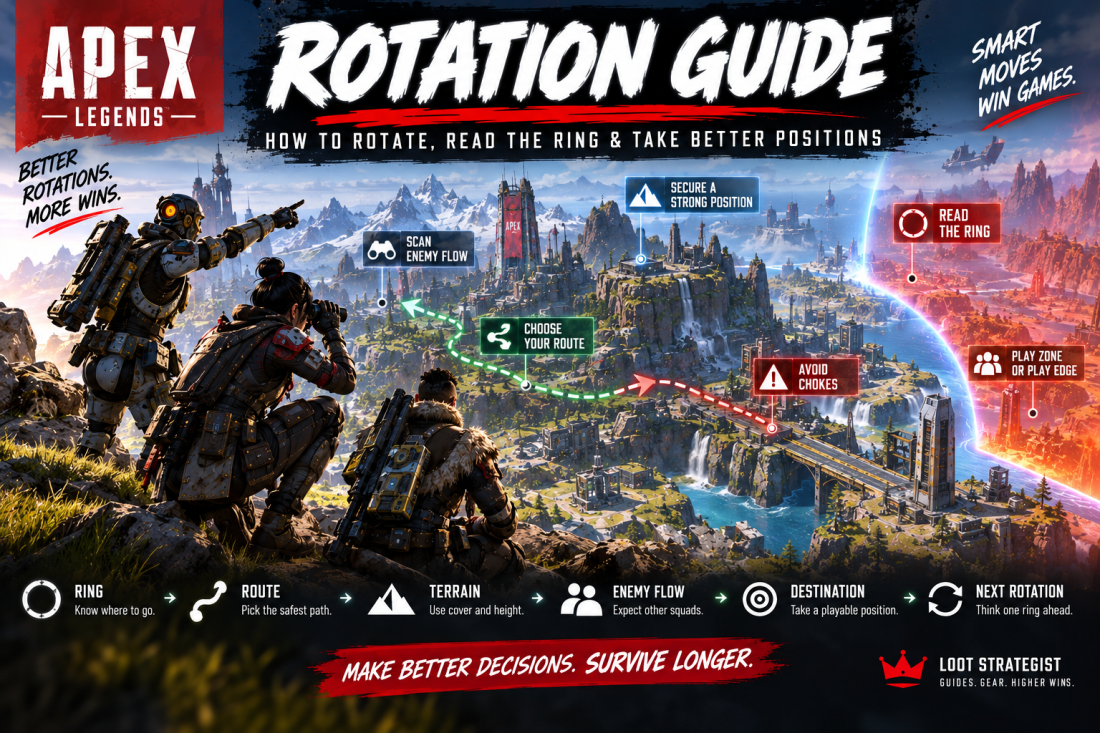
Apex Legends Rotation Guide: How to Rotate, Read the Ring & Take Better Positions
Rotating in Apex Legends is not simply a race toward the next Ring. It is the process of deciding where your squad should play, when it should move, which route gives you the best chance of arriving safely, and what other teams are likely to do along the way.
EA defines a rotation as moving from one area of the map to another while considering the Ring and your position relative to other squads. (EA Help)
That sounds simple. In an actual match, it is anything but.
A squad can have strong weapons and good mechanics and still lose because it rotated too late, crossed the wrong terrain, entered a predictable choke, or arrived at the Ring without a playable position.
The easiest way to improve is to stop thinking about rotation as “go to the circle” and start thinking about it as:
Ring → Route → Terrain → Enemy Flow → Destination → Next Rotation
That is the framework this guide uses.
What Is a Rotation in Apex Legends?
A rotation is any deliberate movement from one area of the map to another, usually because the Ring is shifting, your current position is becoming weaker, or another location offers better strategic value.
The distinction is important because moving and rotating are not necessarily the same thing.
Running across the map because the Ring is closing is movement.
Choosing a route, anticipating another squad, using cover, and arriving at a position you can actually defend is a rotation.
EA also uses two useful terms for different approaches:
Playing zone means moving inside the next zone early to secure a good position.
Playing edge means staying nearer the edge of the zone and looking for squads moving into it. (EA Help)
Neither approach is automatically correct. Good rotation is about choosing the option that makes sense for the situation in front of you.
The Loot Strategist Rotation Framework
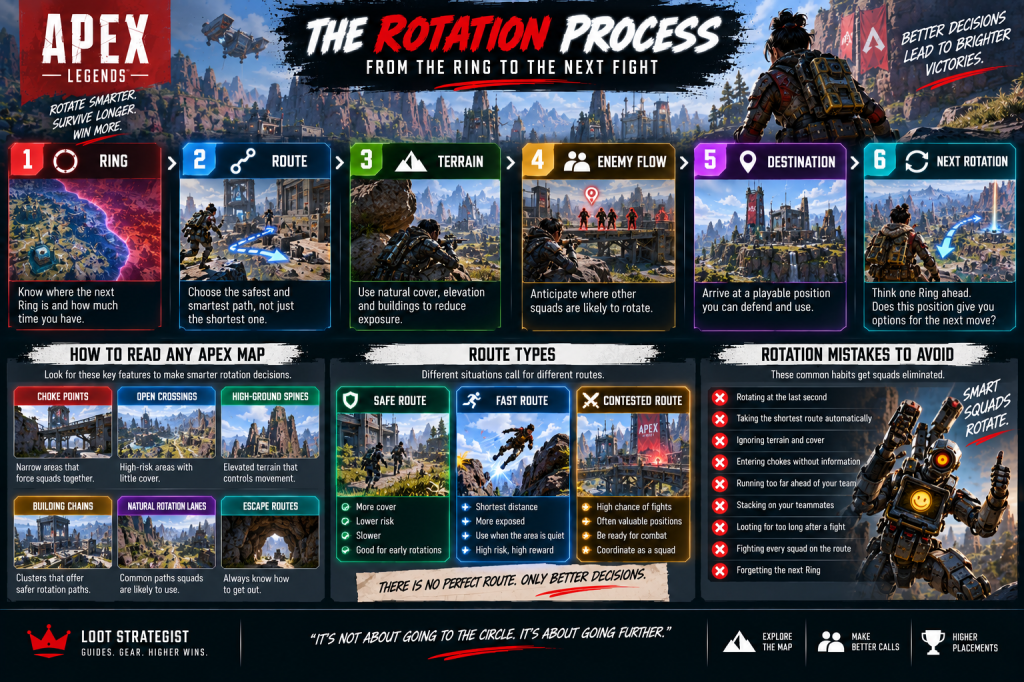
Before we get into individual situations, use this six-step framework whenever your squad needs to move.
1. Ring
Where is the next playable area?
2. Route
Which path gets you there with the least unnecessary exposure?
3. Terrain
What cover, elevation, buildings, chokes, and escape routes exist along that path?
4. Enemy Flow
Which routes are other squads likely to use?
5. Destination
Where do you actually want to play once you arrive?
6. Next Rotation
If the Ring moves again, does your new position give you options?
That final step is where many rotations fall apart. A position can be excellent for thirty seconds and terrible for the next Ring.
Think beyond the immediate move.
1. Read the Ring Early
The Ring should influence your decisions before it becomes an emergency.
EA describes the Ring as an area that shrinks during the match, with players outside it taking damage. (EA Help)
That makes the Ring more than a timer.
It is information.
When you check it, don’t stop at:
“Are we inside?”
Ask:
“Where do we want to be inside it?”
Then look at the space between your squad and that destination.
A short route across open ground may be worse than a slightly longer route through buildings and natural cover.
The earlier you recognize that difference, the more choices you have.
2. Choose a Destination, Not Just a Circle
One of the biggest upgrades you can make to your rotations is learning to distinguish being safe from being well positioned.
You can reach the Ring and still be in trouble.
Maybe you’re:
- below another squad,
- exposed from several directions,
- trapped against a cliff,
- sitting in a building with one exit,
- or already looking at another long rotation.
Instead, identify a playable destination.
A good destination usually gives your squad some combination of:
Cover
Useful sightlines
Defensible terrain
Multiple approaches
An escape route
A reasonable path toward the following Ring
You don’t need the mathematically perfect position.
You need one your squad can actually use.
3. Rotate Before the Route Becomes a Problem
Late rotations are not always avoidable. Making them your default is.
When you wait too long, the number of available routes shrinks.
The straightforward path may now be occupied.
A choke may have become a shooting gallery.
Another squad may have already taken the building you wanted.
And the route you finally choose may leave everyone sprinting through open terrain.
This is why early rotation is really about preserving choices.
You’re not necessarily trying to arrive first.
You’re trying to avoid reaching the point where the only option left is the bad one.
4. How to Read Any Apex Map
You do not need to memorize every rotation on every map to become better at rotating.
Instead, learn to identify the features that influence movement everywhere.
Choke Points
A choke funnels players through a limited path.
Bridges, narrow passes, tunnels, tight corridors, and constrained entrances can become natural confrontation points.
Whenever your route passes through one, consider who else is likely to use it.
Open Crossings
Large exposed areas are dangerous because they reduce the value of movement.
A squad that controls the surrounding high ground can punish almost anyone trying to cross.
When you spot an open crossing, ask:
Can we avoid it?
If not:
What cover can we use, and how quickly can we get across?
High-Ground Spines
Many areas have ridgelines, slopes, rooftops, or elevated terrain that naturally controls movement below.
These positions often matter more than the exact center of the Ring.
A squad that recognizes those terrain patterns early can arrive before the position becomes contested.
Building Chains
Clusters of buildings can create safer rotation paths than open terrain.
They also give your squad natural checkpoints.
Instead of thinking:
“Run from here to there.”
Think:
“Reach that building, reassess, then continue.”
That makes long rotations easier to manage.
Natural Rotation Lanes
Look at where players are forced to travel.
A location with several possible approaches is harder to predict.
A narrow entrance to a Ring or a major pass between terrain features is easier to anticipate.
Those predictable lanes are where enemy flow becomes especially important.
5. Pick the Route, Not the Straight Line
The shortest route and the best route are rarely identical.
When choosing between two paths, compare three things:
Exposure
How much time are you visible?
Predictability
How obvious is the route to another squad?
Flexibility
Can you change direction if someone is already there?
A slightly longer path can be much stronger if it gives your squad cover and another way out.
That does not mean you should always take the slow route.
Sometimes speed is exactly what matters.
The point is to choose deliberately.
6. Use Cover as a Chain
A useful way to visualize a rotation is as a chain:
Building → Rock → Wall → Slope → Building
Each step gives you another place to break line of sight or reassess the situation.
Compare that with:
Open field → Open field → Open field
The second route is simple, but it gives an enemy very few reasons not to shoot you.
Your Apex Legends Movement Guide covers the mechanics of moving efficiently. Rotation adds another layer: knowing where to move, not just how to move.
7. Terrain Matters More Than Distance
Two destinations can be the same distance away and have completely different value.
One might be:
- elevated,
- covered,
- defensible,
- connected to multiple routes.
The other might be:
- exposed,
- difficult to leave,
- surrounded by high ground,
- and separated from the next Ring by open terrain.
This is why experienced players often seem to “know” where to go before the Ring becomes urgent.
They are reading the terrain, not just the circle.
8. High Ground Is Good. Playable High Ground Is Better.
High ground gives you visibility and often better firing angles.
But height alone doesn’t make a position strong.
A hilltop with no cover and no escape can be worse than a lower position surrounded by hard cover.
When evaluating high ground, ask:
Can we survive here?
Can all three players support one another?
Can we leave?
Can we reach the next Ring from here?
If the answer is no to several of those questions, the extra elevation may not be worth taking.
9. Think About Enemy Flow
This is the part that separates basic Ring awareness from genuine rotation awareness.
Don’t only ask:
“Where is the Ring?”
Ask:
“Where are other squads likely to enter it?”
If a large section of the Ring can only be reached through one obvious choke, that route is likely to attract traffic.
If several major paths lead into the same area, predicting enemy movement becomes harder.
You do not need perfect information.
You’re making a probability judgment:
Where would another team go if it were standing where I am?
That question alone can make your rotations more intelligent.
10. Use Audio as Early Warning
Visual information is only part of the picture.
Gunfire, footsteps, abilities, healing, doors, and other sounds can tell you that a route is no longer as quiet as it looked from the map.
You may not know exactly where another squad is.
You don’t need to.
Knowing that there is likely activity ahead can be enough to change your route, slow down, or prepare for a fight.
A rotation should evolve when new information appears.
Never keep following the original plan simply because it was the original plan.
11. Chokes Deserve a Pause
A choke is not automatically a reason to turn around.
It is a reason to think before entering.
Before committing, consider:
Has there been recent gunfire?
Can another squad reach this route first?
Do we have cover approaching the choke?
Can we retreat if the other side is occupied?
Does another route exist?
Sometimes the direct path is still the right path.
The difference is that you’re entering it with your eyes open.
12. Stay Close Without Stacking
Good rotation spacing is a balance.
Your squad should be close enough that one player getting attacked does not become a solo fight.
But standing on top of each other creates another problem: one enemy angle can affect everyone at once.
Think in terms of support distance.
One player can move slightly ahead.
Another can hold the middle.
Another can cover a different angle.
The goal is not perfect formation.
The goal is that every player remains capable of helping the others quickly.
Your Apex Legends Squad Composition Guide goes deeper into team roles and synergy. Here, the important principle is simple: your rotation should preserve your squad’s ability to fight together.
13. Don’t Let Loot Destroy Your Rotation
Looting and rotation are connected.
A squad that has functional weapons, ammunition, shields, healing, and the basic resources it needs eventually reaches a point where another ten seconds of looting has diminishing value.
That becomes especially important when the Ring is moving.
Your Apex Legends Loot Guide goes deeper into loot priorities, but the rotation rule is straightforward:
An upgrade is only worth taking if its value justifies the time and risk required to get it.
You don’t need a perfect backpack before leaving.
You need enough equipment to survive what comes next.
14. Do Not Automatically Run Toward the Center
The center of the Ring can be useful.
It can also be a terrible place to stand.
The central area may attract several squads from different directions, while a slightly off-center position can offer better cover and a more manageable approach.
Don’t optimize for distance alone.
Optimize for:
Cover + information + support + escape options
A strong outer position can be better than a weak central one.
15. Play Zone or Play Edge?
EA describes these as two different approaches: playing zone means entering the next zone early to secure a position, while playing edge means staying near the edge and looking for squads rotating in. (EA Help)
Playing zone
This approach makes sense when the early position offers meaningful value.
You can establish yourself before other teams arrive and force later squads to make the difficult move.
Its weakness is that you may spend too long sitting in a location that isn’t actually strong.
Playing edge
This approach can work when you have a good opportunity to catch teams moving into the Ring.
Its weakness is timing.
Wait too long and the Ring stops being a strategic tool and starts becoming a problem.
The better question
Don’t ask:
“Which style is better?”
Ask:
“Which style gives us better options on this Ring?”
That keeps the decision contextual instead of turning it into a rigid rule.
16. Rotate Through Information, Not Blindly
A good route can become a bad route between one second and the next.
A squad appears.
Gunfire starts.
A teammate gets spotted.
The Ring shifts.
A destination becomes occupied.
When that happens, update the plan.
A strong rotation has checkpoints where you reassess.
For example:
Leave POI → reach cover → scan → continue or change route
That is safer than putting your head down and sprinting the entire distance.
17. Always Know Your Exit
Before settling into a new position, ask:
“If another squad appears here, where do we go?”
This is especially important for buildings and elevated terrain.
A position with one entrance and one exit can become a trap.
A position with multiple routes gives your squad more freedom when the situation changes.
You don’t need to know the exact escape path in advance.
You should at least know which direction you can retreat without crossing a death sentence.
18. Think One Ring Ahead
The strongest rotation question may be the simplest:
“What happens after we get there?”
A location can solve the current Ring but create a terrible next move.
Suppose you secure a comfortable building, but the next likely Ring requires a long exposed crossing.
That building may still be worth taking.
But now you know the next problem early.
You can prepare for it instead of discovering it when the timer is already running down.
A good rotation does not finish when you arrive.
It finishes when you have a plan for what happens next.
19. When Should You Rotate After a Fight?
Post-fight loot is one of the easiest ways to lose a good position.
You win the engagement.
Open the boxes.
Find an upgrade.
Find another upgrade.
Then another.
Meanwhile, the Ring moves and another squad hears the activity.
Use a quick reset:
Cover → Heal → Reload → Scan → Loot → Rotate
Sometimes the answer is to loot.
Sometimes the answer is to leave almost immediately.
The correct choice depends on:
- Ring timing,
- squad health,
- ammunition,
- enemy activity,
- position,
- and the value of the available loot.
Your objective is not to maximize the time spent looting.
It is to maximize the value of the fight you just won.
20. How Rotation Changes in Ranked
Ranked already has its own broader strategy on Loot Strategist, so this guide doesn’t need to duplicate it.
The rotation-specific lesson is simple:
risk should be deliberate.
A dangerous route may be worth taking when the alternative is worse.
What matters is understanding the trade.
Before crossing a questionable area, consider:
Can we reach safer terrain another way?
Are we strong enough to contest the route?
Is the destination valuable enough to justify the risk?
Your Apex Legends Ranked Guide covers the larger Ranked framework. This article should remain focused on the map-level decision itself.
A Simple Route Test
When two routes look reasonable, compare them using five questions:
Which route gives us more cover?
Prefer protection over unnecessary exposure.
Which route is easier for another squad to predict?
Predictable routes deserve more caution.
Which route gives us an alternate path?
Flexibility is valuable when information changes.
Which route lets us arrive in a useful position?
Reaching the Ring is not enough.
Which route leaves us a better next move?
Think beyond the current rotation.
This is faster and more useful than trying to memorize one “correct” rotation for every situation.
The Rotation Mistakes That Cost the Most
Waiting Until the Ring Is Forcing You to Move
You lose route choices.
Taking the Shortest Route Automatically
Distance is only one variable.
Ignoring Terrain
A route through cover can be dramatically safer.
Entering Chokes Without Information
You’re giving predictable terrain more power than it needs.
Running Too Far Ahead of Your Team
Your squad cannot support you.
Stacking on Your Teammates
One enemy angle can punish everyone.
Chasing the Perfect Position
A good, reachable position often beats a theoretically perfect one.
Fighting Every Squad on the Route
You control whether many of those fights happen at all.
Staying Too Long After a Fight
Loot becomes dangerous when the surrounding situation changes.
Forgetting the Next Ring
You solve today’s problem and create tomorrow’s.
The Best Way to Practice Rotations
Don’t try to master every map at once.
Instead, review your bad rotations.
After you die, ask one question:
Which part failed?
Was it the:
Ring?
Route?
Terrain?
Enemy flow?
Destination?
Next rotation?
That gives you a concrete problem to work on.
For example, if you keep reaching the Ring through exposed terrain, the problem probably isn’t your aim.
It’s route selection.
If you consistently arrive safely but end up trapped in poor positions, the problem is probably your destination.
If you repeatedly get surprised by teams using the same choke, you need to improve your understanding of enemy flow.
This is much more productive than simply playing more matches and hoping the answer appears.
A Beginner Rotation Checklist
Before leaving an area, ask:
Where is the Ring?
Where do we actually want to play?
Which route has the best mix of cover and flexibility?
Where are other squads likely to travel?
What position will we take when we arrive?
Where do we go after that?
You don’t need to say all six questions aloud.
After enough practice, they become part of your decision-making automatically.
Apex Legends Rotation Cheat Sheet
Before the rotation
Check the Ring → choose a destination → identify the route.
During the rotation
Stay together → use cover → watch enemy flow → reassess when new information appears.
When you arrive
Secure playable terrain → establish support angles → scan for threats → prepare for the next move.
After a fight
Cover → Heal → Reload → Scan → Loot → Rotate.
When uncertain
Choose the option that preserves the most choices.
Final Thoughts
Good rotation is not about knowing one perfect path across an Apex map.
It is about making better decisions with incomplete information.
Read the Ring early.
Choose a destination instead of blindly running toward the circle.
Treat terrain as part of the route.
Think about where other squads are likely to travel.
Arrive somewhere your team can actually fight from.
And before you settle in, ask where the next rotation will take you.
The biggest upgrade is changing the question from:
“How do we get into the Ring?”
to:
“Where do we want to play, and what is the safest useful way to get there?”
That is the difference between simply moving around the map and actually rotating.
Frequently Asked Questions
What does rotating mean in Apex Legends?
Rotating means moving from one area of the map to another while considering the Ring and your position relative to other squads. (EA Help)
Should I always rotate early?
Not necessarily. Early movement can preserve route choices and help you secure useful terrain, but rotating too early can also put you into an area before you understand what is happening around it. The right timing depends on the Ring, terrain, enemy activity, and your destination.
Is playing zone better than playing edge?
Neither is universally better. EA defines playing zone as moving inside the next zone early for a good position and playing edge as staying near the edge to target squads moving into the zone. (EA Help) Choose the approach that gives your squad the stronger options on that particular Ring.
Should I always take high ground?
No. High ground is valuable when it gives you useful sightlines, cover, support, and escape options. A high position with no protection or poor access to the next Ring can be weaker than a lower but more playable location.
How do I know which rotation route is safest?
Look at more than distance. Consider cover, exposure, predictable chokes, enemy flow, alternate routes, and the position waiting for you at the end.
Should I fight a squad blocking my rotation?
Not automatically. Consider whether you can go around them, whether your squad has the advantage, and whether the destination is worth the risk. The fact that another team occupies your preferred route does not mean you are required to take the fight.
How can beginners improve their rotations?
After a bad death, identify whether the problem was Ring timing, route choice, terrain, enemy flow, destination, or planning for the next Ring. Fix one recurring problem at a time rather than trying to change everything simultaneously.
Sources & Updates
Last reviewed: September 9, 2026
EA’s current Apex Legends Terms Guide was used to verify the definitions of Ring, Rotate, Playing Zone, Playing Edge, and Map Rotation. (EA Help)
EA’s Season 30: Marked Patch Notes were checked for the current Battle Royale map context. The current listed rotation is World’s Edge, Storm Point, and E-District; because map availability and layouts can change, this article deliberately focuses on rotation principles that remain useful across map rotations. (EA)
The strategic recommendations in this article—including route evaluation, terrain reading, enemy-flow prediction, destination selection, and next-rotation planning—are Loot Strategist editorial guidance, not official EA rules.
For related strategy, see the Apex Legends Beginner Guide, Apex Legends Movement Guide, Apex Legends Loot Guide, Apex Legends Squad Composition Guide, and Apex Legends Ranked Guide.

