PS6 Hardware Analysis: Inside Codenamed ‘Orion’, GDDR7 Memory Architecture, and the $960 Silicon Cost
Executive Summary: Sony’s unannounced PlayStation 6 is shaping up to be one of the most technologically ambitious—and economically complex—console launches in modern gaming history. Leaked AMD engineering documents describe a 3nm system-on-chip codenamed “Orion” built around Zen 6 CPU cores and RDNA 5 graphics. However, a transition to high-speed GDDR7 memory and a global DRAM supply crunch driven by AI infrastructure demand have inflated component costs, driving the estimated Bill of Materials (BOM) to nearly $960 and forcing Sony to evaluate a delayed release window of 2028 or 2029.
1. What Is PS6 “Orion”? Architectural Deep Dive
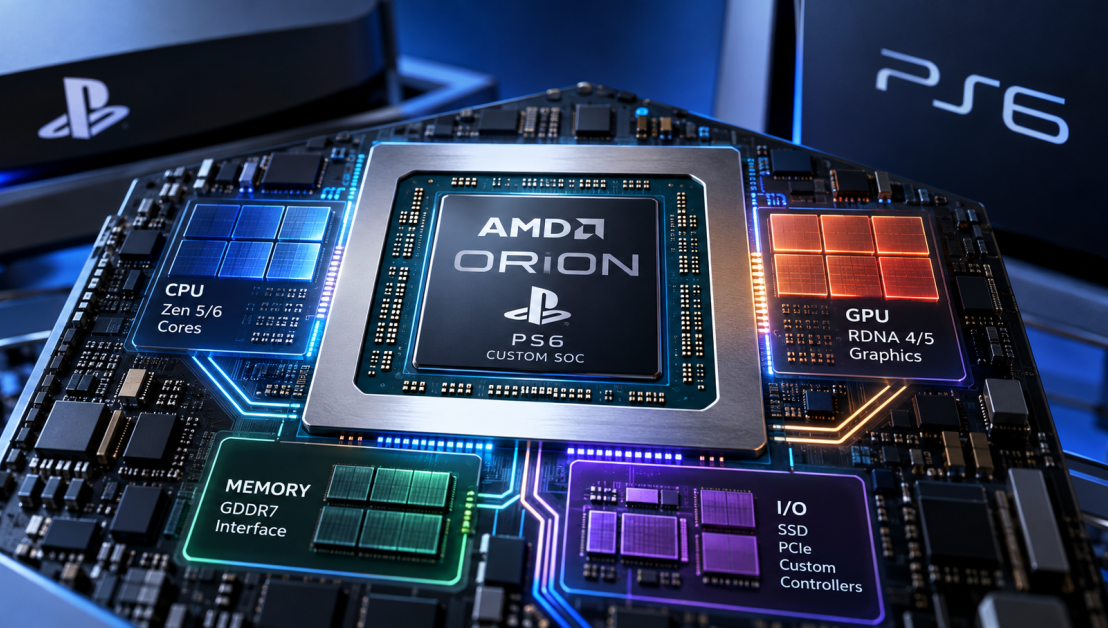
While Sony has not formally announced the PlayStation 6, hardware leaks from reputable semiconductor channels point to an AMD semi-custom system-on-chip (SoC) codenamed Orion. Continuing a partnership that began with the PS4 in 2013, AMD is designing the silicon, which combines CPU and GPU blocks on a single monolithic die.
According to hardware documentation corroborated by tech publications TechSpot and TweakTown, Orion is targeted for TSMC’s 3nm process node with a die area of approximately 280mm² and a Thermal Design Power (TDP) capped near 160W (roughly 60W higher than the launch PS5):
CPU Microarchitecture: The central processor leverages AMD’s Zen 6 architecture, featuring 7 to 8 high-efficiency Zen 6c cores alongside dedicated low-power (LP) cores running at up to 3.0 GHz to handle operating system and background tasks seamlessly.
GPU & Ray Tracing Engine: Graphics are powered by RDNA 5 with 54 physical Compute Units (CUs), 52 of which are active (two disabled for manufacturing yield protection). Clocks run between 2.6 GHz and 3.0 GHz, supported by 10MB of L2 cache, delivering an estimated 34 to 40 TFLOPS of raw compute throughput. Ray tracing performance is rumored to achieve a 6x to 12x leap over baseline PS5 hardware.
2. GDDR7 vs. GDDR6: The Memory Architecture Breakdown
The shift from the PlayStation 5’s GDDR6 memory to GDDR7 represents one of the most substantial architectural leaps in next-generation console hardware.
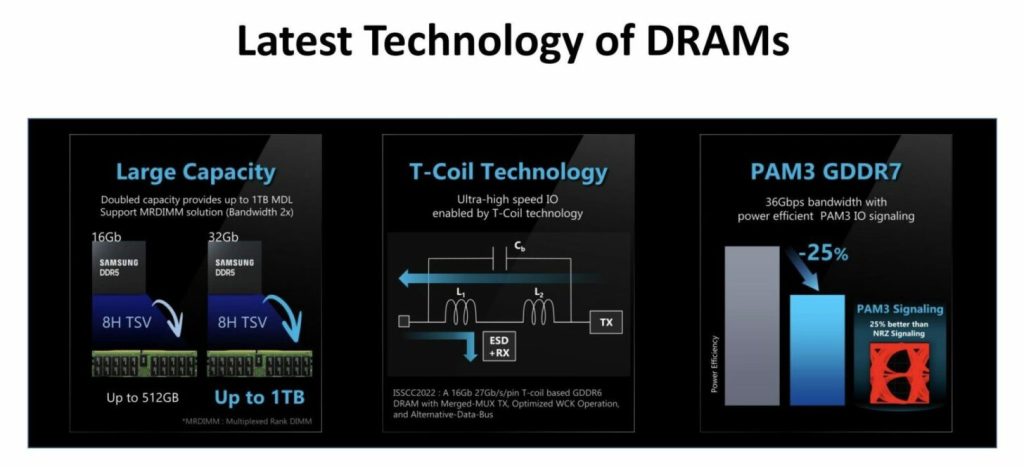
GDDR7 utilizes PAM3 signaling to deliver higher bandwidth with improved power efficiency. Source: Wccftech
PAM3 Encoding vs. Legacy NRZ Signaling
The primary technical breakthrough of GDDR7 lies in its physical layer signaling protocol:
GDDR6 (NRZ / PAM2): Uses Non-Return-to-Zero (NRZ) signaling, transmitting 1 bit of data per cycle using two voltage levels (0 or 1). As signal frequencies scale beyond 20–24 Gbps, noise and signal attenuation on standard printed circuit boards (PCBs) degrade reliability significantly.
GDDR7 (PAM3): Adopts Pulse Amplitude Modulation 3-level (PAM3) encoding. By using three distinct voltage levels (-1, 0, +1), PAM3 transmits 3 bits of data over 2 clock cycles (1.5 bits per cycle). This achieves a 50% increase in data transmission efficiency over NRZ at the same operating clock frequency.
GDDR6 (NRZ / 2-Level): [ High ] -> 1 [ Low ] -> 0 (1 bit / cycle)
Because PAM3 reduces signal attenuation at high clock frequencies, GDDR7 memory modules can achieve speeds of 32 Gbps to 36 Gbps per pin, compared to GDDR6’s practical ceiling of 20–24 Gbps:
Massive Bandwidth Increase: On a rumored 160-bit memory bus running at 32 Gbps, the PS6 would achieve approximately 640 GB/s of bandwidth—a 43% boost over the PS5’s 448 GB/s (and significantly higher than standard desktop GPU configurations).
Power Efficiency: PAM3 signaling lowers the operating voltage and energy consumption per bit transmitted by roughly 20% to 25% compared to high-frequency GDDR6, keeping thermal output manageable within a console form factor.
Why GDDR7 Is Critical for Next-Gen Ray Tracing & AI Upscaling
Next-gen visual pipelines depend heavily on rapid memory access, far beyond what CPU and GPU compute cycles alone provide:
Complex Ray Tracing BVH Traversal: Real-time ray tracing requires continuous queries against Bounding Volume Hierarchy (BVH) structures stored in system RAM. GDDR7’s ultra-low latency and ~640 GB/s bandwidth prevent the GPU execution units from stalling during dense ray-triangle intersection checks.
Neural Upscaling (PSSR 2.0): Machine learning models (such as PlayStation Spectral Super Resolution) rely on high-throughput tensor operations that pull multiple high-resolution frame buffers, motion vectors, and temporal data arrays simultaneously. GDDR7 ensures the NPU hardware receives data streams without creating memory bottlenecks.
Memory Architecture & PSSR 2.0
The platform transitions from GDDR6 to high-speed GDDR7 memory, configured between 30GB and 40GB on a 160-bit bus running at 32Gbps. This yields approximately 640 GB/s of bandwidth—a ~43% increase over the PS5’s 448 GB/s. Dedicated neural processing units (NPU) will drive an expanded AI upscaling pipeline, provisionally designated PSSR 2.0 (PlayStation Spectral Super Resolution).
Hardware Comparison: PlayStation 5 vs. Rumored PS6 “Orion”
Specification
PlayStation 5 (2020)
PS6 “Orion” (Rumored / Unconfirmed)
Manufacturing Process
TSMC 7nm
TSMC 3nm
CPU Architecture
8x Zen 2 cores @ 3.5 GHz
7-8x Zen 6c + LP cores @ up to 3.0 GHz
GPU Architecture
RDNA 2
RDNA 5
Compute Units (CUs)
36 CUs
52 active CUs (54 physical)
Raw Compute
10.28 TFLOPS
34 – 40 TFLOPS
Memory System
16GB GDDR6 (NRZ)
30GB – 40GB GDDR7 (PAM3)
Memory Bandwidth
448 GB/s
~640 GB/s
Thermal Target (TDP)
~100W – 115W
~160W
3. The $960 Component Cost & Semiconductor Economics
The defining challenge for the next console generation is not raw silicon engineering, but macroeconomics in the memory market.
Industry analyst David Gibson (MST Financial) and Sony CEO Hiroki Totoki have both noted that global demand for high-bandwidth memory (HBM) and enterprise DRAM in AI data centers is straining consumer semiconductor supply chains. Speaking to investors, Totoki acknowledged that memory pricing is expected to remain significantly elevated through fiscal year 2027.
March 2026 (Initial BOM Estimate): ~$760
│
▼ +~$200 Memory & Silicon Price Inflation
June 2026 (Revised BOM Estimate): ~$960
Prominent hardware leaker Kepler_L2 initially estimated the PS6 Bill of Materials (BOM)—the direct cost of individual components prior to assembly, shipping, software licensing, and retailer margins—at approximately $760 in March 2026. By late June 2026, driven by spiking GDDR7 and wafer costs, Kepler_L2 revised that figure upward by $200 to ~$960.
4. Timeline Realignment: Why 2028 or 2029 Is Now the Likely Window
The shifting component landscape has directly altered Sony’s internal release target timeline over the past 12 months:
├─ Sony CEO Statement: No Fixed Launch Date or Price
│
Current Industry Consensus: 2028 – 2029 Release Window
Early Projections: Early supply chain indications pointed to a late-2027 production ramp and holiday launch window.
Mid-Term Corrections: As memory cost pressures intensified, reporting from Bloomberg indicated Sony was evaluating a push into 2028 or 2029.
Official Stance: Sony leadership maintains that no release date or pricing structure has been finalized. Sliding the release date back allows memory fab capacity to normalize and reduces the risk of launching a console priced out of reach for core consumers.
5. Companion Strategy: “Project Canis” Handheld
To complement its flagship home console, leaks point to a standalone handheld device codenamed Project Canis. Unlike the PlayStation Portal (which relies exclusively on remote streaming), Canis is designed to run PlayStation games natively.
Architecture: Scaled-down Zen 6c CPU (4x Zen 6c + 2x Zen 6 LP cores) paired with an RDNA 5 GPU and 16GB to 24GB of LPDDR5X memory.
Performance Target: In docked mode, Canis is rumored to achieve 55%–75% of the baseline PS5’s rasterization performance and up to 2.6x its ray tracing output on a 1080p (60Hz/120Hz) display.
Software Ecosystem: The device is expected to leverage a native firmware “Low Power Mode” recently integrated into the PS5 operating system, enabling full backward compatibility with native PS4 and PS5 titles.
Fact Check & Summary Breakdown
Question
Status
Details
Has Sony officially announced PS6?
❌ Unconfirmed
Sony has not formally named, displayed, or scheduled the console.
What is the reported codename?
🔍 Orion
Leaked AMD engineering documents identify the semi-custom SoC as “Orion.”
What is the current release window?
📅 2028 – 2029
Pushed back from earlier 2027 targets due to DRAM memory supply constraints.
How much will it cost?
💰 TBD (BOM ~$960)
Component cost leaks point to ~$960; retail strategy will balance subsidy vs. consumer demand.
Will it support backward compatibility?
🔄 Likely Yes
Architecture continuity (AMD x86-64 + Zen/RDNA) strongly supports backward compatibility with PS5 and PS4 libraries.
7. Frequently Asked Questions (FAQ)
Has Sony officially announced the PlayStation 6?
No. Sony has not officially announced, named, or scheduled a release date for the PlayStation 6. All specifications, internal codenames (“Orion”), and pricing figures stem from semiconductor supply chain leaks, analyst reports, and AMD engineering roadmaps.
What is the codename “Orion”?
“Orion” is reported to be the internal codename for the custom System-on-Chip (SoC) being developed by AMD for Sony’s next console, continuing the lineage of PS4’s “Liverpool” and PS5’s “Oberon.”
Why is the release date expected to be pushed to 2028 or 2029?
While earlier leaks targeted late 2027, an unprecedented global shortage of DRAM and GDDR memory—driven by heavy AI data center demand—has inflated component manufacturing costs. Pushing the console’s launch to 2028 or 2029 gives memory fabrication plants time to normalize supply and lower production costs.
How much will the PS6 cost at retail?
While the estimated Bill of Materials (BOM) has reached ~$960 according to leaker Kepler_L2, retail pricing has not been set. Analysts at Newzoo anticipate Sony will attempt to keep the final consumer price under $999 by subsidizing initial hardware units and recouping costs through digital game sales and PlayStation Plus subscriptions.
Will the PS6 be backward compatible with PS5 and PS4 games?
Yes. Because the PS6 uses AMD’s x86-64 CPU architecture and RDNA graphics architecture, native backward compatibility with existing PS5 and PS4 software libraries is an architectural certainty.
What is “Project Canis”?
Project Canis is the rumored internal codename for a dedicated PlayStation handheld device. Powered by AMD Zen 6c and RDNA 5 silicon, it is designed to run native PS4 and PS5 games on a 1080p portable screen rather than relying on cloud or remote play streaming.