
In Apex Legends, winning a gunfight isn’t always about who lands the first shot. Sometimes it’s about who reaches cover first, who takes the better angle, or who can make the other player miss while keeping their own crosshair on target.
That is why movement matters so much.
You don’t need to master every flashy movement technique to become a better Apex player. In fact, most players will see bigger improvements by learning a few fundamentals—sprinting efficiently, sliding at the right time, strafing while shooting, and using terrain intelligently—before worrying about advanced mechanics.
This Apex Legends movement guide covers those fundamentals first, then moves into more advanced techniques and practical drills you can use in the Firing Range.
Why Movement Matters in Apex Legends
Apex Legends is built around momentum, positioning, and fast engagements. Movement helps you do much more than travel around the map.
Good movement can help you:
- Reach cover before an enemy finishes their reload.
- Make yourself harder to track during a close-range fight.
- Change angles without giving an opponent an easy target.
- Escape a bad engagement.
- Take high ground or stronger defensive positions.
- Stay with your squad during rotations.
- Create better opportunities for your own shots.
EA’s beginner guidance specifically recommends sprinting rather than walking, holstering your weapon while travelling, sliding down declines, and using movement options such as launch pads and ziplines to travel efficiently.
The important distinction is that fast movement isn’t automatically good movement.
If you sprint into an open area with no cover, slide past your teammates, or chase an enemy into a bad position, moving quickly won’t save you. The best movement supports your positioning rather than replacing it.
Apex Legends Movement Basics
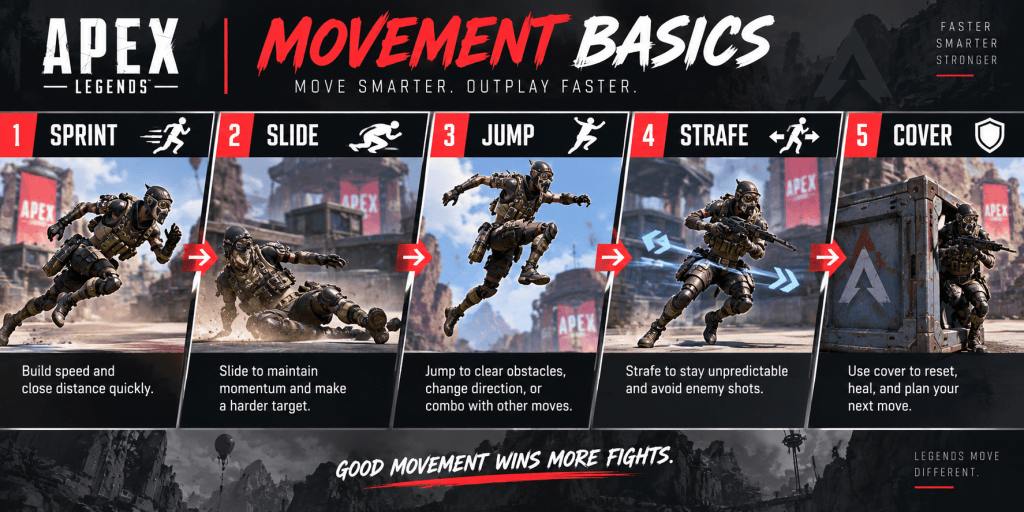
Before learning advanced techniques, make sure the basic movement loop feels natural.
Sprinting
Sprinting is your default way of moving around the map.
Use it when rotating between locations, repositioning during a fight, or closing distance when you aren’t actively aiming.
One simple habit is worth developing early: don’t walk when you could safely sprint.
There is little benefit to moving slowly through open areas when you’re not trying to maintain a specific firing position.
Holstering Your Weapon
Holstering your weapon lets you move faster while travelling.
It is particularly useful when:
- Rotating toward the next Ring.
- Catching up with your squad.
- Crossing a relatively safe area.
- Retreating from a fight.
- Moving between buildings.
You don’t want to spend the entire match with your weapon holstered, though. If you expect an enemy around the next corner, having your weapon ready is more important than squeezing out a little extra movement speed.
That small decision—weapon out or weapon holstered—becomes increasingly important as you improve.
Sliding
Sliding is one of the most useful movement mechanics for beginners.
A basic slide lets you maintain momentum while lowering your character’s profile and moving quickly across suitable terrain.
The easiest way to understand sliding is to think about momentum, rather than treating it as a button you press constantly.
Use slides when terrain and positioning make them useful. Sliding down a slope, for example, can help you cover ground quickly. Sliding across flat terrain can also help you change your position during a fight, but doing it repeatedly without a purpose can make your movement predictable.
Slide Jumping
Slide jumping combines a slide with a jump to preserve momentum and cover ground efficiently.
A simple practice routine is:
- Sprint forward.
- Start a slide.
- Jump near the end of the slide.
- Continue sprinting once you land.
- Repeat the sequence.
Don’t worry about performing it perfectly at first. The goal is to make the transition feel automatic.
Once you stop thinking about every individual input, you can concentrate more on where you’re actually going.
Strafing: The Movement Skill You Should Learn First
Strafing is moving sideways while keeping your aim on an opponent.
It sounds simple, but effective strafing is one of the most important skills in Apex.
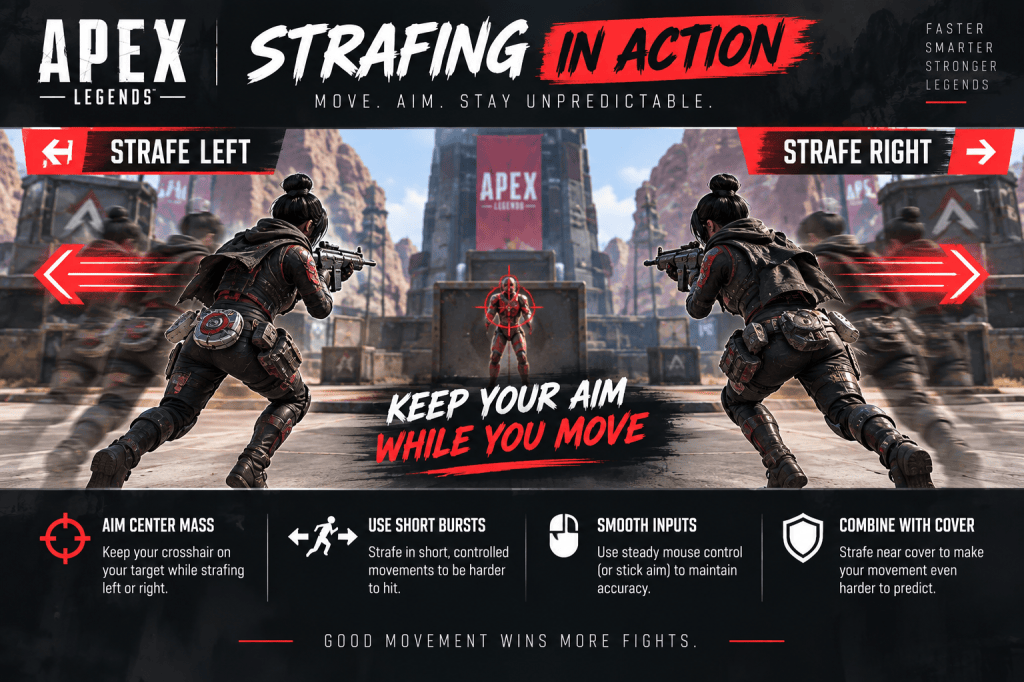
When you’re standing still and shooting, your opponent has a much easier target. When you’re moving unpredictably while maintaining your aim, they have to constantly adjust.
How to Practice Strafing
Start in the Firing Range.
Pick a target and move left and right while keeping your crosshair around the target’s upper body.
Don’t immediately try to move as quickly as possible.
Instead, focus on three things:
- Keep your crosshair on the target.
- Change direction without losing control.
- Avoid falling into an obvious left-right rhythm.
Once you can track a stationary target comfortably, increase the difficulty by shooting while moving and then practicing against moving targets.
EA also recommends using the Firing Range to practice aim, tracking, recoil control, and other mechanical skills.
Don’t Strafe Like a Metronome
One common beginner habit is moving left, then right, then left, then right at exactly the same pace.
That looks like movement, but it isn’t particularly difficult to predict.
Instead, vary your timing.
Move one direction for a moment, change direction, briefly adjust your movement, and occasionally use the environment to break the opponent’s line of sight.
Your objective isn’t to look flashy.
Your objective is to make your opponent’s next shot harder.
Crouching and Changing Your Height
Crouching can be useful during fights, particularly when combined with strafing.
Changing your character’s height can disrupt an opponent’s tracking and create awkward situations in close-range fights.
However, constantly crouch-spamming isn’t a substitute for good positioning.
If you are fighting beside a piece of cover, for example, changing your height while moving around that cover can be much more useful than repeatedly crouching in the open.
Think about where your opponent expects you to be.
Good movement often comes from making small changes that force them to adjust their aim.
Use Cover as Part of Your Movement
One of the biggest mistakes newer players make is treating movement and positioning as separate skills.
They aren’t.
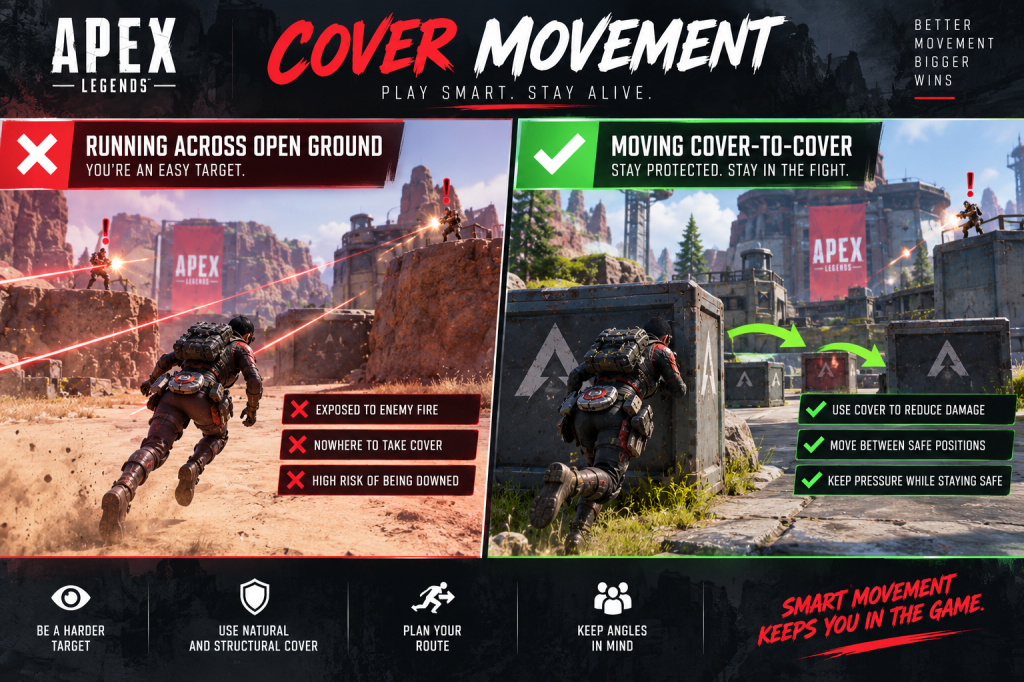
Imagine you’re fighting an enemy outside a building.
You could strafe around in the open and hope your movement is enough to keep you alive.
Or you could move between the doorway, wall, box, rock, or other available cover while taking shots.
The second option gives your movement a purpose.
Try to build the habit of asking:
“Where am I moving next if I get shot?”
If you don’t have an answer, your current position may already be too exposed.
Movement During a Gunfight
Movement becomes much more valuable when combined with shooting.
Close-Range Fights
At close range, standing still is usually a bad idea.
Use strafing, crouching, short slides, and nearby cover to make yourself harder to track.
But don’t sacrifice your aim just to move constantly.
There is a point where excessive movement makes your own shots worse.
A useful rule is:
Move enough to make yourself difficult to hit, but not so much that you can’t control your weapon.
That balance is more valuable than performing complicated movement techniques.
Reloading
Reloading creates a vulnerable moment.
Rather than standing in the open while your weapon reloads, use the time to:
- Move behind cover.
- Change your angle.
- Strafe toward safety.
- Break the enemy’s line of sight.
- Create enough distance to reset the fight.
The same principle applies when healing.
Don’t automatically heal in the exact location where you took damage. If the enemy knows where you are, reposition first whenever the situation allows it.
Moving While Healing
Healing is another opportunity to think about movement.
If you’re behind solid cover, stay protected.
If your cover is weak or the enemy has an angle on it, consider repositioning before committing to a longer heal.
The goal isn’t to constantly run around while healing. It’s to avoid giving an opponent an easy prediction.
Advanced Apex Legends Movement Techniques
Once the basics become comfortable, you can start experimenting with more advanced movement.
However, there is an important warning here: Apex movement mechanics have changed over the game’s lifespan.
Old movement tutorials can remain popular long after the underlying mechanics have been adjusted. Respawn has previously made changes to tap-strafing and specifically described its intention to alter rapid directional inputs associated with the technique.
For that reason, treat older movement tutorials with caution and verify advanced techniques against current patch notes or in-game behavior before building your playstyle around them.
Bunny Hopping
Bunny hopping refers to maintaining momentum through repeated jumps and movement inputs.
It has historically been used to make certain movement situations more fluid, particularly when repositioning or combining movement with healing.
The exact usefulness and execution of movement techniques can change as Apex evolves, so don’t make bunny hopping your first priority.
If your basic slide jumps and strafing aren’t consistent yet, you’ll get more value from practicing those skills.
Tap-Strafing
Tap-strafing is one of the most well-known advanced Apex movement techniques, particularly among mouse-and-keyboard players.
The term has also been used to describe slightly different movement behaviors, which is one reason older guides can become confusing.
Respawn has previously discussed changes targeting rapid directional commands after jumping, including the movement behavior commonly associated with scroll-wheel tap-strafing.
Because Apex is continuously updated, don’t assume that an old tap-strafing tutorial still describes the current implementation.
If you’re interested in learning it, check the latest game behavior and patch notes first.
Wall Bouncing
Wall bouncing involves using a wall and jump input to redirect your movement.
It can be useful for changing direction quickly or creating an unexpected angle during a fight.
But again, mechanics should come after fundamentals.
A player who can consistently strafe, use cover, slide, and maintain accurate aim will generally benefit more from those skills than a player who knows several flashy techniques but can’t win a basic close-range duel.
Movement and Aim Have to Work Together
Movement is only half of the equation.
If you’re moving perfectly but your crosshair is nowhere near the enemy, you’re not accomplishing much.
When practicing movement, deliberately combine it with aim.
Try this:
- Pick a target in the Firing Range.
- Strafe left and right.
- Keep your crosshair around the target’s upper body.
- Fire short bursts.
- Change direction.
- Repeat without stopping your tracking.
Once that feels comfortable, add slides and jumps.
This gradually teaches your hands to coordinate movement and aiming rather than treating them as two separate skills.
EA’s current PC guidance also emphasizes tracking, crosshair placement, recoil control, and regular Firing Range practice.
Movement for Rotations and Team Play
Movement isn’t only for winning 1v1 fights.
It also affects how effectively your squad rotates around the map.
Apex rewards teams that move together and avoid unnecessary exposure. EA recommends staying close to your squad and using movement options to avoid falling behind.
If your teammates are rotating, don’t take an unnecessary detour just because you spotted some loot.
If you’re crossing an open area, think about the safest route rather than simply taking the shortest one.
If the Ring is closing, holster your weapon when appropriate and focus on getting your squad into a good position.
Movement becomes much more powerful when your entire team arrives at the next fight together.
The Biggest Movement Mistakes Beginners Make
Learning what not to do can save you a lot of time.
1. Moving Constantly Without a Purpose
Movement isn’t automatically useful just because you’re moving.
If you’re already behind cover, there may be no reason to sprint around.
Sometimes the strongest position is simply the one that gives you the best angle and protection.
2. Prioritizing Speed Over Cover
Running quickly into an open area can put you in a worse position than moving slowly between pieces of cover.
Don’t confuse mobility with safety.
3. Practicing Advanced Mechanics Too Early
It’s tempting to spend hours learning complicated movement because it looks impressive.
But if your strafing, slide jumping, aim, and positioning are inconsistent, advanced techniques shouldn’t be your main focus yet.
Build the foundation first.
4. Repeating the Same Movement Pattern
Predictable movement is easy to punish.
If you always strafe in the same direction, always slide at the same distance, or always take the same route around cover, experienced opponents can anticipate you.
5. Forgetting Your Squad
Apex is a team game.
Being mechanically fast doesn’t help much if you leave your teammates behind and start a fight alone.
Stay close enough that your squad can support you when an engagement begins.
A Simple Apex Legends Movement Practice Routine
You don’t need a complicated training schedule.
Spend 10–15 minutes in the Firing Range before playing if you want to work specifically on movement.
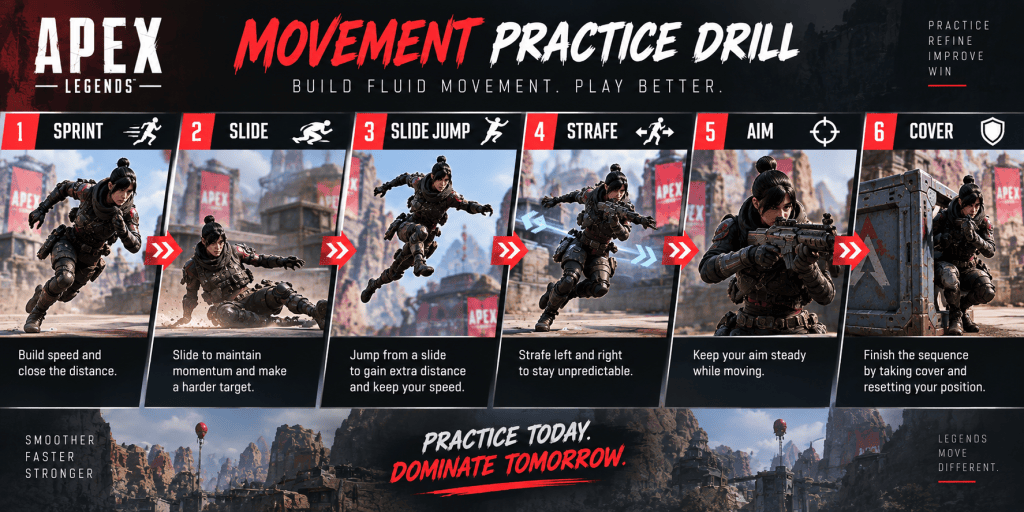
Drill 1: Slide Jumps
Spend a few minutes moving around the range using sprint → slide → jump.
Focus on consistency rather than speed.
Drill 2: Strafing
Choose a target and strafe from side to side while keeping your crosshair on it.
Change your timing occasionally.
Drill 3: Movement + Shooting
Shoot while strafing.
Concentrate on keeping your aim stable while changing direction.
Drill 4: Cover
Move between pieces of cover and practice exposing yourself only long enough to take shots.
This teaches an important habit: movement should create safer opportunities, not simply make you harder to hit.
Drill 5: Apply It in Real Matches
Finally, stop practicing and play.
Movement needs to become useful under pressure.
A mechanic that works perfectly against a stationary target can feel completely different when you’re low on health, being pushed by a squad, and trying to reach cover.
That is why actual matches are part of the practice process.
Which Apex Legends Are Best for Learning Movement?
Some Legends naturally encourage players to think more about mobility.
Octane
Octane is an obvious choice for movement-focused players because his kit is built around speed and mobility.
His Stim and Launch Pad make it easier to experiment with aggressive repositioning and fast rotations.
If you’re learning how to use movement to create openings, Octane is a natural Legend to explore.
Related article: Apex Legends Octane Guide: Abilities, Tips & Beginner Strategies
Pathfinder
Pathfinder rewards players who pay attention to terrain and positioning.
His mobility encourages you to think vertically and look for creative routes around the map.
Wraith
Wraith’s kit can complement players who enjoy taking aggressive angles and quickly disengaging from dangerous situations.
However, you don’t need a mobility-focused Legend to learn good movement.
The fundamentals apply to every Legend.
Apex currently divides Legends into five classes—Assault, Controller, Recon, Skirmisher, and Support—with Skirmishers specifically focused on fast-paced combat and mobility.
Apex Legends Movement Settings
Your settings can affect how comfortable movement feels.
Rather than copying a professional player’s configuration exactly, start with controls that feel natural and make it easy to access the inputs you use most.
Controller players can also explore Advanced Look Controls if they want more control over aiming and movement. EA describes ALC as settings that provide greater control over these areas.
The most important thing is consistency.
If you constantly change sensitivity, button layouts, or movement settings, it becomes harder to develop reliable muscle memory.
Find a setup that feels comfortable and give yourself time to learn it.
The Movement Rule Most Beginners Get Wrong
Here’s the biggest lesson to take away from this guide:
The best movement isn’t necessarily the fastest movement.
Good movement helps you accomplish something.
Maybe you’re moving toward cover.
Maybe you’re breaking an enemy’s line of sight.
Maybe you’re creating a better angle.
Maybe you’re dodging shots while maintaining your aim.
Maybe you’re rotating with your squad before another team can take the position you want.
If you can’t explain why you’re moving, there’s a good chance you’re moving too much.
That mindset will take you further than memorizing a list of advanced techniques.
Final Thoughts
Apex Legends movement can look intimidating when you watch highly skilled players chaining together advanced mechanics, but you don’t need to master everything at once.
Start with the fundamentals:
- Sprint efficiently.
- Holster your weapon when travelling safely.
- Learn consistent slide jumps.
- Practice strafing while aiming.
- Use cover instead of relying purely on speed.
- Change your movement patterns so you’re harder to predict.
- Move with your squad.
- Practice advanced techniques only after the basics feel natural.
Once those habits become automatic, you can start experimenting with more advanced movement mechanics.
And remember that Apex is a live-service game. Movement mechanics can be adjusted over time, so older tutorials aren’t always reliable sources for current techniques. Keep an eye on current updates when learning mechanics such as tap-strafing or other advanced movement techniques.
The goal isn’t to become the flashiest player in the lobby.
It’s to become the player who is consistently in the right place, at the right time, with enough control to win the fight.
 Gaming Guides, Builds, Loot & Strategies