
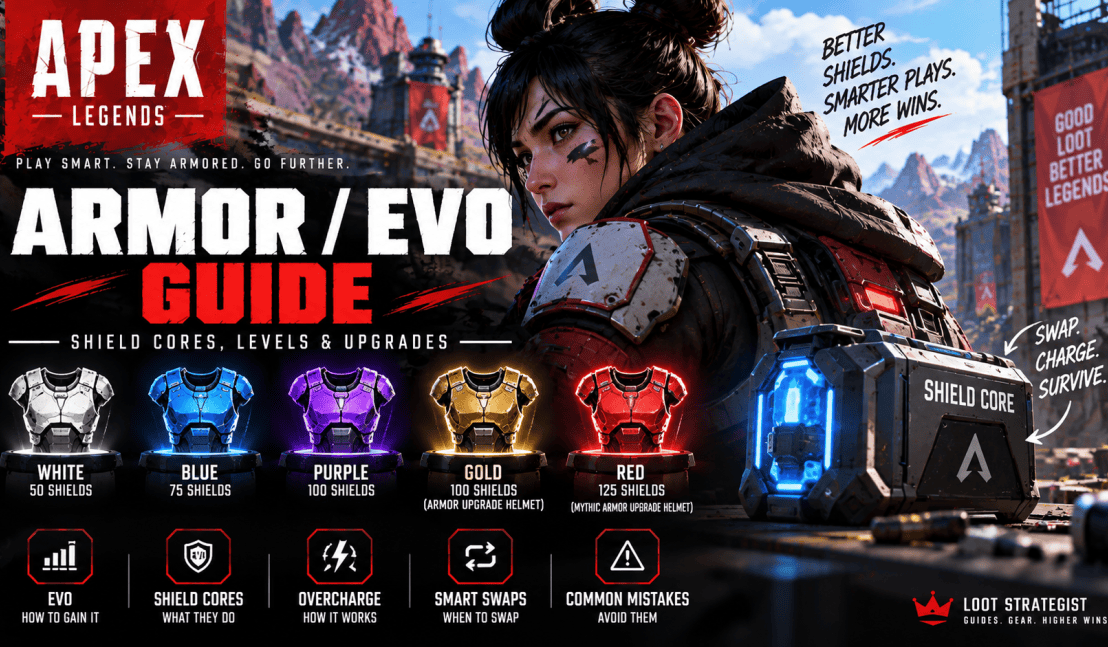
Apex Legends Armor & EVO Guide: Shield Cores, Levels & Upgrades
Armor can be the difference between surviving a bad peek and winning the fight that follows. In Apex Legends, though, armor is no longer as simple as finding the best-colored shield in a death box.
In the current Core Battle Royale and Ranked systems, your armor progresses through EVO and Legend Levels, while a Shield Core provides the charge that fills your shields. EA’s current Ranked documentation lists three normal EVO armor levels—White, Blue, and Purple—and explains that EVO also unlocks Legend upgrades. (EA Help)
That creates an important distinction: your armor level and your current shield charge are not the same thing.
A Purple-level player with a nearly depleted Shield Core is in a very different position from a Purple-level player with a full Core. Likewise, a lower-tier Core with more remaining charge can sometimes be the better immediate choice.
This Apex Legends Armor & EVO Guide explains how the current system works, how Shield Cores differ from your Legend Level, how EVO is earned, when to swap Cores, how overcharge works, and how to make better armor decisions during an actual match.
Current-system note: This guide focuses on the current Core Battle Royale/Ranked-style armor system. Apex has multiple modes, and some systems can differ by mode. EA’s current Ranked documentation specifically describes EVO and Shield Core behavior in Ranked. (EA Help)
How Armor Works in Apex Legends
The easiest way to understand the current system is to separate four things:
EVO is the progression resource.
Legend Level is the progression state you reach through EVO and determines your normal armor tier and access to Legend upgrades.
Shield Core provides your current shield charge.
Armor Upgrade Helmets can change your armor value independently of normal EVO progression.
That separation matters.
When you level up through EVO, you unlock the next normal armor tier and a Legend perk. EA notes that the new armor does not simply appear at full health; it begins regenerating, and incoming damage or an armor change interrupts that regeneration. (EA Help)
So there are really two questions to ask during a match:
What is my armor level?
and:
How much shield charge do I actually have right now?
Learn to separate those two, and the rest of the system becomes much easier to understand.
Normal EVO Armor Levels
EA’s current Ranked documentation lists three levels of normal EVO progression:
| Legend Level | Armor Tier | Shield Capacity |
|---|---|---|
| Level 1 | White | 50 |
| Level 2 | Blue | 75 |
| Level 3 | Purple | 100 |
EA confirms that Ranked EVO progression currently goes through Level 3, with White, Blue, and Purple armor. (EA Help)
That does not mean Purple is the only possible armor value in the game, however. Special Armor Upgrade Helmets can override the normal armor value, which we’ll cover below.
What happened to Red armor?
Older Apex guides often show the progression as:
White → Blue → Purple → Red
That is outdated.
EA changed normal EVO progression so that Level 3/Purple is the maximum armor level earned through EVO. Red armor is no longer something you reach simply by earning enough EVO. (EA)
What About Gold and Red Armor?
This is where the modern system gets more interesting.
EA introduced special Armor Upgrade Helmets that can set your armor above or differently from what your current Legend Level normally provides.
The Gold Armor Upgrade Helmet sets armor to 100 regardless of Legend Level.
The Mythic Armor Upgrade Helmet sets armor to 125 regardless of Legend Level, providing the current Red armor value.
Your Legend Level still matters for unlocking Legend upgrades, but while one of these helmets is equipped, leveling no longer determines your armor value in the same way. (EA)
So the cleanest way to remember the current system is:
Normal EVO progression: Level 1 White → Level 2 Blue → Level 3 Purple
Special Armor Upgrade Helmets: can override your normal armor value.
That distinction will save you from a lot of outdated Apex advice.
Apex Legends Armor at a Glance
| System | What it controls |
|---|---|
| EVO | Progression toward higher Legend Levels |
| Legend Level | Normal armor tier and Legend upgrade access |
| Shield Core | Current shield charge |
| Core Swap | Replaces your current Shield Core |
| Overcharge | Temporary shield above your normal capacity |
| Gold Armor Upgrade Helmet | Sets armor to 100 regardless of level |
| Mythic Armor Upgrade Helmet | Sets armor to 125 regardless of level |
This is the entire system in one table.
The important part is knowing which number you are actually looking at.
What Is EVO in Apex Legends?
EVO is the progression system that advances your Legend through the normal armor levels during a match.
EA’s current Ranked guide says players can earn EVO by dealing damage, collecting EVO Caches, and finding EVO Harvesters. (EA Help)
The exact sources and values can change with future updates, so this is one part of the game that should be checked against current patch notes whenever the system changes.
For practical purposes, though, the principle is simple:
EVO helps you progress.
That doesn’t mean it should become your only objective.
How to Gain EVO Efficiently
The best EVO usually comes from actions that already help your squad.
Fight when the fight makes sense
Dealing damage naturally contributes to EVO, so a worthwhile fight can advance your progression while also removing an enemy squad and giving you access to their loot.
That’s efficient.
Taking unnecessary damage trades simply because your EVO bar is nearly full is not.
Use EVO opportunities that fit your route
EVO Caches and EVO Harvesters can be valuable, but the route matters.
An EVO objective sitting along your next rotation is far more attractive than one that drags your squad into open ground or away from safety.
Don’t let EVO become the objective
Armor exists to help you survive fights and reach stronger positions.
You are not playing a damage-counter simulator.
A player with more EVO but a terrible position can still be eliminated before the extra progression matters.
Shield Cores Explained
The Shield Core is what separates the current armor system from the old “swap to a better body shield” model.
EA explains that armor is fueled by a Shield Core, which holds the remaining charge of your current shields. You can drop or swap Cores, and enemy death boxes contain the Cores of defeated players. (EA Help)
This means your Legend Level tells you what your normal armor tier is, while your Shield Core tells you how much shield charge is actually available.
And that brings us to one of the easiest mechanics to misunderstand.
Shield Core Color Does Not Always Mean Armor Level
EA specifically states that the color of a dropped Shield Core reflects its current charge value, not the original Legend Level of the player who dropped it. For example, a Core with only 45 HP remaining can appear white even if it came from a higher-level player. (EA Help)
That means:
Core color ≠ automatically the enemy’s armor level.
Check the actual charge.
Imagine you’re Level 3 with Purple armor, but your current Core has only 20 shield HP left.
A death box contains a Core with 75 shield HP.
The second Core may display as Blue.
That does not mean you have become a Blue-level player.
Your Legend Level is still Level 3.
You’ve simply replaced your current shield charge with a healthier Core.
That small distinction makes shield swapping much easier to understand.
When Should You Swap Shield Cores?
The simplest rule is:
Swap when the new Core gives you a meaningful survivability advantage without creating a worse tactical problem.
That usually means a healthier Core is especially valuable immediately after a knock or squad wipe.
But there is another question that matters just as much:
Is the swap safe?
A full Core isn’t worth much if you stand in the middle of a death box and get eliminated while taking it.
Before swapping, check:
How much charge does the new Core have?
How much shield do I have now?
Do I have cover?
Is another squad nearby?
Am I about to rotate?
A good shield swap is a combat reset.
A bad shield swap is just dangerous looting.
Armor Swapping After a Fight
Armor swapping is one of the most useful habits in Apex.
Suppose you win a close-range fight and your shields are nearly gone.
You can use a Shield Battery.
Or you can replace your current Core with a healthier one.
The swap can put you back into the fight much faster than completing a normal shield heal, which is particularly valuable when a third party is already approaching.
Still, don’t make the mistake of grabbing the nearest Core automatically.
A swap is useful when it improves your immediate fighting state.
It is not useful because a death box happens to contain something with a higher color.
What Is Armor Overcharge?
Overcharge is another major part of the current Shield Core system.
EA explains that when you swap to a Core corresponding to a tier above your current Legend Level, you gain the additional shield health as overcharge. That extra health cannot be restored normally and lasts for 30 seconds. After that, any remaining overcharge drains and the Core returns to your normal armor capacity. (EA Help)
Think of it as temporary combat insurance.
You have extra durability.
You don’t own a permanent higher armor tier.
When Is Overcharge Useful?
Overcharge is strongest when you can immediately convert it into something valuable.
For example:
You’re about to commit to a close-range fight.
You’re holding a position during an enemy push.
You need extra durability while finishing a fight.
You’re crossing a dangerous area and every extra shield point matters.
The 30-second window is short enough that the value comes from timing.
If the extra shield disappears without helping you survive or win anything, you didn’t really gain much from it.
Don’t Waste Overcharge
The worst use of overcharge is taking the extra shield and then spending the entire window doing nothing.
If it gives you the durability to take a fight, use it.
If it helps you survive a dangerous rotation, make the move.
If it gives you an advantage while holding a key position, take advantage of it.
Think of overcharge as:
a temporary opportunity
not:
a new armor tier.
Do You Always Want the Highest Armor?
No.
Armor level matters.
But in a real fight, usable shield charge, positioning, timing, and healing resources matter too.
A full Blue Core in strong cover can be more useful in the next ten seconds than a nearly empty Purple Core.
Likewise, having higher armor doesn’t compensate for standing in the open, getting isolated from your squad, or taking a fight you cannot exit.
Armor gives you more room for error.
It doesn’t remove the need to make good decisions.
Armor, Shield Healing and Resource Management
A damaged Core does not automatically mean “heal now.”
Sometimes you should heal.
Sometimes you should swap.
Sometimes you should simply keep moving.
The right answer depends on what is happening around you.
Heal when:
You have safe cover.
You have enough time.
You expect another fight soon.
No better Core is available.
Swap when:
A meaningfully healthier Core is nearby.
You just won a fight.
A third party is closing in.
You need shields immediately.
Leave it alone when:
You’re about to rotate.
The available Core isn’t significantly better.
Taking it would expose you.
Survival matters more than the loot.
That’s why armor management is really a form of time and risk management.
Why You Shouldn’t Farm EVO at Any Cost
Apex rewards combat, but that doesn’t mean every possible damage opportunity is worth pursuing.
Imagine you’re outside the safe area and an enemy team is sitting across an open valley.
You can probably squeeze another 200 damage out of them.
Your EVO bar would love it.
Your position might not.
You are exposed.
The Ring is moving.
Another squad could arrive from behind.
The extra EVO isn’t worth turning a safe rotation into a bad fight.
EA’s Takeover patch notes explicitly explained that removing Red armor from normal EVO progression was intended in part to reduce incentives to farm damage and avoid encounters simply to build resources. (EA)
The broader lesson is still useful:
EVO should support your game plan, not replace it.
Efficient EVO vs. Forced EVO
The difference is easy to spot.
Efficient EVO
You fight an enemy because the engagement is favorable.
You collect an EVO Cache on your route.
You find an EVO Harvester while rotating.
You earn EVO while gaining useful map control.
You progress naturally through actions that already benefit your squad.
Forced EVO
You cross an open area because an EVO objective is nearby.
You keep shooting a distant squad that has already escaped.
You stay outside your safe position to farm damage.
You take a bad fight because you’re almost at the next armor level.
You separate from your squad to chase progression.
The rule is simple:
Efficient EVO supports the match.
Forced EVO dictates the match.
Armor Decisions in the Early Game
Early-game armor management is mostly about getting yourself into a playable state.
Your priorities should be:
Usable weapons.
Usable shields.
Enough resources to survive the next engagement.
Proximity to your squad.
A sensible position.
You don’t need to obsess over reaching Purple as quickly as possible.
Early fights can naturally push your EVO forward while giving you loot, information, and control.
That is a much better return than wandering around looking for a perfect armor state.
Armor Decisions in the Mid Game
Mid-game armor management becomes more strategic.
By now, you should know:
Your current Legend Level
Your Core’s actual charge
Your healing inventory
Your squad’s position
Your next rotation
This is also where unnecessary EVO farming becomes increasingly expensive.
The match is progressing.
Enemy teams are moving.
Good positions are becoming more valuable.
An EVO objective that was worth taking five minutes ago may now be completely irrelevant.
Don’t let the bar on your HUD make your decisions for you.
Armor Decisions in the Endgame
In the endgame, armor management is less about progression and more about preserving effective health.
Every shield point matters.
Every reset matters.
Every safe Core swap can keep your squad alive through another engagement.
Death-box Cores become especially valuable because you may not have time for a full shield heal between fights.
But the same rule applies:
Don’t die for the shield.
If the Core is sitting in the open while multiple teams have line of sight, leave it.
No armor upgrade is worth donating your squad’s position.
The Armor Swap Decision
When you see a Shield Core, use this quick check:
1. How much charge does it actually contain?
Don’t judge by color alone.
2. How much shield do I have?
Compare the actual values.
3. Is the swap safe?
Check cover and enemy positions.
4. Do I need shields immediately?
A quick swap can be more valuable than a longer heal.
5. Am I about to rotate?
Don’t spend too long looting when the Ring or another squad is forcing movement.
6. Does the swap improve my next decision?
That’s the question that matters.
The Armor Rule
Here’s the framework I’d use:
Charge First. Level Second. Safety Always.
Charge tells you how ready you are for the next fight.
Level tells you your normal armor progression and Legend upgrade access.
Safety tells you whether taking advantage of either is actually worth the risk.
This is a better mental model than simply chasing armor colors.
Common Apex Legends Armor Mistakes
Chasing Purple just because it’s Purple
Higher-tier armor is useful, but the color alone doesn’t tell you whether it is the best immediate resource.
Ignoring Shield Core charge
A dropped Core’s color can reflect its remaining charge rather than the previous player’s Legend Level. (EA Help)
Check the actual value.
Healing when an instant swap is available
A healthy nearby Core can sometimes put you back into fighting shape faster.
Swapping in the open
Getting eliminated while looting isn’t an armor upgrade.
Farming EVO instead of rotating
Progression won’t help if the Ring or another team forces you out of position.
Assuming normal EVO still reaches Red
It doesn’t. Normal EVO progression currently stops at Level 3/Purple. (EA)
Forgetting about Armor Upgrade Helmets
Gold and Mythic Armor Upgrade Helmets can change your armor value independently of normal EVO progression. (EA)
Wasting overcharge
Temporary extra shield is valuable only when you turn that temporary advantage into something useful within its window. (EA Help)
Separating from your squad for armor
A slightly better Core is rarely worth becoming an isolated target.
A Practical Armor Routine for Every Match
You don’t need to stare at your EVO bar all game.
Build armor checks into the decisions you’re already making.
After landing
Ask:
What is my Legend Level?
How healthy is my Core?
Can I take an early fight safely?
After a fight
Ask:
Is there a healthier Core nearby?
Do I need to heal instead?
Is another team coming?
Before rotating
Ask:
Is my current shield state good enough?
Is an EVO objective already on our route?
Is it worth stopping for?
Before a major fight
Ask:
Do I have enough shield charge?
Are my teammates ready?
Do I have cover?
Would a Core swap or heal improve my next engagement?
That is enough to make armor management much more deliberate without turning it into a second HUD to monitor.
Armor Doesn’t Win the Fight by Itself
A stronger armor state gives you more room for error.
It doesn’t give you permission to make bad decisions.
A player with Purple armor can still lose instantly after overextending into the open.
A player with Blue armor can win by taking a better angle, focusing the right target, and forcing the enemy into worse cover.
That’s why armor works best alongside the rest of your fundamentals:
Positioning keeps you alive.
Aim lets you convert the extra durability.
Team fighting helps your squad trade damage.
Rotations put you in stronger positions.
EVO helps your progression keep pace with the match.
Armor is one part of the fight, not the entire fight.
Frequently Asked Questions
Is EVO armor still in Apex Legends?
Yes. In current Ranked play, EVO progresses your Legend through Level 1 White, Level 2 Blue, and Level 3 Purple armor. (EA Help)
What is a Shield Core in Apex Legends?
A Shield Core fuels your armor and holds your current shield charge. You can drop or swap Cores, and defeated enemies leave their Cores in death boxes. (EA Help)
What does EVO do in Apex Legends?
EVO advances your Legend Level. In current Ranked play, leveling unlocks higher normal armor tiers as well as Legend upgrade choices. (EA Help)
Can you still get Red Armor in Apex Legends?
Yes, but not through normal EVO leveling. Normal EVO progression currently caps at Level 3/Purple. Red armor is available through the Mythic Armor Upgrade Helmet, which sets armor to 125 regardless of Legend Level. (EA)
Can you get Gold Armor?
Yes. The Gold Armor Upgrade Helmet sets your armor to 100 regardless of Legend Level, while also providing its associated perk. (EA)
How does armor overcharge work?
Swapping to a Core above your current Legend Level can give you temporary additional shield health. EA says the extra charge cannot be restored normally and lasts for 30 seconds before the remaining overcharge drains away. (EA Help)
Does Shield Core color show the enemy’s armor level?
Not necessarily. EA says a dropped Core’s color reflects its current charge, not the original Legend Level of the player who dropped it. (EA Help)
Should I always farm EVO as quickly as possible?
No. EVO is useful, but not at the expense of your rotation, position, squad cohesion, or fight selection.
Is Purple armor always better than Blue?
Purple is the higher normal armor tier, but immediate shield charge and tactical position matter more than color alone. A healthier Core in a safer position can be the better choice for the next engagement.
Final Thoughts
The current Apex Legends armor system makes more sense once you stop treating armor color, EVO progression, and Shield Core charge as the same thing.
Your Legend Level determines your normal armor progression and helps unlock Legend upgrades.
Your Shield Core determines how much shield charge you can actually bring into the next fight.
EVO moves that progression forward.
Armor Upgrade Helmets can override the normal armor value.
And your decision-making determines whether any of those advantages survive long enough to matter.
The habits worth remembering are simple:
Don’t chase armor at the expense of position.
Don’t judge a Core by color alone.
Use healthier swaps when they’re safe.
Treat overcharge as a temporary advantage.
Let useful fights and efficient rotations generate EVO rather than turning EVO into the reason you take bad fights.
The Loot Strategist rule is worth keeping in your head:
Charge First. Level Second. Safety Always.
Once that becomes automatic, armor stops being something you simply pick up and becomes another resource you actively manage.
And in Apex, good resource management often buys you the extra few seconds you need to win the fight that decides the match.
Related Apex Legends Guides
Apex Legends Loot Guide — Learn how to prioritize weapons, ammo, healing, attachments, and other loot without wasting time.
Apex Legends Positioning Guide — Improve your use of cover, angles, high ground, and playable space.
Apex Legends Fight Guide — Learn when to engage, push, reset, or disengage.
Apex Legends Team Fighting Guide — Improve focus fire, crossfires, target isolation, synchronized pushes, and team resets.
Apex Legends Rotation Guide — Learn how to read the Ring, choose safer routes, and arrive at stronger positions.
Apex Legends Firing Range Practice Guide — Build better aim and combat habits with structured drills.
Sources & Updates
Last reviewed: September 14, 2026
EA’s current How Apex Legends Ranked Works documentation was checked for EVO progression, normal armor levels, Shield Core mechanics, armor regeneration, and overcharge behavior. EA currently lists Level 1 White, Level 2 Blue, and Level 3 Purple as the normal EVO progression in Ranked. (EA Help)
EA’s Takeover Patch Notes were checked for the change that capped normal EVO progression at Level 3/Purple and removed Red Armor from normal leveling. The same update introduced the Gold Armor Upgrade Helmet, which sets armor to 100, and the Mythic Armor Upgrade Helmet, which sets armor to 125. (EA)
EA’s official Apex Legends update archive remains the appropriate place to check for future gameplay changes. Apex continues to receive seasonal updates and balance patches in 2026. (EA)
Editorial note: Current mechanics in this guide are based on EA’s official documentation. The decision-making advice, examples, prioritization rules, and the “Charge First. Level Second. Safety Always.” framework are Loot Strategist editorial analysis intended to help players apply those mechanics in real matches.
Update policy: Apex Legends is a live-service game. Armor, EVO, Shield Core, and loot mechanics can change between seasons and patches, so this guide should be checked against EA’s latest documentation whenever a major gameplay update affects the system.
 Gaming Guides, Builds, Loot & Strategies