
Apex Legends has a habit of teaching lessons the hard way.
You land with your squad, find a weapon, take a fight, and thirty seconds later you’re staring at the spectator screen wondering what happened.
Often, there wasn’t one enormous mistake.
You wandered too far from your team.
You looted for too long.
You pushed someone without cover.
You chased a knock that wasn’t worth chasing.
You heard gunfire and decided it had to be free kills.
These are normal mistakes. Every new Apex player makes them.
The useful part comes afterward: figuring out why the mistake happened and avoiding it next time.
This Apex Legends Tips for Beginners guide focuses on 25 habits that commonly make new players struggle, along with a practical alternative for each.
The advice is aimed primarily at Core Battle Royale modes such as Ranked and Unranked. EA currently separates Core from Freestyle modes such as Wildcard, and some of the systems discussed here work differently outside Core. (EA Help)
The 25 Biggest Beginner Mistakes in Apex Legends
You don’t need to fix everything in one session.
Start with the mistakes that are costing you the most fights, then work outward.
1. Landing Directly on Top of Your Teammates
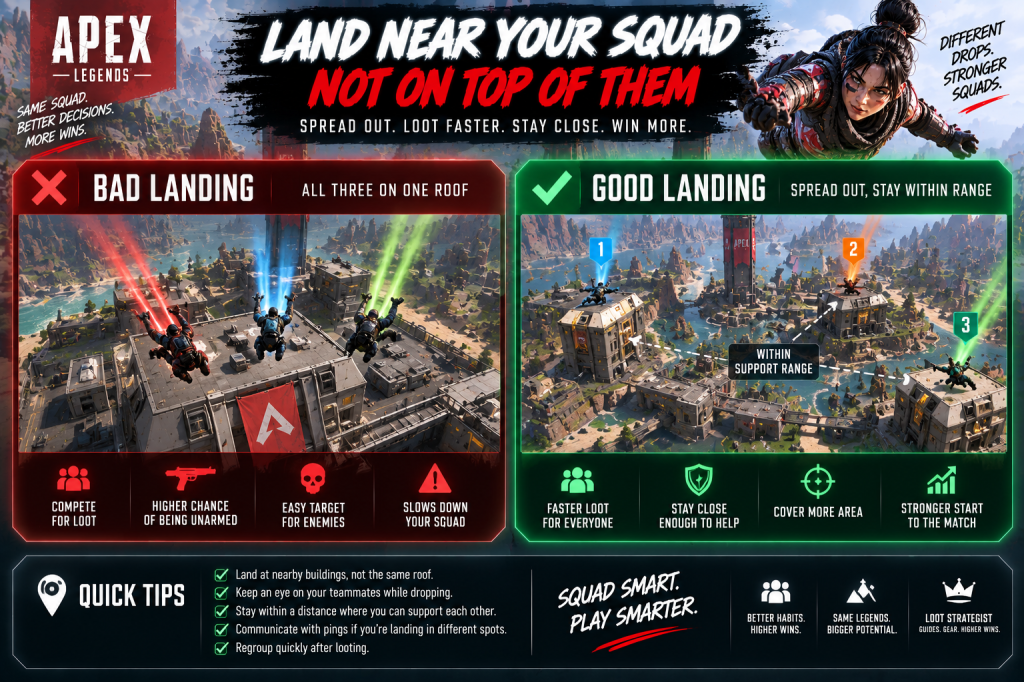
Apex is a squad game, but that doesn’t mean three players should land on the same roof and fight over the same loot.
EA recommends landing close to teammates without landing directly on top of them. That gives everyone room to loot while keeping the squad close enough to respond to nearby enemies. (EA Help)
Better habit
Land within supporting distance.
Take a different building, room, or nearby loot area.
The goal is simple:
Separate enough to loot.
Stay close enough to fight.
2. Landing So Far Away That Nobody Can Help You
The opposite mistake is just as dangerous.
If you’re exploring one side of a POI while your teammates are on the other, an enemy squad can isolate you before anyone can help.
Better habit
Keep an eye on your teammates’ positions while you loot.
You don’t need to stand beside them.
You do need to be close enough that help can arrive before the fight is over.
Think support range, not maximum distance.
3. Waiting for Your Perfect Weapon
New players often ignore perfectly usable guns because they’re waiting for their favorite weapon to appear.
That can be an expensive habit.
Better habit
Take the first reasonable weapon you can use.
Once you’re armed, you can search for an upgrade without being completely defenseless.
A mediocre gun in your hands is more useful than a perfect gun that you haven’t found yet.
4. Carrying the Wrong Ammo
A weapon isn’t much help when you don’t have ammunition for it.
EA’s current beginner guidance specifically recommends matching ammunition to the weapon you’re carrying. (EA Help)
Better habit
Before leaving your starting area, check three things:
Do I have a usable weapon?
Do I have its ammunition?
Do I have enough to take a fight?
You can optimize your inventory afterward.
5. Ignoring the Gear You Already Have
Core-mode players don’t start completely empty.
EA currently lists a starter kit that includes a Level 1 Helmet, Level 1 Evo Shield, Level 1 Knockdown Shield, two Syringes, and two Shield Cells. (EA Help)
That means some early loot decisions are really about filling gaps, not replacing everything.
Better habit
Check what you already have before grabbing duplicates.
Then prioritize the things you’re missing.
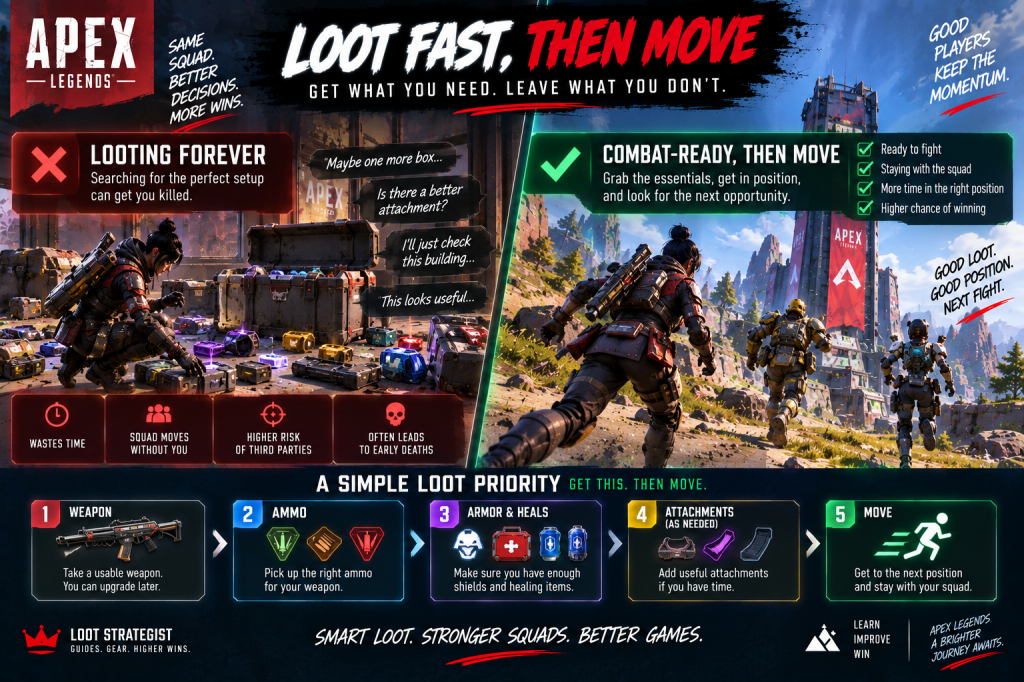
6. Looting for Too Long
This is one of the easiest beginner habits to underestimate.
You find a decent weapon.
Then a better magazine.
Then another building.
Then a better backpack.
Then one more death box.
Meanwhile, your squad has already rotated.
Better habit
Once you can fight, start thinking about your next position.
A useful question is:
“What am I still missing that is worth staying here for?”
If the answer is “not much,” move.
For a deeper breakdown of inventory priorities, see our Apex Legends Loot Guide.
7. Picking Up Everything Because It’s Purple
A purple item looks important.
Sometimes it is.
Sometimes it’s an attachment for a weapon you don’t even use.
Better habit
Before taking an upgrade, consider:
Will I use it?
Will I notice the difference?
Does a teammate need it more?
Will getting it delay our rotation?
Rarity is useful information.
It isn’t an order.
8. Waiting Until You’re Nearly Dead to Heal
New players often keep fighting with broken shields because they don’t want to stop.
Then they get cracked again.
Better habit
When the immediate danger is gone, reset.
Check:
Shields
Health
Ammo
Legend abilities
EA’s current beginner advice also emphasizes maintaining both health and shield resources. (EA Help)
A short reset can be the difference between winning the next fight and being the first knock.
9. Healing in the Open
Healing takes time.
An exposed player is an easy target.
Better habit
Heal behind:
Cover
Corners
Buildings
Terrain
Ideally, your teammates should also know where you’re resetting.
A few seconds of protection are worth far more than trying to save a few steps.
10. Reloading Automatically
Reloading after every burst feels safe.
It isn’t always safe.
If an enemy is one shot away from going down, starting a long reload can give them the time they need to push.
Better habit
Reload when the situation allows it.
Consider:
How much ammunition is left?
How close is the enemy?
Do I have cover?
Is my second weapon ready?
In some close-range situations, switching weapons is better than waiting for a reload.
11. Shooting Every Enemy You See
Seeing another squad doesn’t mean you have to start a fight.
A few bullets from long range can turn into a long-distance argument that attracts a third team.
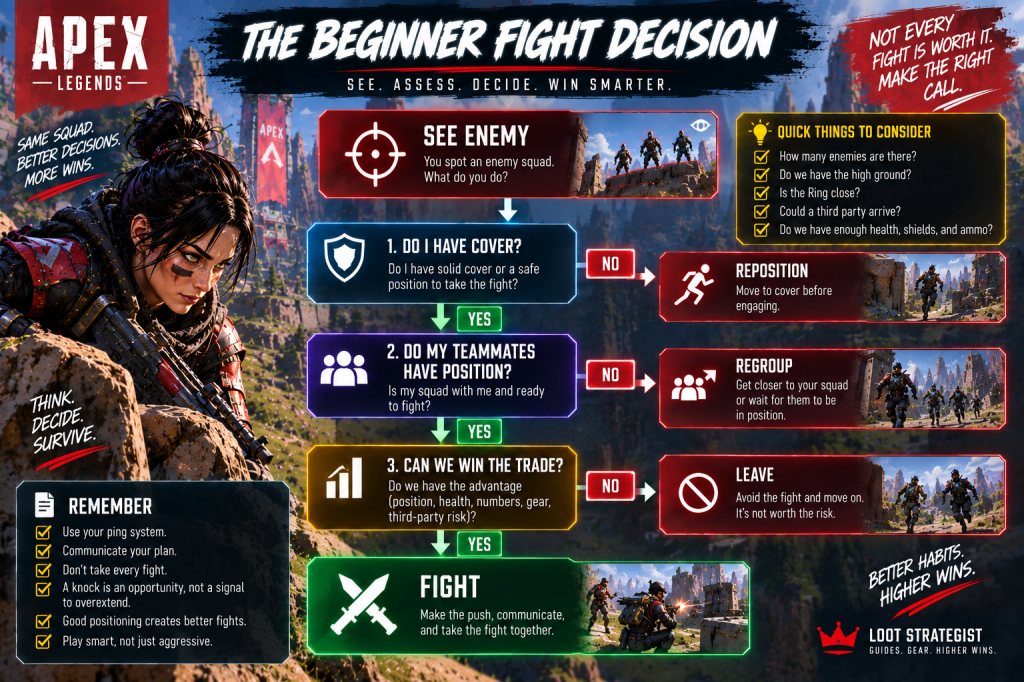
Better habit
Before shooting, consider:
Can we realistically win this?
Do we have cover?
Are we together?
What does the Ring look like?
Could another squad punish us?
If the answers are poor, keep moving.
12. Chasing a Knock Too Far
You knocked one player.
They are crawling away.
You chase.
Their teammates are waiting.
Your own squad is still behind you.
The knock has now become a problem.
Better habit
Let the knock create pressure.
Push when:
Your squad is together
The enemy is isolated
You have a position advantage
You have a realistic path to the finish
A knock is an opportunity.
It isn’t a reason to abandon your team.
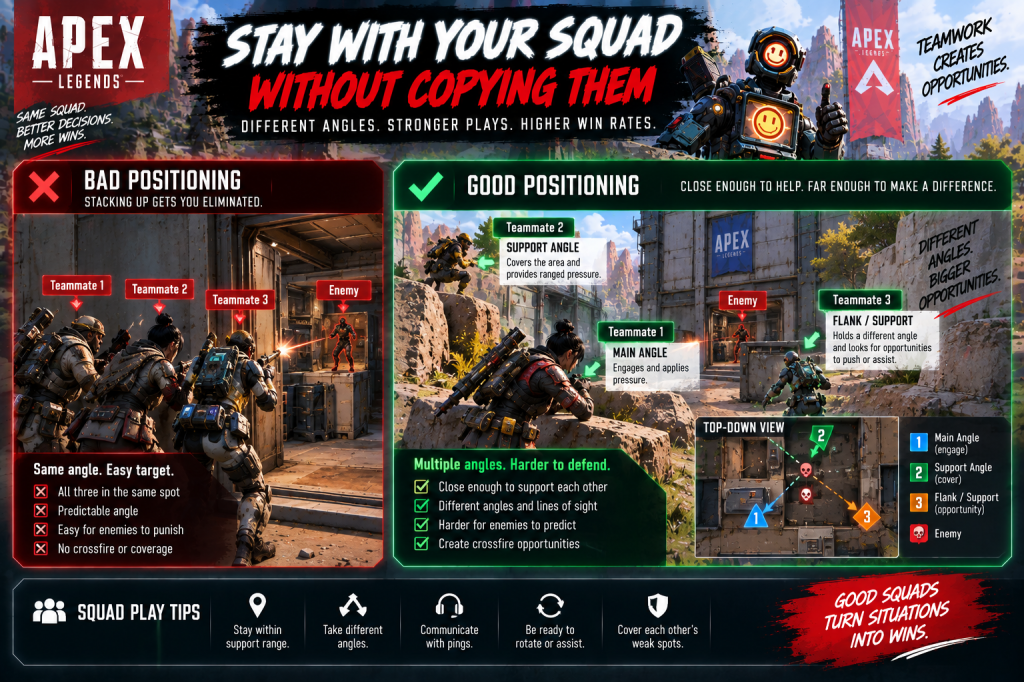
13. Following Your Teammate Through the Same Door
Supporting a teammate doesn’t mean walking directly behind them.
Three players entering through one doorway can give the enemy one predictable angle to punish.
Better habit
Take a complementary angle.
Use:
Another doorway
A window
A side route
A nearby head-glitch position
Your teammate applies pressure.
You create another problem for the enemy.
That is much harder to defend against.
14. Fighting in Open Ground
Open terrain gives your opponents options.
If several enemies can see you and you can’t reach useful cover, you’re making their job easy.
Better habit
Move through:
Cover
→ Angle
→ Cover
→ Reposition
You don’t need to stand still to shoot well.
You do need to make yourself difficult to punish.
15. Taking High Ground Without Asking Why
High ground is useful.
But “higher” doesn’t automatically mean “better.”
A rooftop with no cover and no escape can be worse than a lower position behind solid cover.
Better habit
When evaluating a position, consider:
Can enemies easily shoot me?
Can my teammates reach me?
Do I have cover?
Can I leave if things go wrong?
Does this position help our next rotation?
The useful goal is advantageous positioning, not simply height.
16. Forgetting the Ring
The Ring is one of the game’s biggest strategic pressures.
EA’s current beginner guidance specifically tells players to stay with their squad and stay in the Ring. (EA Help)
Better habit
Check the map regularly.
Know:
Where the next zone is
How far away it is
Which route gets you there
Whether another squad could be holding that route
Moving early often gives you more choices.
17. Rotating Without Checking What’s Ahead
Getting into the Ring doesn’t mean running blindly toward it.
The next area may already belong to another squad.
Better habit
Before moving through an important choke or POI, consider:
What can we hear?
Where are enemies likely to be?
What cover is available?
Where can we stop if we get shot?
You don’t need perfect information.
You need enough information to avoid walking into an obvious trap.
18. Forgetting to Holster While Rotating
Apex is fast, and movement efficiency matters.
EA’s beginner guide recommends holstering while running, sprinting instead of walking when appropriate, sliding downhill, and using available movement systems to travel efficiently. (EA Help)
Better habit
When you’re safely rotating:
Holster
→ Sprint
→ Slide when useful
→ Draw your weapon when danger becomes likely
Don’t interpret this as “always run with your weapon away.”
When you’re entering a dangerous area, being ready matters more than shaving a little time off the rotation.
19. Never Using Grenades
Think of grenades as movement tools, not just damage tools.
EA’s current beginner guidance recommends carrying grenades and notes that they can push enemies out of cover, deal damage, or buy time when retreating or repositioning. (EA Help)
Better habit
Use grenades to:
Force enemies out
Block routes
Interrupt healing or revives
Create space
Cover a retreat
You don’t need perfect grenade lineups.
Start using them deliberately.
20. Looting a Death Box Immediately After a Fight
Winning a fight does not guarantee safety.
The gunfire may have attracted another squad.
Better habit
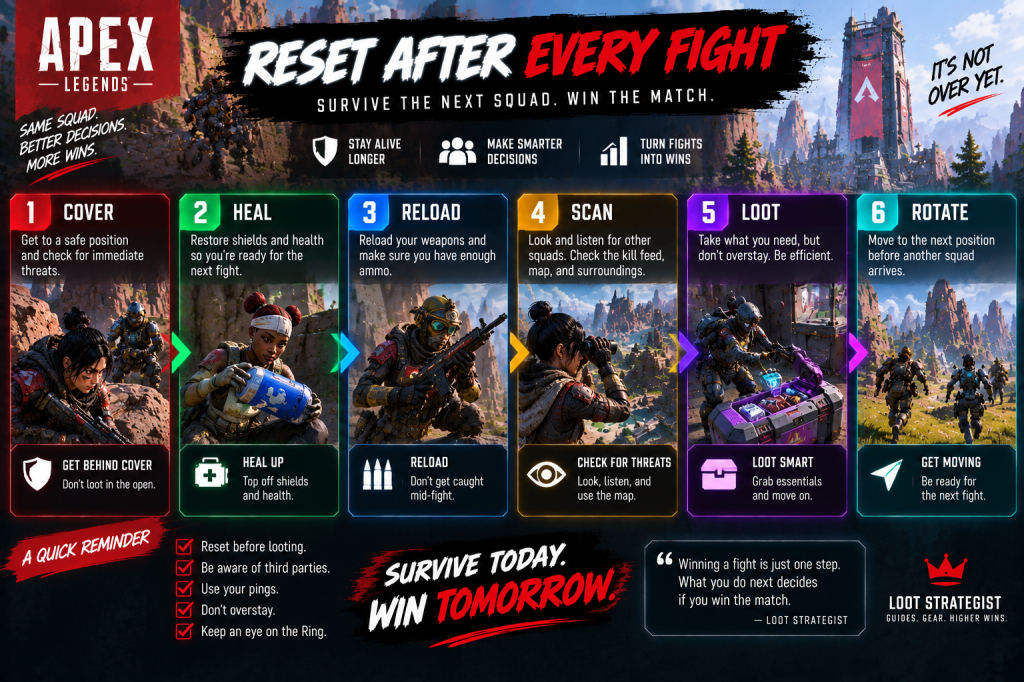
Reset first:
Heal
→ Reload
→ Check surroundings
→ Listen for another squad
→ Loot essentials
→ Leave
This is one of the simplest habits you can develop early.
21. Treating Every Fight Like It Must Be Won
Not every fight is worth taking.
Some fights are unfavorable before the first bullet is fired.
Better habit
Judge fights using:
Position
Numbers
Cover
Resources
Ring
Third-party risk
Your objective isn’t to fight constantly.
It’s to take fights that improve your chances of winning the match.
22. Splitting From Your Squad During a Fight
You can spread out while looting.
During an actual fight, separation becomes much harder to justify.
If your teammate is fighting three enemies while you’re 80 meters away, your extra loot isn’t helping.
Better habit
Stay close enough to:
Trade damage
Cover a retreat
Push together
Revive or recover a teammate
EA’s current beginner advice similarly emphasizes staying with your squad. (EA Help)
You don’t have to stand on top of one another.
You need to remain mutually reachable.
23. Ignoring the Ping System
You don’t need a microphone to communicate effectively.
EA specifically highlights Apex’s ping system as a way to communicate enemy positions, loot, and movement quickly without typing or using voice chat. (EA Help)
Better habit
Ping:
Enemies
Useful loot
Your destination
A rotation
Where you want the squad to move
A good ping can communicate an idea instantly.
24. Treating Ranked Like Your Training Ground
You can enter Ranked when you’re comfortable.
But you don’t have to learn every basic mechanic there.
EA currently recommends Unranked for players who want a lower-pressure environment to learn the fundamentals before committing to Ranked. (EA Help)
Better habit
Use:
Firing Range → mechanics and experimentation
Unranked → real-match practice
Ranked → competitive games once the fundamentals feel familiar
You don’t need to wait until you’re “good enough” for Ranked.
You simply want to know enough about movement, looting, healing, positioning, and squad play that you’re learning from your matches rather than fighting the controls.
25. Trying to Win Every Match Instead of Learning From It
This is the mistake that keeps the other 24 alive.
You get knocked and think:
“My aim was awful.”
Maybe.
But what actually happened?
Were you:
Exposed?
Isolated?
Too aggressive?
Late to the Ring?
Reloading at the wrong time?
Taking a fight your squad couldn’t support?
Looting while another team was approaching?
That question is more useful than simply blaming your aim.
Better habit
After a bad death, identify one mistake.
Not ten.
Fix that one in the next match.
Then find the next one.
That’s how improvement becomes measurable instead of frustrating.
The Five Beginner Habits to Fix First
You don’t need to memorize all 25 mistakes.
Start here:
Stay Near Your Squad
Be close enough to support one another.
Get Combat-Ready Quickly
Find a weapon, ammunition, and enough resources to survive.
Use Cover
Make yourself difficult to punish.
Choose Your Fights
Seeing an enemy isn’t an obligation to shoot them.
Reset After Fights
Heal, reload, check the area, then loot.
These five habits alone can eliminate a huge amount of unnecessary frustration.
A Simple Beginner Fight Checklist
Before committing to a fight, quickly consider:
Are we together?
Do we have cover?
Do we have enough health and shields?
Do we have ammunition?
Where is the Ring?
Could another squad arrive?
What happens if the first push fails?
You don’t need every answer to be perfect.
But if several answers are obviously bad, you’re probably better off repositioning.
What Beginners Should Practice First
Don’t try to master the entire game simultaneously.
Build your fundamentals in this order:
1. Movement
Learn sprinting, sliding, climbing, and efficient travel.
2. Aim
Work on tracking, recoil control, and target switching.
3. Positioning
Learn how cover changes a fight.
4. Looting
Learn what you need and when you have enough.
5. Team Play
Stay close, ping, and support your teammates.
6. Rotations
Read the Ring and think ahead.
7. Fight Selection
Learn when not to shoot.
That last skill usually takes the longest.
Use the Firing Range Properly
The Firing Range isn’t just somewhere to warm up.
EA currently identifies it as a place to practice and test weapons, ammunition, and Legends. (EA Help)
Use it to isolate a problem.
For example:
Bad recoil?
Practice one weapon.
Aim too slow?
Test sensitivity.
Missing close-range shots?
Practice tracking while moving.
Uncomfortable with a Legend?
Test the abilities before taking them into a serious match.
You don’t need an hour-long routine.
Even a short, focused session can tell you much more than randomly changing things between matches.
Don’t Change Legends Constantly
Learning the roster takes time.
EA’s current beginner guidance recommends learning a small group of Legends so you have alternatives when another player chooses your preferred character. (EA Help)
A simple approach works:
One main
One backup
One different-style Legend
For example, learning one aggressive, one mobility-focused, and one support-oriented option gives you flexibility without forcing you to memorize the entire roster.
Your First Goal Isn’t to Become a Kill Leader
Kills are satisfying.
They aren’t the only measure of improvement.
A much better early benchmark is:
Did I make a better decision than last match?
Maybe you:
- stayed with your team
- took cover
- rotated earlier
- stopped chasing a knock
- healed before re-engaging
- recognized a bad fight
- escaped instead of forcing it
Those improvements eventually produce more kills and wins.
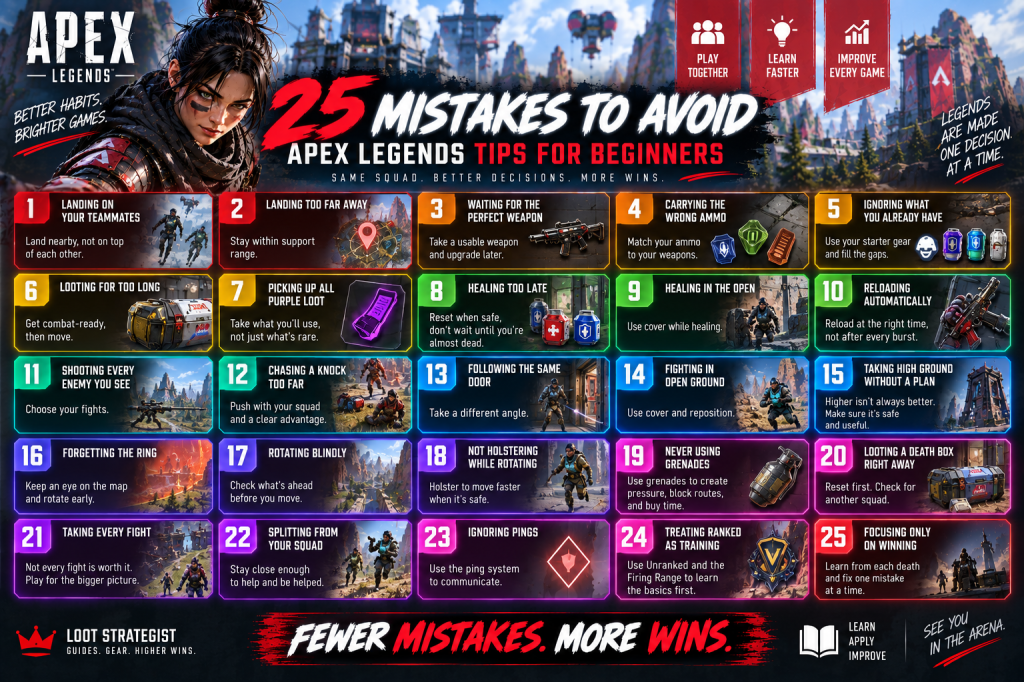
The 25 Mistakes at a Glance
| Mistake | Better Habit |
|---|---|
| Landing directly on teammates | Land nearby and spread out |
| Landing too far away | Stay within support range |
| Waiting for the perfect gun | Take a usable weapon |
| Carrying the wrong ammo | Match ammo to your weapon |
| Ignoring existing gear | Check what you already have |
| Looting too long | Get ready and move |
| Taking every purple item | Prioritize useful upgrades |
| Waiting too long to heal | Reset when safe |
| Healing in the open | Use cover |
| Reloading automatically | Reload when the situation allows |
| Shooting every enemy | Take fights deliberately |
| Chasing knocks | Push when your squad can support it |
| Following the same doorway | Create another angle |
| Fighting in open ground | Move between cover |
| Taking high ground blindly | Choose useful positions |
| Ignoring the Ring | Watch the zone |
| Rotating blindly | Check the next area |
| Forgetting to holster while rotating | Holster when safe |
| Never using grenades | Use them to create pressure |
| Looting death boxes immediately | Reset before looting |
| Taking every fight | Fight for a reason |
| Splitting during fights | Stay mutually reachable |
| Ignoring pings | Communicate with the ping system |
| Treating Ranked as training | Use Unranked/Firing Range for fundamentals |
| Focusing only on winning | Learn from each death |
A Beginner’s Apex Improvement Loop
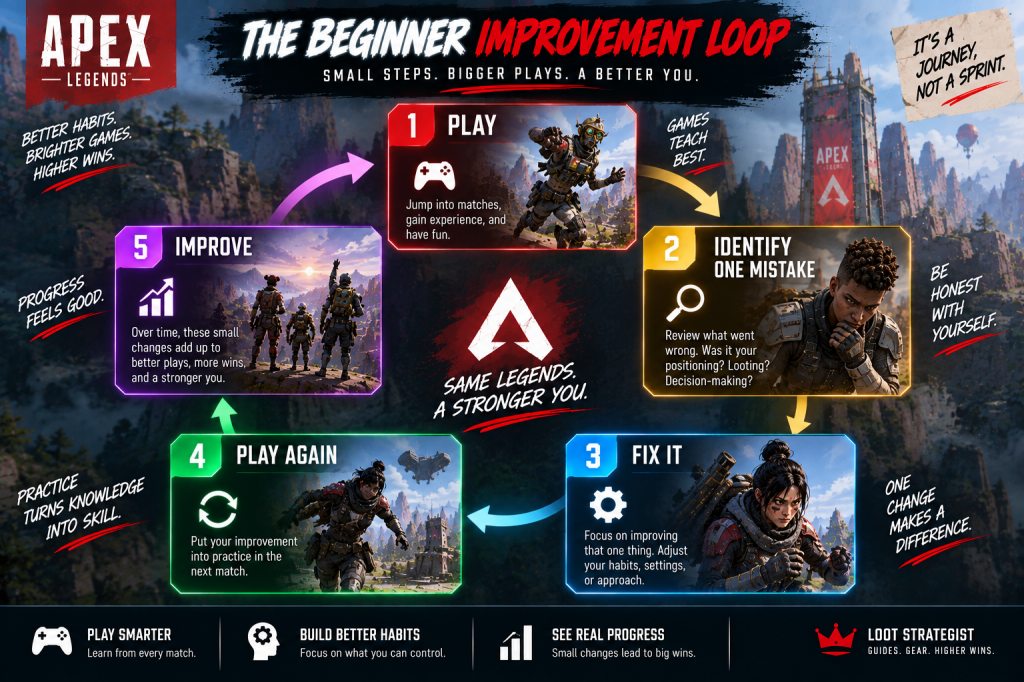
Here’s a simple routine you can use every session:
Play a match
↓
Identify one mistake
↓
Decide what you should have done instead
↓
Try that adjustment next match
↓
Repeat
That is more useful than watching ten videos and changing your entire playstyle every night.
Frequently Asked Questions
How should a beginner play Apex Legends?
Start by staying near your squad, learning basic movement, getting combat-ready quickly, using cover, and taking fights that your team can actually support.
Should beginners play Ranked?
You can.
But Unranked and the Firing Range provide lower-pressure environments for learning fundamentals first. EA currently recommends Unranked for players who aren’t ready to jump directly into Ranked. (EA Help)
How many Legends should a beginner learn?
Start with one main and one or two backups.
Learn them well before trying to master the entire roster.
Should beginners land somewhere quiet?
Not necessarily.
A contested landing can teach fighting quickly, while a quieter POI gives you more room to learn looting, movement, and positioning. Choose based on what you’re trying to practice.
Should I copy professional players?
Use professional players as references, not instruction manuals.
Their settings, mechanics, decision-making, and team coordination are built around a different skill level and play environment.
Final Thoughts
Apex Legends has a steep learning curve because you’re learning several things at once.
Movement.
Aim.
Looting.
Positioning.
Rotations.
Teamwork.
Fight selection.
You don’t need to master all of them immediately.
Start by fixing the mistakes that happen most often.
Stay close to your squad.
Get combat-ready quickly.
Use cover.
Think before you push.
Reset after fights.
Then review your deaths instead of simply being angry about them.
The goal isn’t to play every match perfectly.
It’s to make fewer avoidable mistakes.
That is how Apex gradually stops feeling chaotic.
The enemy doesn’t necessarily become easier.
You simply start recognizing bad situations before they become bad.
And that’s one of the biggest milestones a new Apex player can reach.
Related Apex Legends Guides
Apex Legends Beginner Guide — Start here for a broader introduction to Apex Legends, including movement, weapons, looting, positioning, healing, and squad fundamentals.
Apex Legends Loot Guide — Learn how to prioritize loot, manage your inventory, handle death boxes, and know when to stop searching.
Apex Legends Settings Guide — Optimize FOV, sensitivity, controller settings, graphics, audio, FPS, and accessibility options.
Apex Legends Best Legends Guide — Find Legends that fit your playstyle, from beginners and solo queue to mobility, support, and defense.
Apex Legends Solo Queue Guide — Learn how to communicate, position, adapt to random teammates, and stay useful without a premade squad.
Apex Legends Ranked Guide — Learn how to approach Ranked with better positioning, rotations, fight selection, and decision-making.
Apex Legends Squad Composition Guide — Learn how complementary Legend roles can make a squad stronger.
Apex Legends Tier List — See which Legends currently have the strongest overall value in Season 30.
Sources & Updates
Last reviewed: September 8, 2026
This article is primarily written for Core Apex Legends Battle Royale, including Ranked and Unranked. EA currently distinguishes Core from Freestyle modes such as Wildcard, Mixtape, and Bot Royale Evolved. Wildcard uses a substantially simplified loot, inventory, healing, and revival system, so some of the advice in this article does not apply there in the same way. (EA Help)
EA’s current Apex Legends beginner guide was used to verify advice regarding landing near teammates, spreading out while looting, matching weapons with ammunition, using the ping system, maintaining shields and health, moving efficiently, carrying grenades, staying with the squad, and learning a small group of Legends. (EA Help)
EA’s current game-mode documentation was used to verify that Ranked and Unranked are Core modes, while Wildcard is part of Freestyle. EA currently recommends Unranked as a lower-pressure way to practice the fundamentals before moving into Ranked. (EA Help)
EA’s current documentation also identifies the Firing Range as a place to practice and test weapons, ammunition, and Legends. (EA Help)
Editorial note: The 25 mistakes and recommended habits in this article are Loot Strategist’s editorial guidance. EA’s documentation provides the underlying game information; the tactical recommendations and examples are our interpretation of how beginners can apply those mechanics in real matches.

