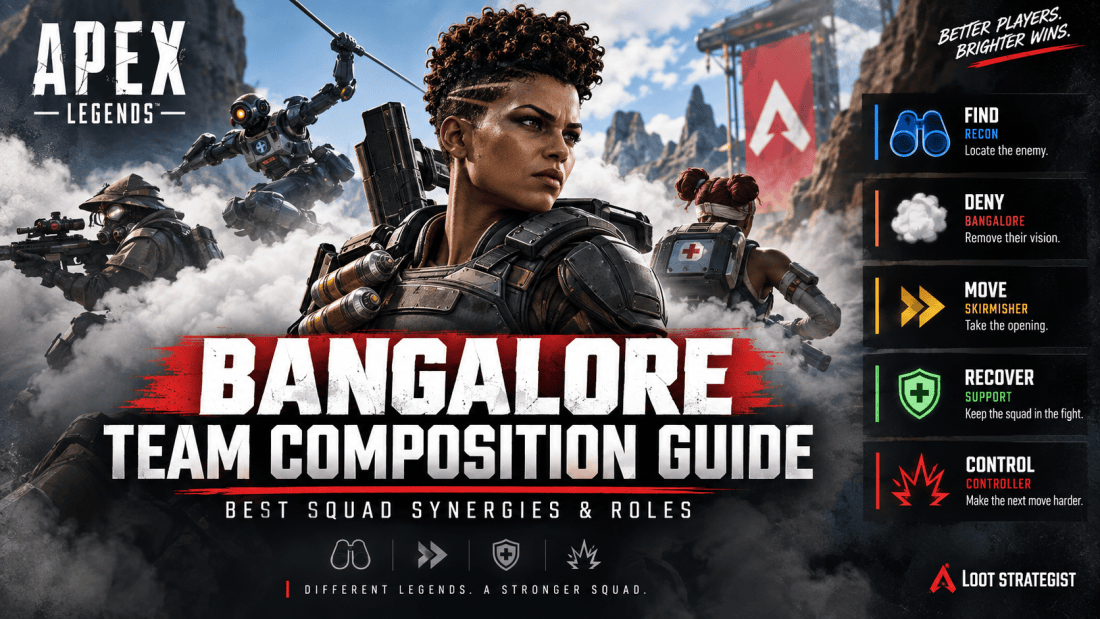
Apex Legends Bangalore Team Composition Guide: Best Squad Synergies & Roles
Bangalore already brings several jobs to an Apex squad.
The Smoke Launcher blocks sightlines and can breach doors, Double Time gives her a temporary speed increase when she takes fire while sprinting, and Rolling Thunder disrupts an area with a creeping artillery strike. She is also an Assault Legend, giving her class-specific combat benefits such as extra ammo capacity, additional grenade slots, faster weapon handling, and other combat advantages in Core modes. (EA Help)
That makes team building around Bangalore less about finding two Legends who simply add more aggression.
The better question is:
What should the other two players add that makes Bangalore’s openings more useful?
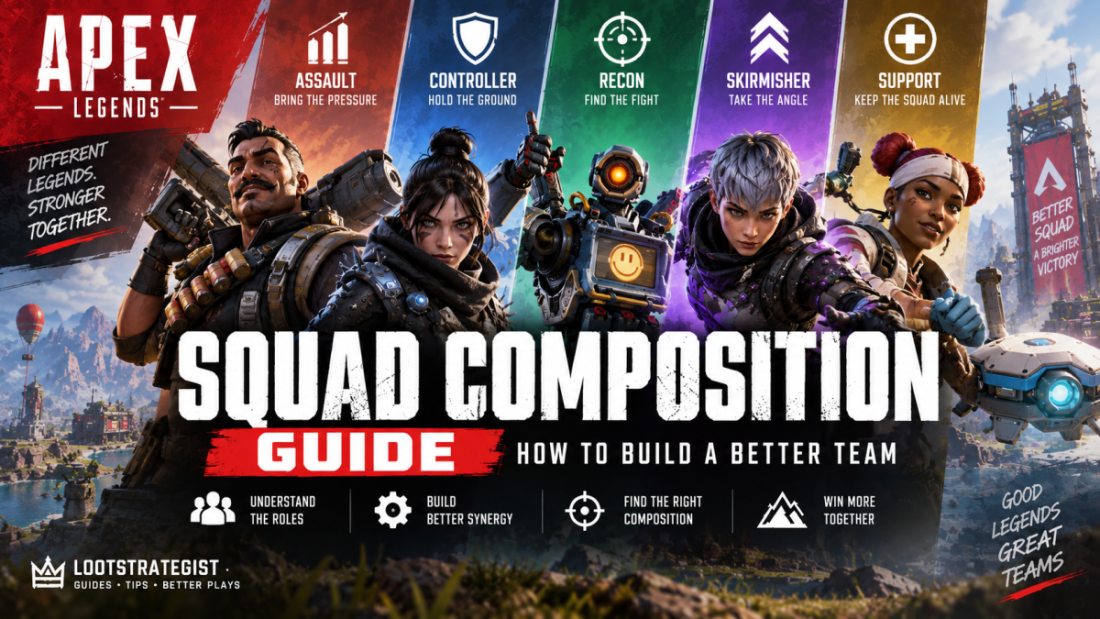
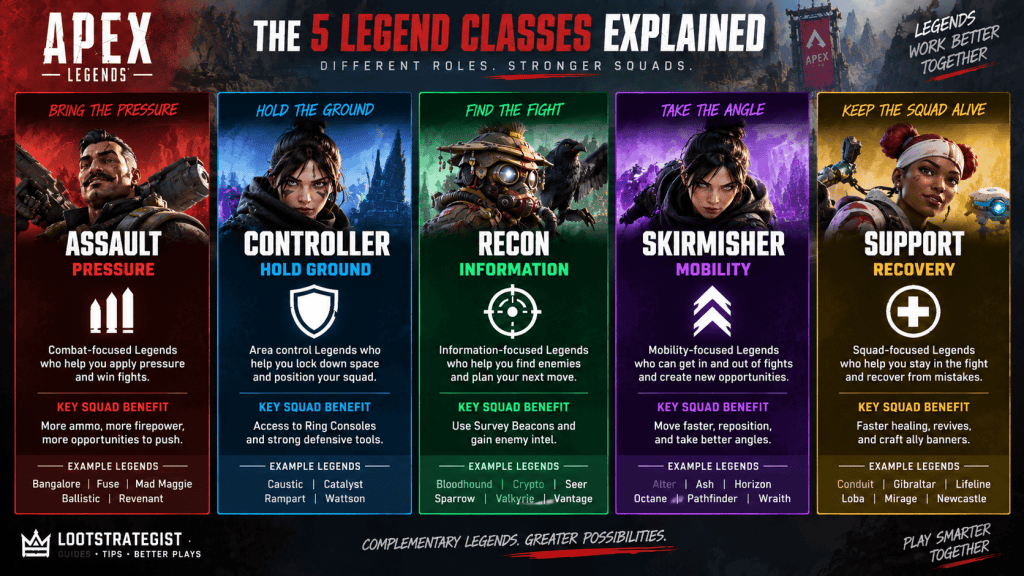
A Recon Legend can provide information before Bangalore smokes an angle. A Skirmisher can turn that smoke into a fast entry. A Controller can make the enemy’s remaining routes harder to use. A Support Legend can turn a temporary opening into a safer reset.
This guide focuses on those interactions rather than trying to declare one permanent “best” Bangalore trio.
Mode note: This guide focuses on Core modes such as Ranked and Unranked, where Legend classes apply and each Legend can only be selected once per squad. Wildcard uses different selection rules and allows duplicate Legends. (EA Help)
How we evaluate Bangalore team comps: We look at what Bangalore already provides, what the partner Legend adds, how the abilities interact during an actual fight, and what the squad can do when the first plan fails. These are Loot Strategist editorial recommendations, not official EA rankings.
Bangalore Team Comp at a Glance
| Composition | Core Synergy | What It Covers |
|---|---|---|
| Bangalore + Recon + Support | Find → deny → recover | Information, pressure, recovery |
| Bangalore + Skirmisher + Support | Smoke → move → reset | Mobility and sustain |
| Bangalore + Recon + Controller | Scout → deny → control | Information and positional control |
| Bangalore + Recon + Assault | Find → pressure → disrupt | Aggressive coordinated fights |
| Bangalore + Controller + Support | Deny → hold → recover | Defensive and late-game play |
| Bangalore + Assault + Skirmisher | Pressure → smoke → collapse | High-tempo combat |
These are composition archetypes, not a ranking. The right setup depends on your team’s strengths, preferred fight distance, map position, and whether you are playing coordinated or solo queue.
What Bangalore Already Gives the Squad
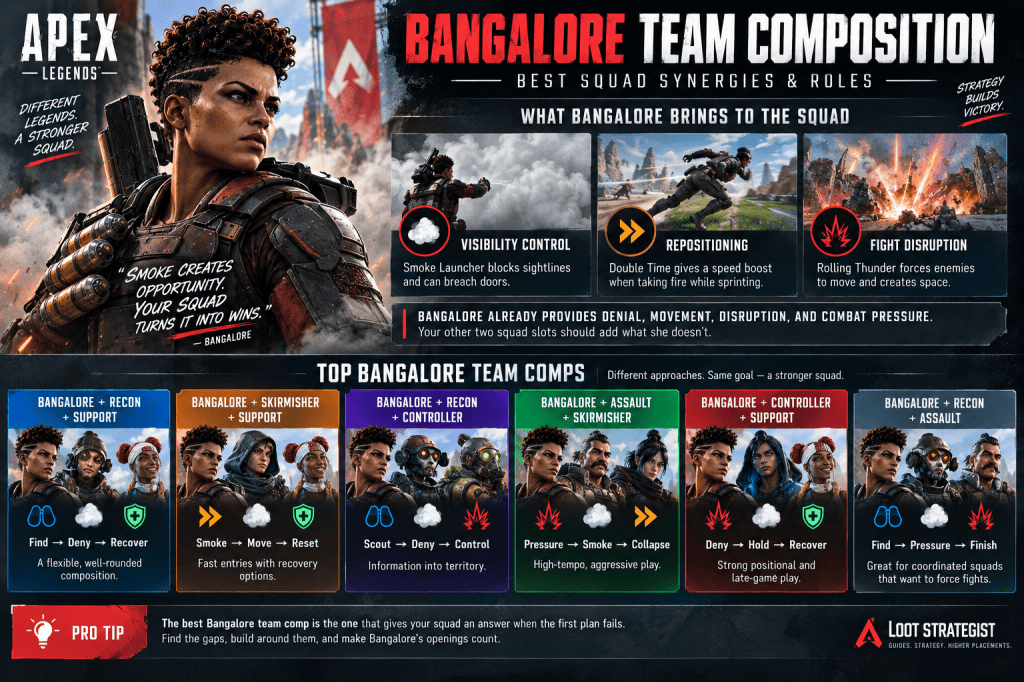
Before choosing teammates, understand the jobs you already have covered.
EA currently classifies Bangalore as Assault. Assault Legends carry more ammunition per stack, have extra grenade slots, use weapons faster, and gain temporary reload and movement-speed benefits when their shield breaks. They can also access weapon attachments from the secret compartment of Supply Bins in Core modes. (EA Help)
Bangalore’s own kit adds three major pieces:
Visibility control
Smoke Launcher creates a smoke wall on impact and can interact with doors. (EA Help)
Repositioning
Double Time gives Bangalore a temporary speed increase when she is taking fire while sprinting. (EA Help)
Fight disruption
Rolling Thunder creates a creeping artillery strike that can force enemies to react to an area. (EA Help)
Put together, Bangalore naturally contributes:
Denial.
Movement.
Disruption.
Combat pressure.
That is why the other two squad slots should usually be chosen for what they add, rather than what they duplicate.
Bangalore’s Team-Building Question
Once Bangalore is selected, ask:
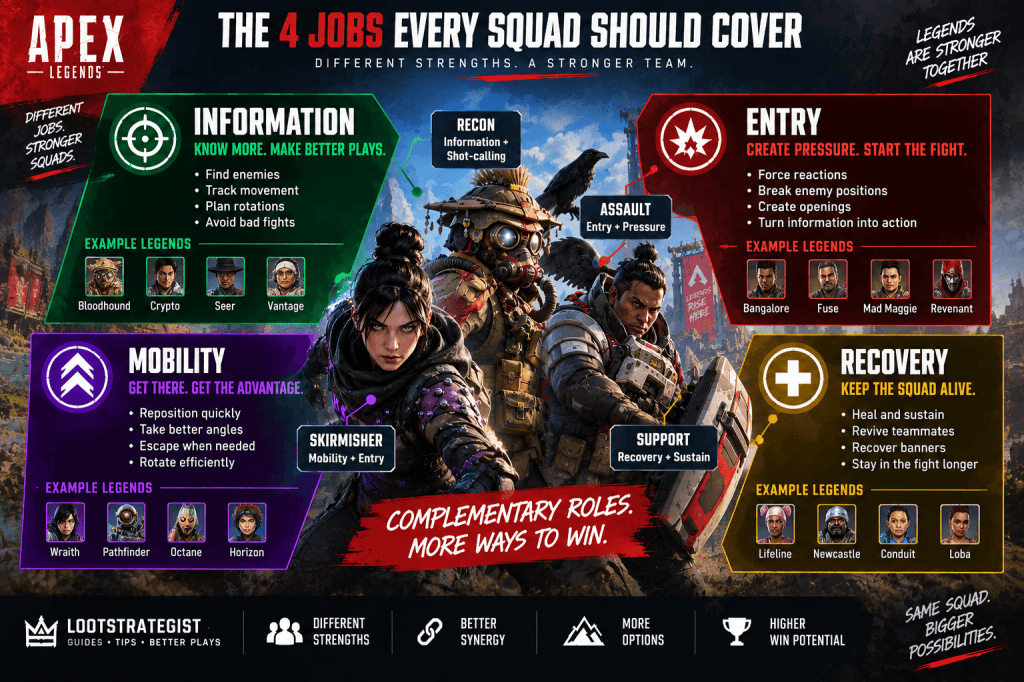
Who finds the enemy?
Who exploits the opening?
Who helps when the first push fails?
Those jobs do not necessarily require three different Legends.
A Recon Legend can provide information and help with shot-calling.
A Skirmisher can provide entry and mobility.
A Support Legend can provide recovery.
Bangalore can connect those pieces by changing the sightlines around the fight.
That is the foundation of a Bangalore-centered composition.
For a broader explanation of Apex classes and squad roles, check this Apex Legends Squad Composition Guide rather than repeating the entire class system here.
Bangalore + Recon: Find First, Smoke Second
Recon is one of the most natural complements to Bangalore because the two Legends approach information from different directions.
EA describes Recon Legends as focused on tracking enemies and gathering intel.
The basic sequence is:
Recon finds → Bangalore denies → squad moves
That is more useful than simply stacking information tools.
The Recon player can help establish:
- where the enemy is
- which player is exposed
- whether another squad is nearby
- which route is safest
- where the enemy is likely to rotate
Bangalore then changes the amount of information the opposing team gets in return.
This is the key interaction.
Your squad starts the maneuver with information.
Then Bangalore makes the enemy work with less of it.
Bangalore + Bloodhound: Information Around the Smoke
Bloodhound is an obvious pairing, but the old “Bloodhound sees through Bangalore smoke” strategy should not be presented as current doctrine.
EA’s current Legend documentation describes smoke as capable of blocking threat-vision effects, so the useful interaction is information gathered before or around the smoke rather than assuming Bloodhound has unrestricted vision through it.
A better sequence is:
Scan → identify → Smoke → push
Bloodhound helps the squad understand the engagement.
Bangalore then changes its visual structure.
That makes the pairing useful without relying on an outdated smoke interaction.
Bangalore + Crypto: Information Before the Push
Crypto offers a more deliberate version of the same concept.
His Drone provides scouting and enemy information, while EMP can damage shields, slow affected enemies, and disable traps and certain deployables. (EA Help)
That creates a strong coordinated sequence:
Drone → EMP → Bangalore Smoke → push
Crypto identifies the structure of the fight.
Bangalore removes a key sightline.
The squad acts while the enemy is dealing with both problems.
This composition is better suited to teams that communicate than players who want to sprint into every fight without preparation.
Bangalore + Skirmisher: Turn Smoke Into Movement
A Skirmisher complements Bangalore by making the temporary opening created by Smoke easier to exploit.
EA describes the Skirmisher class around fast-paced combat and mobility.
The interaction is straightforward:
Bangalore creates the opening → Skirmisher takes it
That can mean:
- crossing dangerous ground
- closing distance
- taking high ground
- chasing a weakened enemy
- escaping after a failed push
- changing angles during a fight
The Bangalore player should not think of the smoke as the final destination.
The Skirmisher’s job is often to turn that visual opening into actual positional advantage.
Bangalore + Pathfinder
Pathfinder is a particularly clear example.
His Grappling Hook provides mobility, while Zipline Gun can create a route for the squad. (EA Help)
A simple team sequence looks like:
Smoke the dangerous angle → Pathfinder creates access → squad moves
The important interaction is speed.
Bangalore removes the enemy’s clean view.
Pathfinder turns that temporary window into distance or a new angle.
That makes this pairing especially useful when the safest route is also the most exposed one.
Bangalore + Axle
Axle adds another form of mobility through Nitro Gate, which can launch players into a high-speed slide. EA currently classifies Axle as a Skirmisher and notes that both allies and enemies can use the gate.
The synergy is simple:
Smoke hides the transition.
Nitro Gate accelerates it.
For a coordinated squad, that can make Bangalore’s temporary visual advantage much easier to convert into a fast reposition.
The trade-off is that this is a mobility-heavy composition. You may gain more freedom of movement while giving up some recovery or information.
Bangalore + Support: Turn a Smoke Window Into Recovery
Support solves a different problem.
EA describes Support Legends around helping and healing the squad, with class benefits that include improved healing/revival utility and additional recovery options.
This creates a useful Bangalore sequence:
Smoke → recover → reposition
The Tactical does not have to be used only for an attack.
It can create the few seconds needed to:
- revive a teammate
- heal
- recover from a poor trade
- move away from a third party
- stabilize before the next fight
That makes Support particularly attractive for squads that often survive the first exchange but struggle to survive the second.
Bangalore + Newcastle: Layered Protection
Newcastle provides an especially clear example of the Bangalore-plus-Support relationship.
His kit includes Mobile Shield, Retrieve the Wounded, and Castle Wall, giving him several ways to protect a teammate or establish a defensive position. (EA Help)
That lets the squad layer protection:
Smoke → Mobile Shield → revive or reposition
Bangalore disrupts the enemy’s information.
Newcastle adds physical protection and recovery.
Neither ability replaces the other.
That is what makes the pairing useful.
Bangalore + Lifeline: Make the Reset Productive
Lifeline provides another kind of recovery utility.
Her D.O.C. Heal Drone supports healing, while Combat Revive allows a teammate to be revived without Lifeline remaining locked to the interaction. (EA Help)
Bangalore can create the visual window.
Lifeline can turn that window into actual team recovery.
The composition is therefore less about overwhelming the enemy immediately and more about making a temporary advantage last longer.
Bangalore + Controller: Control What Happens After the Smoke
This is one of the more interesting Bangalore combinations.
Controllers specialize in area control and strategy. EA currently lists Legends such as Catalyst, Caustic, Rampart, and Wattson in the class.
Bangalore controls what the enemy can see.
A Controller can influence where the enemy can comfortably go.
That produces a useful two-stage interaction:
Bangalore denies the information.
Controller constrains the response.
That can be especially valuable around buildings, choke points, and late-game positions.
Bangalore + Catalyst: Deny the Angle, Control the Route
Catalyst can reinforce doors, deploy ferrofluid structures, and use her kit to influence movement through an area. (EA Help)
A Bangalore-Catalyst squad can therefore make an enemy solve two different problems.
First:
Where can we see?
Then:
Where can we go?
Bangalore handles the first problem with Smoke.
Catalyst can make the remaining route less comfortable.
This becomes particularly useful when the squad wants to fight around a building rather than immediately leave it.
Bangalore + Caustic: Change the Approach, Punish the Space
Caustic offers another form of area denial through Nox Gas Traps and Nox Gas Grenade. (EA Help)
The combination has a simple purpose:
Smoke makes the approach harder to read.
Gas makes certain positions harder to occupy.
This works best when the squad already knows where it wants the enemy to move.
The danger is over-denial.
Abilities that make an area miserable to enter are not automatically useful if the squad never converts them into a positional or combat advantage.
Bangalore + Assault: More Pressure, Fewer Answers
Bangalore is already Assault, so adding another Assault Legend creates a heavily combat-focused squad.
EA currently includes Bangalore, Fuse, Ash, Mad Maggie, Ballistic, and Revenant among the Assault roster.
The upside is straightforward:
More combat pressure.
The downside is equally important:
Fewer dedicated tools for information, mobility, or recovery.
That makes a double-Assault composition more appealing when your squad is confident it can convert pressure into knocks rather than repeatedly needing to reset.
Bangalore + Fuse: Turn Denial Into Pressure
Fuse is an easy example of how the Assault pairing can work.
His Knuckle Cluster provides repeatable explosive pressure, while The Motherlode influences a larger area. (EA Help)
A coordinated sequence could look like:
Smoke → enemy loses information → movement becomes predictable → Fuse applies explosive pressure
The value is not simply having more damage.
It is making the enemy uncomfortable in the limited space they still have available.
Bangalore + Recon + Support: The Flexible Core
For players who want a balanced three-player structure, this is a natural model:
Information + Denial + Recovery
The Recon player helps the squad understand the situation.
Bangalore controls sightlines and creates movement opportunities.
Support helps the squad survive after the first engagement.
This gives the team answers for:
Find → fight → reset → rotate → fight again
The composition is particularly attractive for players who do not want every match to become an all-in push.
Bangalore + Skirmisher + Support: The Forgiving Composition
This version swaps information for mobility.
Bangalore creates the opening.
Skirmisher exploits it.
Support helps the squad recover.
That gives the team strong answers for:
- aggressive rotations
- building entries
- fast disengagements
- chasing weak teams
- recovering from a failed first push
Its weakness is information.
The team may need to rely more heavily on observation, audio, pings, and disciplined movement.
Bangalore + Recon + Controller: Information Into Territory
This is the more methodical composition.
Recon finds.
Bangalore denies.
Controller controls.
The result is a team that can locate an opponent, remove a key sightline, and then make the remaining space less comfortable.
It is especially appealing when your team prefers taking strong positions rather than constantly forcing movement.
The weakness is mobility.
Once the squad has to abandon its position, the composition may have fewer tools for making a rapid transition.
Bangalore + Recon + Assault: Find, Then Finish
This composition is built for pressure.
Recon identifies the opportunity.
Bangalore creates the visual opening.
The second Assault Legend helps turn that opening into damage.
The sequence is:
Find → Smoke → Pressure → Collapse
This is a good fit for coordinated players who are confident about target selection and commit timing.
It is less forgiving when the first engagement goes poorly.
Bangalore + Assault + Skirmisher: The High-Tempo Composition
This is the pure pressure version.
Bangalore creates disruption.
The Assault teammate adds more combat pressure.
The Skirmisher converts the temporary opening into movement or entry.
The team can move quickly from:
Pressure → Smoke → Entry → Collapse
The trade-off is recovery.
There is less room for a slow reset after the first attempt fails.
That means communication matters more.
Bangalore + Controller + Support: Hold, Recover, Punish
This composition plays a slower game.
Bangalore denies vision.
Controller tools help establish a difficult position to challenge.
Support helps the team survive the resulting engagements.
It can be valuable around:
- strong buildings
- chokepoints
- late-game positions
- defensible terrain
The weakness is rotation.
A squad that is excellent at holding ground still needs a plan for leaving that ground when the Ring changes.
Does a Bangalore Team Need Recon?
No.
Recon adds information, which makes Bangalore’s smoke more deliberate, but Bangalore does not become useless without it.
The better question is:
Does your squad already have enough information to make good decisions?
A disciplined team can gather plenty of information through map awareness, audio, pings, visual checks, and enemy behavior.
Recon is an addition, not a mandatory slot. EA’s class system describes Recon as information-focused, but it does not require every squad to contain one.
Does a Bangalore Team Need Support?
Again, no.
Support becomes more valuable when your squad regularly reaches the reset phase of a fight.
If you often win the first exchange but lose the next one while healing, recovery tools become much more attractive.
If your squad rarely gets the opening knock at all, another offensive or information-focused Legend may provide more immediate value.
Build around the problem your team actually has.
Does a Bangalore Team Need a Skirmisher?
Not necessarily.
Bangalore already has Double Time and can create movement opportunities with Smoke.
A Skirmisher becomes more appealing when the team wants to capitalize on those windows immediately.
That can mean:
take height
close distance
escape
chase
change angles
Mobility is therefore a multiplier for Bangalore rather than a requirement.
Avoid One-Dimensional Bangalore Comps
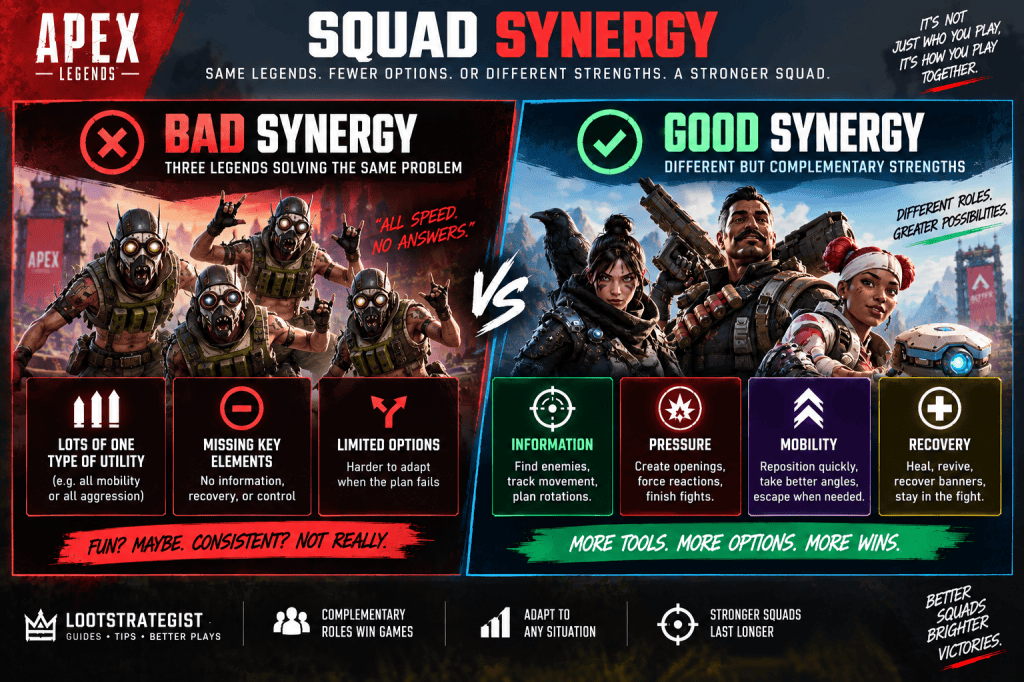
The easiest mistake is building a squad where every Legend wants to solve the same problem.
Three aggressively minded Legends can be terrifying when the first push works.
But what happens when the enemy survives?
Who provides information?
Who controls the next position?
Who helps recover?
Who gets the team out?
The opposite problem exists too.
Three defensive Legends may hold ground beautifully while struggling to rotate, chase, or convert damage into a finish.
The strongest compositions usually have enough overlap to reinforce one another without becoming copies of the same job.
The Most Important Part Is Ability Timing
A strong team composition on paper can still feel terrible in a match if the players use their abilities independently.
Consider this:
Recon identifies the target.
Bangalore cuts the sightline.
Skirmisher enters.
Support stays ready for the reset.
That is synergy.
Now imagine the same four actions happening at completely different moments.
The composition has not changed.
The timing has.
That is why a team’s communication and decision-making can matter more than the theoretical strength of the three Legends on the banner.
Bangalore Team Comp for Ranked
Ranked currently uses staggered Legend selection, meaning the players choose their Legends one at a time. Duplicate Legends are not allowed in the same squad, and class perks apply in Ranked. (EA Help)
That makes flexible team planning particularly useful.
A Bangalore player can communicate what the squad still lacks:
“We need information.”
“We already have mobility.”
“Let’s add recovery.”
“We need more pressure.”
That’s much more practical than trying to build around a fixed tier-list formula.
Keep a backup plan in mind, especially when teammates choose their Legends before you know the complete squad.
Bangalore Team Comp for Solo Queue
Solo queue changes the calculation because you cannot control what the other two players choose—or how aggressively they play.
That makes Bangalore’s flexibility particularly valuable.
If two teammates pick aggressive Legends, you do not necessarily need to become the third.
You can still provide:
Smoke for the entry
cover for the reset
disruption during the push
a safer rotation
Likewise, if your teammates are playing cautiously, Bangalore can become the player who creates the opening.
The best solo-queue composition is therefore often the one that leaves you with multiple ways to contribute when the original plan disappears.
For a deeper treatment of playing with unpredictable teammates, link this section to your Apex Legends Solo Queue Guide.
The Bangalore Composition Cheat Sheet
Once Bangalore is selected, use this quick check:
Need more information?
→ Consider Recon
Need faster entries or rotations?
→ Consider Skirmisher
Need stronger positional control?
→ Consider Controller
Need better recovery?
→ Consider Support
Already have those covered?
→ Consider Assault for more combat pressure
Then ask one final question:
What does this squad do when the first push fails?
That question catches a lot of bad compositions before the match even begins.
Common Bangalore Team Composition Mistakes
Picking teammates because they are popular
Popularity does not tell you whether the abilities actually fit your squad’s style.
Choosing three Legends with the same job
More aggression is not automatically more complete.
Assuming Bangalore must have a Recon teammate
Information is useful, but it can come from several sources.
Ignoring recovery
A composition should have a plan for the fight that comes after the first fight.
Building a defensive squad with no rotation plan
Eventually, the Ring moves.
Treating class as a permanent role
A class describes broad tools and perks. It does not dictate every action the player takes. EA’s current system separates class identity from the broader possibilities of individual Legend kits.
Throwing abilities without coordination
The same abilities become dramatically more useful when one creates the opening for another.
A Simple Bangalore Team-Building Framework
Start with Bangalore.
Step 1: Identify what she already provides
Denial + disruption + pressure + repositioning
Step 2: Identify the squad’s biggest gap
Choose the job you need most:
Information
Mobility
Control
Recovery
More pressure
Step 3: Plan for failure
Ask:
What happens if we don’t get the knock?
That third step is the one most lineup discussions skip.
A squad should not only have a plan for winning the first exchange.
It should have a plan for continuing after it fails.
Final Thoughts
There is no permanent Bangalore trio that solves every Apex match.
The more reliable approach is to start with what Bangalore already brings and then use the other two slots to fill the gaps.
She provides:
Visibility control.
Repositioning.
Disruption.
Combat pressure.
A Recon teammate can help the squad find the right engagement.
A Skirmisher can turn a smoke-created opening into actual movement.
A Controller can make the enemy’s remaining routes harder to use.
A Support Legend can transform a temporary window into a successful reset.
Another Assault Legend can add more pressure when the squad already has enough information and recovery.
That gives you a much better way to think about Bangalore team composition:
Find → Deny → Exploit → Recover
Not every job needs its own Legend.
The point is to make sure the three players collectively have enough tools to cover what the match demands.
When Bangalore is your anchor, don’t simply ask:
“Who is the best teammate for Bangalore?”
Ask:
“What does Bangalore already solve, and what does the rest of our squad still need?”
That question will survive balance patches much better than any static list of supposedly perfect trios.
Sources & Updates
EA’s current Legends guide documents the five Core-mode classes—Assault, Controller, Recon, Skirmisher, and Support—along with their broad roles and current Legend abilities. Bangalore is currently an Assault Legend. (EA Help)
EA’s current documentation confirms Bangalore’s Smoke Launcher, Double Time, and Rolling Thunder, as well as her current Assault-class benefits. (EA Help)
EA’s current Ranked documentation states that Legend selection is staggered, duplicate Legends are not permitted within the same team, and class perks apply in Ranked. (EA Help)
EA’s current game-mode documentation distinguishes Core modes from Wildcard; Wildcard allows simultaneous Legend selection and duplicate Legends within a squad, while Core modes use the one-Legend-per-squad structure. (EA Help)
EA’s February 2026 roadmap said a Legend Class/team-composition overhaul is planned for Season 32, while also noting that roadmap timing can shift during development. This article should therefore be reviewed when that change arrives. (EA)
Editorial note: The compositions and synergy frameworks in this guide are Loot Strategist recommendations based on documented abilities and squad-role interactions, not official EA rankings.
Recommended internal links
“Apex Legends Squad Composition Guide” → broader squad-building principles
“Bangalore Guide” → overall Bangalore playstyle and abilities
“Bangalore Smoke Guide” → advanced Smoke Launcher placements
“Bangalore Best Loadouts” → weapons that capitalize on Bangalore-created openings
“Team Fighting Guide” → coordinated combat and target focus
“Solo Queue Guide” → playing effectively with unpredictable teammates
“Positioning Guide” → turning team-composition advantages into better positions